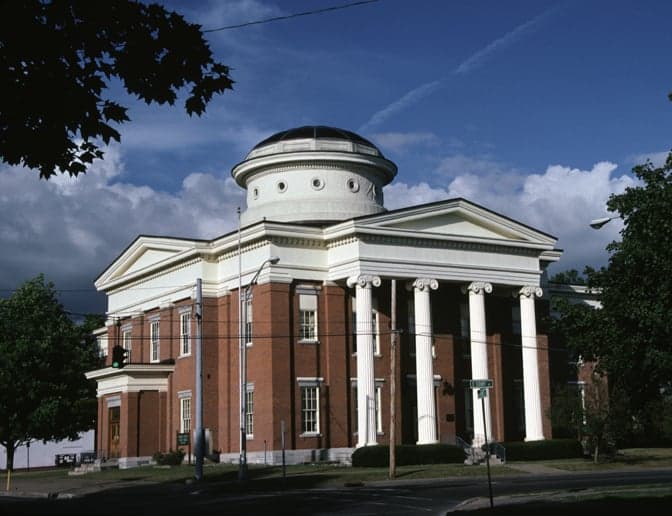
Photo: Wikipedia
Political ClimatePolitical Climate in Oneida County
Showing district-level results — no local-only data available.
Local Political AnalysisPolitical Analysis of Oneida County
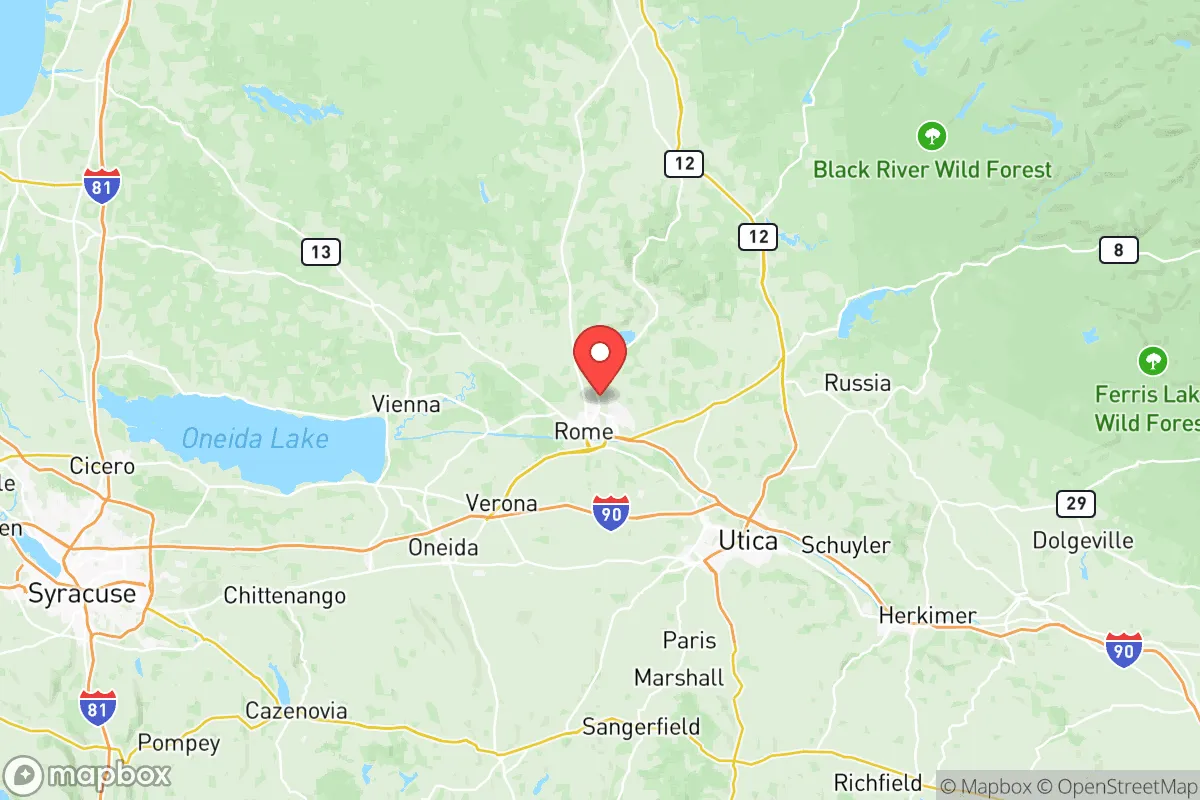
Oneida County, New York, is a reliably Republican stronghold in an otherwise blue state, carrying a Cook Partisan Voting Index of R+10. This means the county votes about ten points more Republican than the national average, a stark contrast to the deep-blue politics of New York City. The county has shifted rightward over the past decade, driven largely by the exodus of union manufacturing jobs and a growing cultural divide between its rural and suburban towns and the urban centers downstate. In the 2024 presidential election, Donald Trump carried Oneida County by roughly 15 points, while New York City’s five boroughs went for Joe Biden by margins exceeding 60 points in most precincts.
How it compares to New York City
The political gulf between Oneida County and New York City is enormous. In the city, Democrats dominate every level of government, with Republicans holding no citywide offices and only a handful of state legislative seats. In Oneida County, the opposite is true: the county legislature has a solid Republican majority, and the county executive, Anthony Picente Jr., is a Republican. The city of Utica, the county seat, is the only real blue dot—its working-class, ethnically diverse neighborhoods (like East Utica and Cornhill) lean Democratic, largely due to strong support from the city’s sizable Somali and Bosnian immigrant communities. Meanwhile, the towns of New Hartford and Clinton are swing precincts, often splitting tickets between moderate Republicans and conservative Democrats. Out in the rural towns—like Boonville, Remsen, and Forestport—Republican margins routinely hit 70% or higher. The contrast with New York City is not just partisan but cultural: Oneida County residents often view the city as out of touch with upstate concerns like property taxes, gun rights, and energy policy, while city residents see the county as politically and socially insular.
What this means for residents
For conservative residents, Oneida County feels like a safe haven. Local government is generally pro-business, with lower property tax rates than the state average and a permissive attitude toward development. The county’s Republican majority has kept state-level progressive policies—like the Green Light Law for driver’s licenses for undocumented immigrants—from being implemented locally. For liberal residents, the political climate can feel isolating. While Utica provides a progressive enclave, countywide elections are rarely competitive, and Democratic candidates often struggle to raise funds or attract volunteers. That said, the county’s political reality is not as monolithic as the PVI suggests. Local races often hinge on personality and service record rather than party label, and many elected Republicans are fiscally conservative but socially moderate—for example, supporting LGBTQ+ nondiscrimination ordinances and funding for the arts. The trajectory is toward further polarization, however, as younger, more educated residents move to Utica or leave the county entirely, while older, whiter populations age in place in the rural towns.
Culturally, Oneida County is distinct from New York City in ways that go beyond voting. The county is home to the Oneida Indian Nation, which operates the Turning Stone Resort Casino and has become a major political and economic force, often clashing with state and local officials over land rights and tax exemptions. The county’s identity is rooted in its industrial past—Remington Arms, Utica’s textile mills, and the Erie Canal—but today it’s a mix of healthcare (the Mohawk Valley Health System is the largest employer), education (Utica University, SUNY Poly), and logistics. Gun ownership is common, and the Second Amendment is a live issue; many residents view New York City’s strict gun laws as an infringement on their way of life. The county’s politics are also shaped by a deep skepticism of state government in Albany, which is seen as dominated by downstate interests. This tension—between a Republican-leaning county and a Democratic-controlled state—means that Oneida County residents often feel like they’re fighting a rear-guard action, even as they win local elections handily.

State Political ClimatePolitical Climate in New York
State Political AnalysisPolitical Environment in the State
New York State has been a solidly Democratic stronghold for decades, but the picture is far more nuanced than the national headlines suggest. The state’s overall partisan lean is roughly D+10 to D+15 in presidential elections, driven overwhelmingly by New York City and its immediate suburbs. However, the last 10-20 years have seen a dramatic acceleration of the urban-rural divide, with upstate and western regions flipping hard to the right while the downstate metro areas become even more progressive. For a conservative-leaning relocator, the key takeaway is that your experience will vary wildly depending on whether you land in Manhattan, Buffalo, or the Hudson Valley.
Urban vs. rural divide
The political map of New York is essentially two different countries. New York City, with its 8.5 million residents, votes about 80% Democratic and single-handedly decides statewide elections. The five boroughs—Manhattan, Brooklyn, Queens, the Bronx, and Staten Island (the only one that occasionally flips red)—are the engine of the state’s leftward tilt. Just north of the city, Westchester County and Long Island’s Nassau and Suffolk counties have historically been swing areas, but they’ve trended blue in recent cycles, especially after the 2020 suburban backlash against Trump. Head upstate, and the story flips: places like Erie County (Buffalo), Monroe County (Rochester), and Onondaga County (Syracuse) are Democratic-leaning only because of their urban cores; the surrounding rural counties—like Wyoming, Livingston, and Orleans—routinely vote 65-70% Republican. The Southern Tier, from Chautauqua County to Broome County, is deeply red, while the North Country (St. Lawrence, Jefferson, Clinton counties) leans conservative but with a libertarian streak. The most dramatic shift has been in the Hudson Valley: Dutchess and Ulster counties are now reliably blue, while Orange and Putnam remain purple but trending left. In 2024, Donald Trump won 58 of New York’s 62 counties, but lost the state by 12 points because of the NYC vote.
Policy environment
New York’s policy environment is among the most progressive in the nation, with a tax structure that reflects it. The state has a progressive income tax with rates from 4% to 10.9% on income over $25 million, plus some of the highest property taxes in the country—averaging around 1.7% of home value, with rates in places like Monroe County and Erie County often exceeding 2.5%. Sales tax varies by county, typically 8-8.875%. The regulatory posture is heavy: New York has strict rent control laws in NYC and some suburbs, a statewide ban on fracking, and some of the nation’s toughest environmental regulations under the Climate Leadership and Community Protection Act. Education policy is dominated by the Board of Regents, which sets curriculum standards; the state has universal pre-K and a robust public university system (SUNY), but school choice is limited—charter schools exist but face caps and political opposition. Healthcare is heavily regulated, with the state running its own health insurance exchange and expanding Medicaid under the Affordable Care Act. Election laws are among the most accessible in the country: no-excuse absentee voting, early voting, automatic voter registration, and same-day registration are all in place. For a conservative, the policy environment can feel stifling, especially on taxes and regulation, but the state’s infrastructure—roads, public transit, schools—is generally well-funded.
Recent policy direction
The last five years have seen a sharp leftward turn in Albany, driven by a Democratic supermajority in the Assembly and a Democratic-controlled Senate. On gun rights, the state passed the SAFE Act in 2013 (expanded in 2022 after the Bruen decision), which bans assault weapons, limits magazine capacity to 10 rounds, and requires a permit to purchase any firearm. The 2022 Concealed Carry Improvement Act further restricted where guns can be carried, including “sensitive places” like Times Square and public transit. On parental and education rights, the state has moved toward progressive curriculum standards, including mandatory LGBTQ+ history instruction and ethnic studies, while rejecting parental notification laws for school library materials. Speech is broadly protected under the state constitution, but the 2022 Hate Crimes Task Force and social media disinformation laws have raised concerns about chilling effects. Privacy and surveillance: New York has strong data breach notification laws and a biometric privacy law, but also allows warrantless surveillance of license plates and has a controversial “Green Light Law” that blocks federal immigration enforcement from accessing DMV records. Medical and bodily autonomy is fully protected: abortion is legal up to viability, with a 2019 law codifying Roe v. Wade protections, and the state has shield laws for providers serving out-of-state patients. Property rights are constrained by rent control and strict zoning in downstate areas, but upstate counties have far fewer restrictions. Taxation remains high, though the 2023-2024 budget included modest middle-class tax cuts. Voting access has expanded dramatically, with early voting and automatic registration, but the state also has a strict ballot harvesting law that allows third-party collection of absentee ballots, which critics say invites fraud.
Civil unrest & political movements
New York has a long history of political activism, and recent years have seen both left- and right-wing movements flare up. The 2020 Black Lives Matter protests in NYC, Buffalo, and Rochester were among the largest in the nation, with property damage and clashes with police. The “defund the police” movement gained traction in the city, leading to a $1 billion NYPD budget cut (later partially restored). On the right, the “Second Amendment Sanctuary” movement has spread through upstate counties like Wyoming, Orleans, and St. Lawrence, where local sheriffs have declared they won’t enforce certain gun laws. Immigration politics are a flashpoint: New York City’s sanctuary city policy, which limits cooperation with ICE, has been a target of conservative criticism, especially as the city has struggled to house tens of thousands of asylum seekers since 2022. The state’s Green Light Law, which blocks federal immigration enforcement from accessing DMV data, has led to lawsuits and federal threats. Election integrity controversies have been relatively muted compared to swing states, but the 2020 and 2022 elections saw Republican lawsuits over ballot harvesting and the counting of absentee ballots. Secession rhetoric is mostly a fringe movement—the “New York State of Mind” secessionists in NYC and the “Upstate New York” secessionists have little real traction, though the idea of splitting the state into two (downstate vs. upstate) occasionally resurfaces in op-eds. A new resident would notice the visible political polarization: “Fuck Trump” flags in Hudson Valley towns and “Let’s Go Brandon” banners on rural pickup trucks are both common.
Projection
Over the next 5-10 years, New York’s political trajectory points toward continued Democratic dominance at the state level, but with increasing internal friction. Demographic shifts are working against the GOP: the state is losing population in upstate rural areas (the “Rust Belt” exodus) while gaining in NYC and its suburbs, which are becoming more diverse and younger. In-migration from other states is net negative—New York loses about 200,000 residents per year to Florida, Texas, and the Carolinas—and those leaving tend to be more conservative or moderate. This self-selection means the remaining electorate is becoming more uniformly progressive. However, the 2022 gubernatorial race showed that a moderate Republican (Lee Zeldin) could come within 6 points of victory by focusing on crime and the cost of living, suggesting the state is not a lost cause for conservatives if they can find the right message. The wild card is the NYC mayoral race and the city’s ability to manage its fiscal and migrant crises; if the city’s quality of life deteriorates further, it could drive a suburban backlash. For a conservative moving in now, expect to see the state’s tax burden remain high, gun laws stay restrictive, and education policy continue leftward, but also expect to find strong communities of like-minded people in upstate counties and some Hudson Valley towns. The state will not flip red in a presidential election, but local races in the Assembly and Senate could become more competitive if the Democratic coalition fractures over housing, crime, and education.
For a new resident, the bottom line is that New York offers a deeply polarized experience. If you’re a conservative, you’ll find your political views are a minority in the state government, but you’ll also find plenty of neighbors who share your values in places like Wyoming County, Orleans County, or the Southern Tier. You’ll pay higher taxes and face more regulation than in a red state, but you’ll also get world-class infrastructure, public services, and natural beauty. The key is to choose your location carefully: the political climate of Buffalo is not the political climate of Manhattan, and the rural North Country is a world away from the Hudson Valley. Know what you’re signing up for, and you can make it work.
* Values derived from national, state, county, city and local statistics and may differ in a specific area. Last updated: 2026-07-24T00:30:19.000Z
Narrative content on this page is AI-generated and may contain mistakes. Verify any details that matter before acting on them.
ReloMaps may earn a commission from affiliate links at no extra cost to you.

