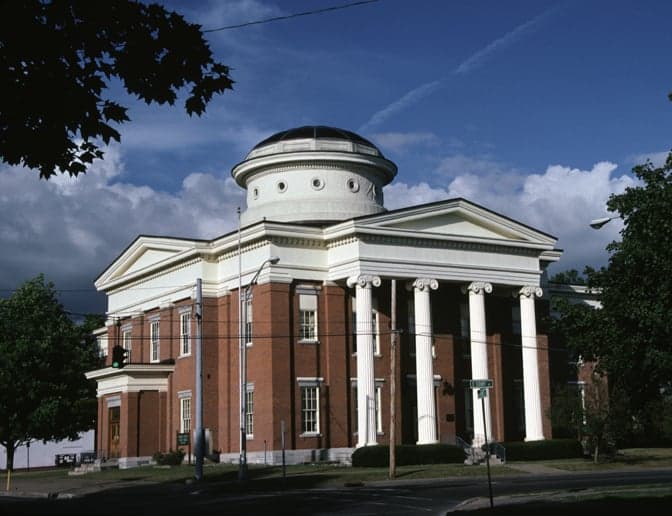
Photo: Wikipedia
Demographics of Oneida County
Affluence Level in Oneida County
A middle-class area roughly in line with national averages across income, home values, education, and employment.
People of Oneida County
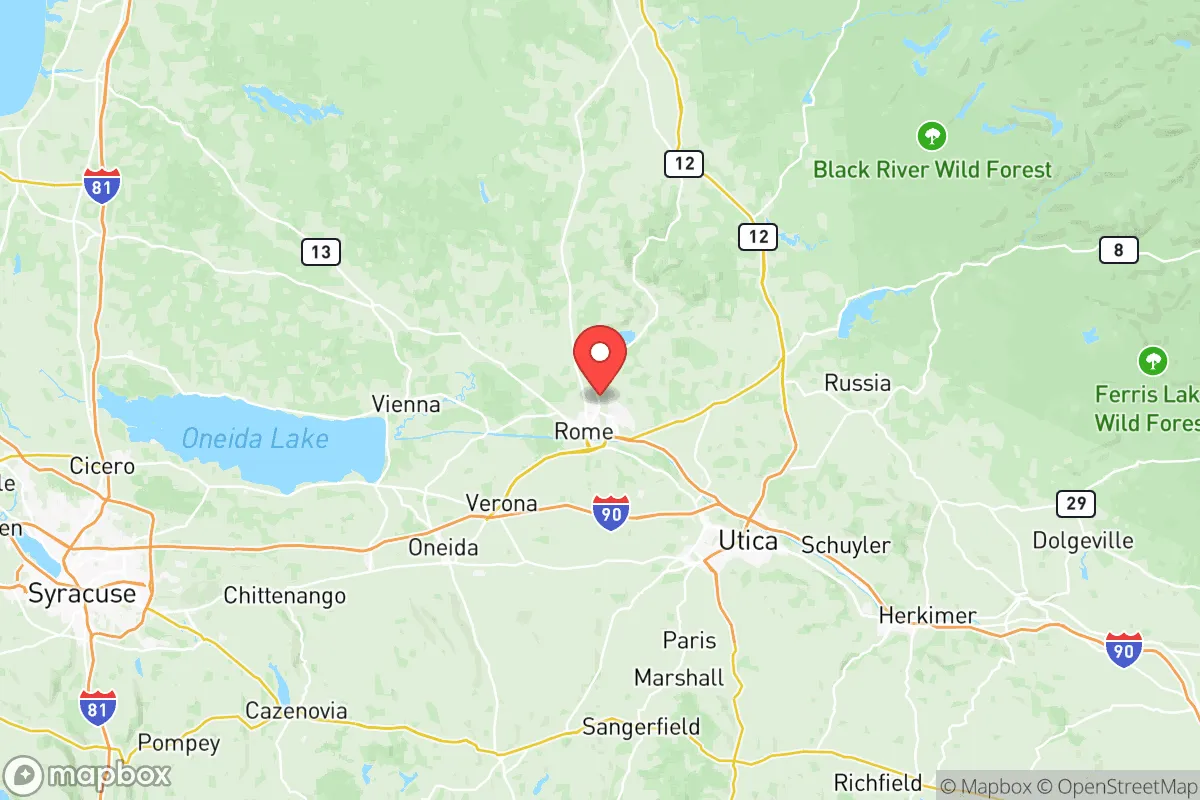
Oneida County, New York, is home to 229,645 residents, a population shaped by centuries of industrial migration and, more recently, a gradual diversification. The county remains predominantly white (79.5%) with a modest Hispanic population (6.8%) and Black population (5.2%), while East and Southeast Asian communities make up 3.8% and Indian subcontinent residents 0.4%. Its character is defined by the legacy of the Erie Canal and manufacturing, with a population density that clusters around the city of Utica and spreads into smaller cities like Rome and historic villages like Clinton and New Hartford.
Settlement & growth (pre-1960)
The original inhabitants of Oneida County were the Oneida Nation, one of the five founding nations of the Iroquois Confederacy, who controlled the region’s fertile valleys and waterways for centuries before European contact. After the American Revolution, the Oneida allied with the colonists, but the subsequent land cessions—most notably the 1788 Treaty of Fort Schuyler—opened the territory to white settlement. The first major wave of newcomers were Yankees from New England, primarily from Connecticut and Massachusetts, who arrived in the 1790s and 1800s, drawn by cheap land and the promise of the Mohawk River corridor. They founded the county’s earliest settlements, including the city of Utica (incorporated 1798) and the village of Whitesboro (1788), establishing a rural, Protestant, and largely English-speaking foundation.
The completion of the Erie Canal in 1825 transformed Oneida County from a farming backwater into a manufacturing and transportation hub. The canal brought a second, much larger wave of immigrants: Irish laborers who dug the canal and stayed to work in Utica’s new textile mills and breweries. By the 1850s, the Irish had established a dense neighborhood in Utica’s West End, centered around St. Patrick’s Church, and their descendants remain a visible cultural force in the city today. Simultaneously, German immigrants began arriving in the 1840s and 1850s, settling in Rome and the rural towns of Deerfield and Marcy, where they worked as farmers, brewers, and skilled tradesmen. The German community founded churches, social clubs, and the Utica Maennerchor, a singing society that operated into the 20th century.
The late 19th and early 20th centuries brought the county’s most diverse wave: Southern and Eastern Europeans recruited to work in Utica’s booming textile, garment, and metalworking industries. Italian immigrants arrived in large numbers between 1890 and 1920, settling in Utica’s East Utica neighborhood, which became known as “Little Italy” and still hosts the city’s annual Italian-American Festival. Polish immigrants followed, concentrating in Yorkville and New York Mills, where they found work in the mills and founded parishes like St. Stanislaus Kostka. A smaller but significant wave of Lebanese and Syrian immigrants—mostly Christian—arrived in the 1900s, establishing a community in Utica’s downtown that would later anchor the city’s refugee resettlement efforts. By 1920, Oneida County’s population had swelled to over 180,000, with Utica alone housing nearly 100,000 residents, making it one of the most ethnically diverse cities in upstate New York.
The post-World War II period saw a slowdown in immigration but a surge in domestic migration. Returning veterans and their families moved to new suburban developments in New Hartford and Whitesboro, drawn by the GI Bill and the expansion of local manufacturing, including the Rome Air Development Center (now Griffiss Institute) and the Utica-based Bendix Corporation. The county’s population peaked at 264,401 in 1960, but the decline of the Erie Canal as a commercial artery and the gradual erosion of the textile industry had already begun to shift the economic landscape.
Modern era (post-1965)
The 1965 Hart-Cellar Act opened the door for new immigration, but Oneida County’s foreign-born population remains low at just 3.5%, well below the national average. The most significant demographic shift since 1965 has not been new immigration but the arrival of refugees through federal resettlement programs. Starting in the late 1970s, Utica became a designated refugee resettlement city, initially welcoming Vietnamese and Cambodian refugees fleeing the aftermath of the Vietnam War. These East and Southeast Asian communities settled primarily in Utica’s Cornhill and East Utica neighborhoods, establishing small businesses and Buddhist temples. Today, the Asian population (East and Southeast Asian) stands at 3.8%, with the largest concentrations in Utica and the village of New Hartford.
The 1990s and 2000s brought a second wave of refugees: Bosnians fleeing the Yugoslav Wars, followed by Somalis, Burmese, and Bhutanese refugees. The Bosnian community, in particular, has been notable for its rapid integration, opening restaurants and grocery stores in Utica’s downtown and revitalizing once-vacant commercial corridors. The Indian subcontinent population remains small at 0.4%, concentrated among professionals working in healthcare and education in Utica and Clinton. The Hispanic population, at 6.8%, has grown steadily since 2000, driven by Puerto Rican and Dominican families moving from New York City and by Mexican immigrants working in agriculture and service industries. This community is most visible in Utica’s Cornhill and West Utica neighborhoods.
Domestic migration has been a story of loss and stabilization. The county lost population steadily from 1960 through 2010 as manufacturing jobs disappeared, with Utica’s population falling from 100,000 to roughly 60,000. However, the 2020s have seen a modest reversal, driven by remote workers and retirees from the New York City metro area seeking lower housing costs. The suburban towns of New Hartford and Clinton have absorbed most of this growth, while Utica’s urban core has stabilized due to refugee resettlement and a nascent downtown revival.
The future
Oneida County is slowly becoming more diverse, but the pace is gradual. The white population share has declined from 86% in 2010 to 79.5% today, while the Hispanic and Asian shares have each risen by roughly two percentage points. The refugee resettlement pipeline has slowed under federal policy changes, but the existing communities—Bosnian, Burmese, Somali, and Vietnamese—are aging in place and beginning to see second-generation professionals move to the suburbs. The Indian subcontinent population is expected to grow modestly as Mohawk Valley Health System expands and local colleges recruit international students.
The county’s cultural identity is evolving from a white, working-class, manufacturing base toward a more multi-ethnic, service-oriented society. The most significant unknown is whether domestic migration from downstate will accelerate or stall. If housing prices in the New York City suburbs continue to rise, Oneida County’s affordable housing stock—particularly in Utica and Rome—could attract a new wave of families and remote workers, potentially accelerating diversification. Conversely, if the local economy stagnates, the county may continue its slow demographic drift without a dramatic transformation.
For someone moving in now, Oneida County offers a stable, affordable, and increasingly diverse community with a strong sense of local identity rooted in its immigrant and industrial past. The population is no longer growing rapidly, but it is no longer shrinking either, and the cultural texture—from Italian festivals in Utica to Bosnian bakeries in Cornhill to suburban subdivisions in New Hartford—reflects a place that has absorbed wave after wave of newcomers without losing its essential character. The county is becoming more varied, but it remains a place where the old and new coexist, and where a newcomer can find both history and opportunity.

* Values derived from national, state, county, city and local statistics and may differ in a specific area. Last updated: 2026-07-24T00:30:19.000Z
Narrative content on this page is AI-generated and may contain mistakes. Verify any details that matter before acting on them.
ReloMaps may earn a commission from affiliate links at no extra cost to you.

