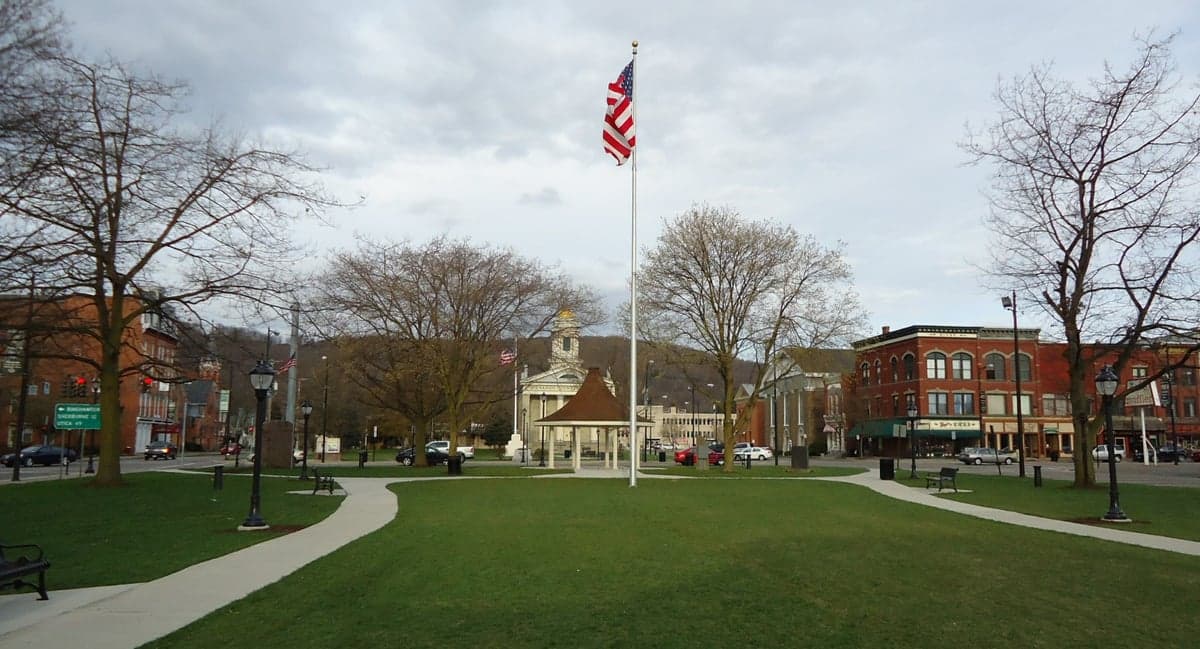
Photo: Wikipedia
Political ClimatePolitical Climate in Norwich, NY
District shown is the primary district for this city’s centroid. Cities may span multiple districts.
Local Political AnalysisPolitical Analysis of Norwich, NY
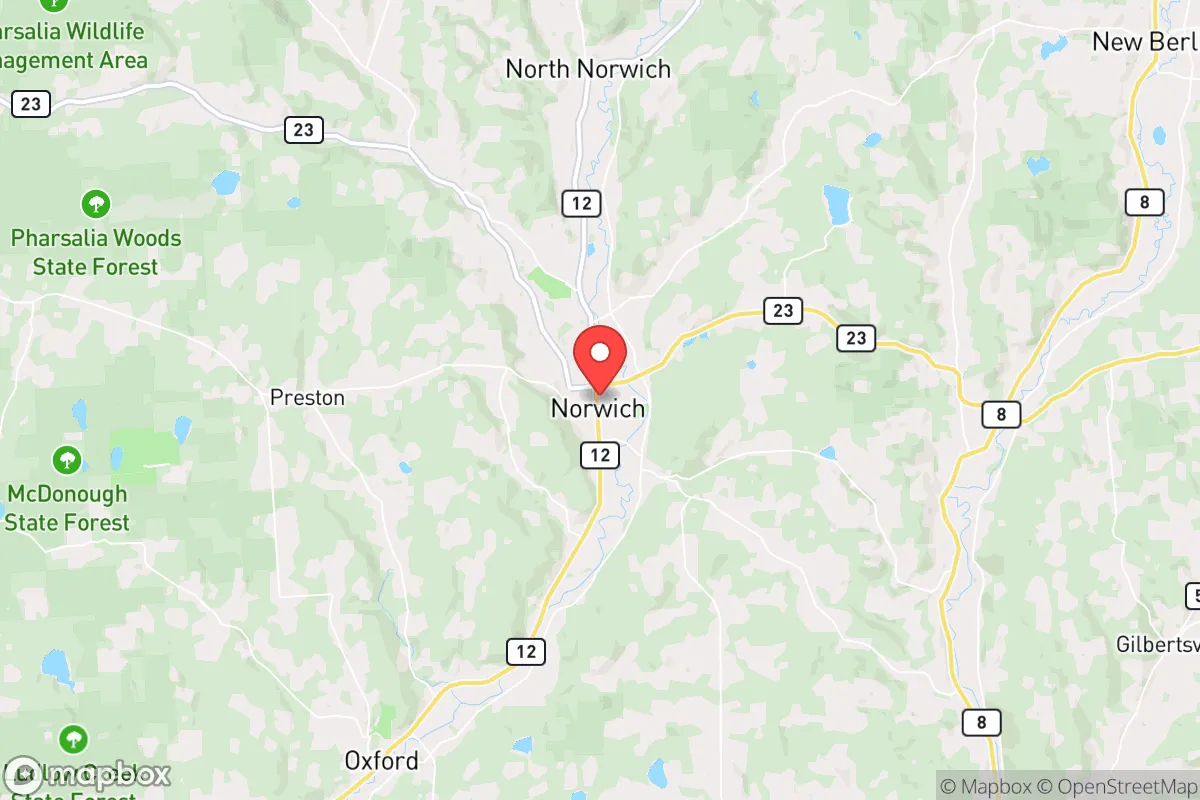
Norwich, New York, sits in a political sweet spot that’s more nuanced than its Cook PVI of D+1 suggests. For decades, this Chenango County seat was reliably blue in local races, but the last two presidential cycles have tightened considerably—Trump won the county by about 15 points in 2020 and 2024, even as Norwich itself stayed narrowly Democratic. The real story is the urban-rural split: the city of Norwich leans left, but drive ten minutes in any direction and you’re in deep-red territory, with towns like Oxford and Sherburne voting Republican by 2-to-1 margins. That D+1 rating masks a community that’s genuinely purple, where a conservative can find plenty of like-minded neighbors and a liberal won’t feel isolated, but where the political conversation is more about local issues than national culture wars.
How it compares
Compared to New York City, Norwich is a different political planet. The Big Apple’s Cook PVI is effectively off the charts—likely D+30 or higher—driven by Manhattan, Brooklyn, and the Bronx. In Norwich, you won’t see the same intensity of progressive activism or the same density of Democratic voters. The contrast is starkest on economic and land-use issues: Norwich residents, regardless of party, tend to be skeptical of state-level mandates from Albany, whether on gun laws, energy policy, or school funding. A conservative in Norwich feels the state government is out of touch with rural life, while a liberal here might find the local Democratic party more moderate than its NYC counterpart—less focused on defunding police or rent control, more on infrastructure and small business support. The nearest city that mirrors NYC’s politics is Ithaca, about 90 minutes west, but that’s a college town bubble; Norwich is more like a scaled-down version of Utica or Binghamton, where working-class pragmatism often trumps ideology.
What this means for residents
For a conservative living in Norwich, the practical reality is that you can win local elections—the city council and county board have a mix of Republicans and Democrats—but you’ll need to build coalitions. The local GOP is strong but not dominant; they hold the county sheriff’s office and a majority on the board of supervisors, but the city mayor is a Democrat. For a liberal, you’ll find your voice in city politics, especially on issues like downtown revitalization and housing, but you’ll need to accept that statewide progressive priorities (like the Green New Deal or bail reform) are unpopular here. The upshot: both sides can get things done if they focus on bread-and-butter concerns like road repairs, property taxes, and keeping the hospital open. National politics feels like background noise; the real fights are over the school budget and the local sales tax rate.
One cultural distinction that sets Norwich apart from NYC is the role of the NFA (Norwich Free Academy) and the Chenango County Fair—these are civic touchstones that transcend party lines. You won’t see the same kind of political polarization in daily life; neighbors help each other regardless of yard signs. The trajectory is toward a slow reddening of the county as retirees move in from downstate, but the city itself is likely to stay a blue island. For anyone moving here, the key takeaway is that Norwich rewards engagement over ideology—show up to the town hall meeting, volunteer at the food pantry, and you’ll be welcomed whether you voted for Trump or Biden.

State Political ClimatePolitical Climate in New York
State Political AnalysisPolitical Environment in the State
New York State has been a solidly Democratic stronghold for decades, but the political reality is far more complex than the state’s overall blue tint suggests. The Democratic coalition is powered by New York City and its immediate suburbs, while vast stretches of upstate and western New York lean heavily Republican. Over the past 10-20 years, the state has shifted left on social and fiscal policy, driven by supermajority control in Albany, but that same period has seen a growing rural backlash and a steady erosion of Democratic margins in places like the Hudson Valley and the Southern Tier. For a conservative-leaning relocator, the key takeaway is that your experience will vary dramatically depending on whether you land in Manhattan, Buffalo, or a small town in the Adirondacks.
Urban vs. rural divide
The political map of New York is a textbook case of the urban-rural split. New York City’s five boroughs—Manhattan, Brooklyn, Queens, the Bronx, and Staten Island—deliver roughly 40% of the state’s vote, with Manhattan and Brooklyn routinely giving Democrats 80-85% of the vote. The inner-ring suburbs of Westchester County, Nassau County on Long Island, and Albany’s Capital District also lean blue, though Nassau has shown signs of tightening in recent cycles. In contrast, the vast majority of upstate counties—from Erie County (Buffalo) westward, through the Finger Lakes, the North Country, and the Southern Tier—vote Republican. Oneida County (Utica) and Steuben County (Corning) are reliably red, while Monroe County (Rochester) is a purple battleground where the city votes blue and the suburbs lean red. The divide isn’t just about population density; it’s cultural. Upstate residents often feel ignored by Albany and resent the outsized influence of NYC on state policy, from gun laws to energy regulations. This tension has fueled a quiet but persistent “secession” chatter in rural counties, though no serious movement has gained traction.
Policy environment
New York’s policy environment is among the most progressive in the nation, with a tax structure that is both high and steeply progressive. The state income tax tops out at 10.9% for incomes over $25 million, but even middle-class earners in the $100,000-$300,000 range face rates of 6-7%. Property taxes are among the highest in the country, especially in upstate counties like Erie and Monroe, where effective rates can exceed 2.5% of home value. The regulatory posture is dense: New York has strict rent control laws in NYC, a statewide ban on fracking, and some of the nation’s toughest environmental regulations under the Climate Leadership and Community Protection Act. Education policy is dominated by the state’s powerful teachers’ unions, and school funding is heavily skewed toward NYC and urban districts, leaving rural schools scrambling. Healthcare is a mix: the state expanded Medicaid under the ACA and runs its own health insurance exchange, but rural hospital closures have been a persistent problem. Election laws are relatively liberal—no-excuse absentee voting, early voting, and automatic voter registration—but the state’s ballot access laws for third parties are notoriously restrictive, with the “Wilson-Pakula” law requiring minor-party candidates to get permission from major-party county committees to run in primaries.
Recent policy direction
Over the last five years, Albany has moved aggressively on several fronts that matter to a conservative relocator. On gun policy, the state passed the SAFE Act in 2013 (expanded in 2022 after the Bruen decision), which bans “assault weapons,” limits magazine capacity to 10 rounds, and requires universal background checks and a permit to purchase ammunition. The 2022 Concealed Carry Improvement Act made New York a “sensitive places” state, effectively banning firearms in most public spaces, including Times Square, subways, and parks. On education and parental rights, the state has resisted the “parents’ bill of rights” movement seen in red states; school boards remain locally controlled, but the state Department of Education has pushed LGBTQ-inclusive curriculum and diversity initiatives. On speech and privacy, New York passed the Digital Fair Repair Act and strong data privacy laws, but also expanded surveillance under the New York State Intelligence Center. On medical and bodily autonomy, the state codified abortion rights in 2019 with the Reproductive Health Act, removing criminal penalties and allowing late-term abortions for health reasons. Property rights are constrained by rent control in NYC and strict environmental regulations upstate, but there is no statewide ban on short-term rentals like Airbnb. On voting, the state passed the John R. Lewis Voting Rights Act of New York in 2022, which requires pre-clearance for any local voting changes in jurisdictions with a history of discrimination—a move that has drawn legal challenges from Republican counties.
Civil unrest & political movements
New York has been a flashpoint for both left- and right-wing activism. The 2020 Black Lives Matter protests in NYC were among the largest in the country, and the state responded with police reform mandates (the Eric Garner Anti-Chokehold Act) and bail reform laws that have since been partially rolled back after a spike in crime. On the right, the “Second Amendment sanctuary” movement has spread to dozens of upstate counties, with local sheriffs refusing to enforce parts of the SAFE Act. Immigration politics are a constant tension: New York is a “sanctuary state” under the Green Light Law, which allows undocumented immigrants to obtain driver’s licenses and limits cooperation with ICE. This has led to clashes between state officials and upstate sheriffs who want to honor ICE detainers. Election integrity controversies flared after 2020, with Republican-led counties like Rensselaer and Sullivan passing resolutions calling for audits of voting machines, though no widespread fraud was ever found. A visible flashpoint for new residents is the congestion pricing plan for Manhattan, which charges drivers entering the central business district—a policy that has sparked lawsuits from New Jersey and suburban commuters.
Projection
Over the next 5-10 years, New York’s political trajectory points toward continued Democratic dominance at the state level, but with growing internal friction. Demographic trends are working against the GOP: the state’s population is aging and slowly declining, but the growth is concentrated in NYC and its suburbs, which are becoming more diverse and more liberal. In-migration from other states is net negative—New York loses residents to Florida, Texas, and the Carolinas—and those leaving tend to be moderate and conservative-leaning, which further concentrates the blue vote. The upstate population is flat or declining, meaning rural Republican counties will have less political weight in redistricting. However, the state’s high cost of living and tax burden may eventually hit a ceiling; if the economy slows, expect renewed calls for tax caps and spending restraint, even from Democratic governors. A new resident moving in now should expect that the state’s policy direction—on guns, taxes, and social issues—will remain left of the national median, but that local control in upstate counties can provide a buffer. The practical reality is that a conservative family in Orleans County will live under very different local conditions than a liberal family in Brooklyn, even though both are subject to the same state laws.
For a conservative-leaning relocator, the bottom line is that New York offers a stark choice. If you value low taxes, gun rights, and local control, you’ll find a welcoming community in places like Chautauqua County or the Adirondack foothills, but you’ll be fighting state policy at every turn. If you’re willing to trade those for world-class urban amenities, a strong social safety net, and a progressive cultural environment, the city and its suburbs are unmatched. The key is to pick your county carefully—and to understand that Albany’s reach is long, but not absolute.
* Values derived from national, state, county, city and local statistics and may differ in a specific area. Last updated: 2026-09-20T20:12:53.000Z
Narrative content on this page is AI-generated and may contain mistakes. Verify any details that matter before acting on them.
ReloMaps may earn a commission from affiliate links at no extra cost to you.

