Photo: Wikipedia
Demographics of Norwich, NY
Affluence Level in Norwich, NY
A low-income area with significant economic hardship. Household wealth and educational attainment are well below national averages.
People of Norwich, NY
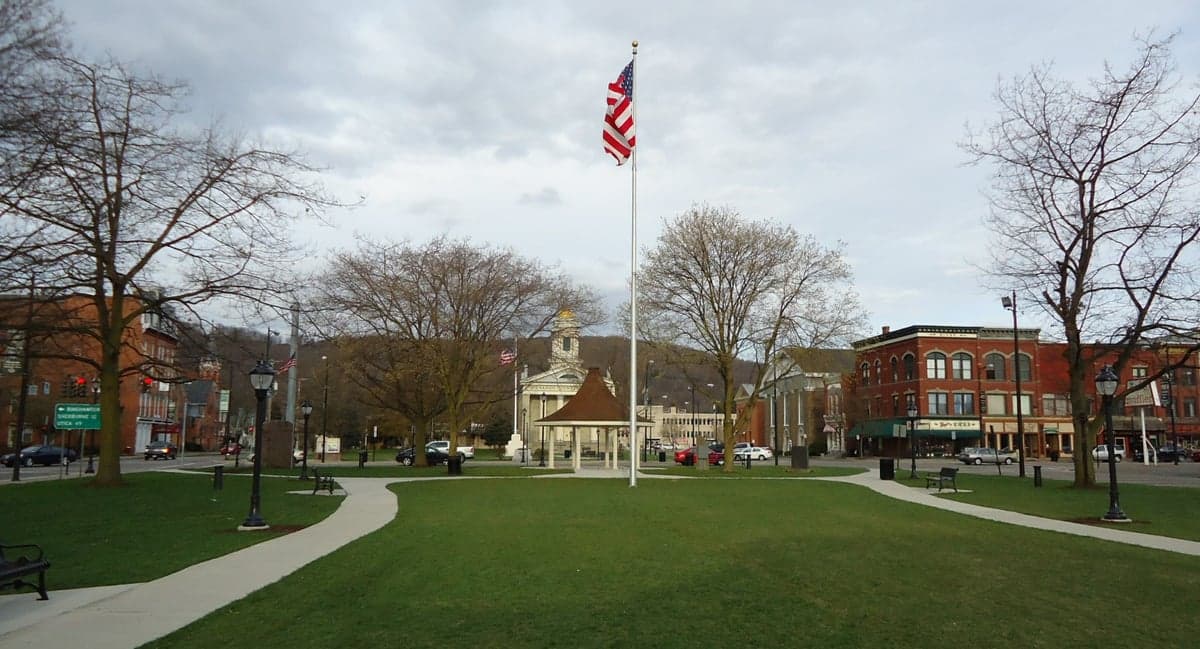
The people of Norwich, New York, today form a small, predominantly white community of 6,880 residents, marked by a strong sense of local identity rooted in its industrial and agricultural past. With 86.8% of the population identifying as white and 7.2% as Hispanic, the city is less diverse than New York State as a whole, yet it has seen modest growth in its Hispanic and foreign-born populations over the past two decades. A college attainment rate of 26.0% is below the national average, reflecting a workforce historically tied to manufacturing and trades rather than professional services. The city’s character remains that of a tight-knit, working-class hub in Chenango County, where family ties run deep and newcomers often arrive through employment at major local employers like the NBT Bank headquarters or the Chobani yogurt plant.
How the city was settled and grew
Norwich was originally settled in the late 18th century by Anglo-American pioneers from New England, drawn by the Chenango River’s water power and the fertile valleys of central New York. The village was formally incorporated in 1816 and became a city in 1914, growing as a center for dairy farming, textile mills, and later, the manufacturing of machinery and tools. The earliest settlers clustered around the Pleasant Street Historic District, where Federal and Greek Revival homes still stand, built by merchants and mill owners who dominated the local economy. By the mid-19th century, the arrival of the Chenango Canal and later the railroad brought Irish and German immigrants, who settled in the West Side neighborhood near the rail yards and the Chenango River, working in the mills and foundries. A smaller wave of Italian immigrants arrived around 1900, establishing a presence in the East Side around East Main Street, where they opened grocery stores and barbershops that served the growing industrial workforce. These ethnic enclaves remained distinct through the 1950s, with each group maintaining its own churches and social clubs, such as the St. Paul’s Roman Catholic parish for the Irish and the Sacred Heart Church for the Italians.
Modern era (post-1965)
After the 1965 Hart-Cellar Act, Norwich saw only a modest increase in immigration, unlike larger Upstate cities. The foreign-born population today stands at just 4.2%, with the largest share coming from Latin America, particularly Mexico and Puerto Rico, who began arriving in the 1990s to work in the region’s expanding food processing and warehousing sectors. These newer residents have concentrated in the North Broad Street corridor, a mixed-use area near the city’s industrial park, where affordable rental housing and proximity to employers like Chobani and Procter & Gamble’s distribution center have drawn families. The Hispanic population has grown from roughly 3% in 2000 to 7.2% today, making it the city’s fastest-growing demographic group. Meanwhile, the Black population remains very small at 1.1%, and East/Southeast Asian and Indian subcontinent communities each account for just 0.3%, reflecting limited in-migration from those regions. Suburbanization has been minimal; most residents still live within the city’s 2.1 square miles, though some families have moved to outlying hamlets like Plymouth or Sherburne for larger lots. The city’s white population has aged and declined slightly, with many younger adults leaving for college or jobs in larger metros like Syracuse or Binghamton, a trend that has kept the overall population flat at around 6,900 since 2010.
The future
Norwich’s population is projected to remain stable or decline slightly over the next decade, as the city’s aging white cohort shrinks and younger families continue to out-migrate. The Hispanic share is expected to grow slowly, potentially reaching 10-12% by 2035, driven by births and continued recruitment for food manufacturing jobs, but the city is unlikely to see significant diversification beyond that. New residential development is concentrated in the Southwest neighborhood near the Chenango Valley Central School District, where a handful of single-family subdivisions have been built since 2020, attracting some commuters who work in Norwich but prefer newer homes. The cultural identity of the city is evolving from a historically Anglo- and Italian-American mill town toward a more bilingual, working-class community, with Spanish-language signage appearing in some stores on South Broad Street and a growing presence of Hispanic-owned businesses. For a newcomer moving in now, Norwich offers a stable, low-cost environment with a strong sense of place, but those seeking rapid demographic change or a highly diverse social scene will find it a quiet, slow-moving community where the past still shapes daily life.

* Values derived from national, state, county, city and local statistics and may differ in a specific area. Last updated: 2026-09-20T20:12:53.000Z
Narrative content on this page is AI-generated and may contain mistakes. Verify any details that matter before acting on them.
ReloMaps may earn a commission from affiliate links at no extra cost to you.

