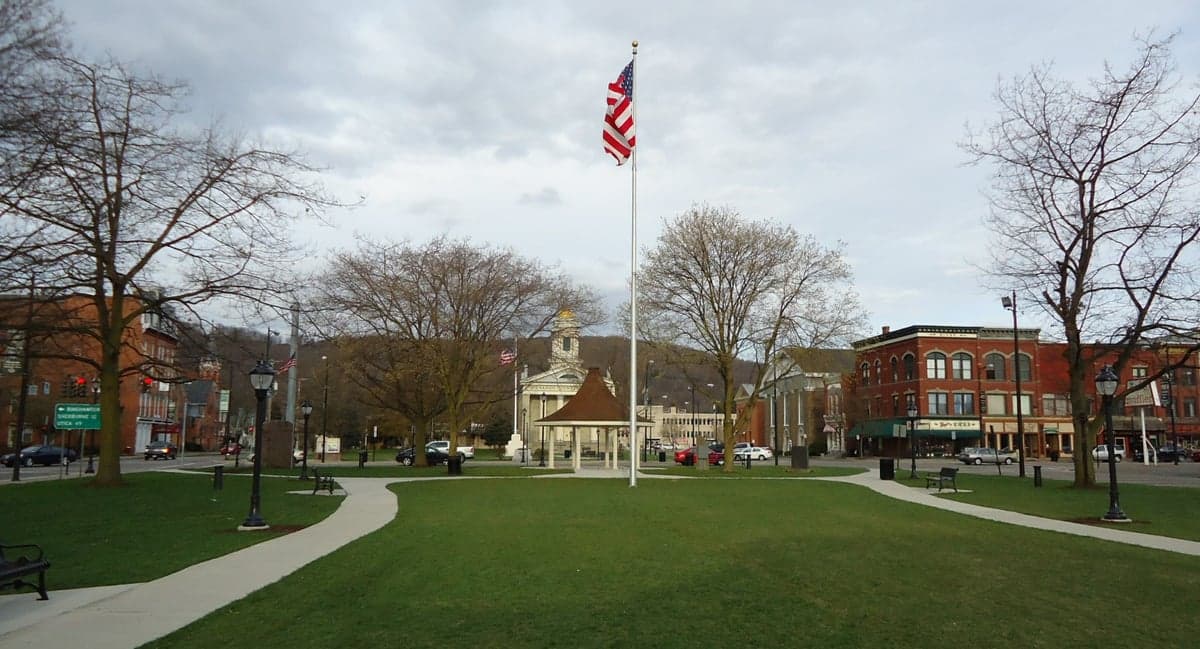
Photo: Wikipedia
Personal Sovereignty in Norwich, NY
Moderate friction. Expect trade-offs in some aspect of personal liberty and independence.
What does Personal Sovereignty tell us?
Personal Sovereignty measures your capacity for self-reliance and independence with minimal government friction. Higher scores mean fewer barriers between you and the way you want to live... but it assumes you have the space you need and good neighbors.
What does this tell us?
Personal Sovereignty measures your capacity for self-reliance and independence with minimal government friction. Higher scores mean fewer barriers between you and the way you want to live... but it assumes you have the space you need and good neighbors.
State Policy
Energy independence: Importer (12% of energy produced in-state)
Personal Liberty
Homesteading

Personal Liberty Analysis
Norwich, New York, offers a mixed personal sovereignty environment shaped by its upstate rural character and New York State's broader regulatory framework. While the city and surrounding Chenango County provide more breathing room than downstate areas, residents must navigate a state government that imposes some of the nation's highest taxes and strictest gun laws, balanced by relatively light local zoning and a culture of self-reliance. For individuals and families who prioritize autonomy, Norwich represents a trade-off: lower housing costs and a hands-off local government, but with state-level constraints that limit certain freedoms more than in states like Texas or New Hampshire.
Tax burden and regulatory posture in Chenango County
New York State carries the highest combined state and local tax burden in the U.S., and Norwich residents feel this directly. Property taxes in Chenango County average around 2.5% of home value, among the highest in the nation, though this is partially offset by median home prices near $120,000—well below state and national averages. Income tax rates range from 4% to 10.9%, with most middle-income households paying roughly 6-7%. Sales tax in Norwich is 8.5% (4% state, 4% county, 0.5% city). The regulatory posture at the local level is notably lighter than in larger New York cities. Chenango County has no county-wide zoning for agricultural or rural residential use, and the city of Norwich's zoning code is relatively permissive for a municipality of its size. Building permits for minor structures like sheds or fences are generally not required in unincorporated areas, though the state's energy code and septic regulations still apply. Business licensing is straightforward for most small operations, but state-level regulations—such as the Scaffold Law (unique to New York) and strict environmental review requirements under the State Environmental Quality Review Act (SEQRA)—add layers of compliance that can frustrate entrepreneurs. Overall, the tax burden is heavy, but the local regulatory touch is light, creating a bifurcated sovereignty landscape.
Self-defense and gun law specifics for Norwich residents
New York's gun laws are among the most restrictive in the country, and Norwich residents must comply fully. The state's Concealed Carry Improvement Act (CCIA), enacted in 2022, requires a pistol permit for any concealed carry, with applicants undergoing a 16-hour safety course, a background check, and a "good moral character" review by a county judge. Chenango County's pistol permit office is known for processing applications within 6-12 months, faster than downstate counties but still a significant wait. Open carry is effectively banned for handguns and restricted for long guns. The state also bans "assault weapons" (defined by a feature-based test) and limits magazine capacity to 10 rounds. Self-defense in the home is legally protected under the "castle doctrine," but New York does not have a "stand your ground" law; residents have a "duty to retreat" in public spaces if safely possible. Chenango County Sheriff's Office generally takes a pragmatic approach to enforcement, but state police and the SAFE Act's ammunition background check requirements (for online purchases) add friction. For those prioritizing self-defense rights, Norwich's legal environment is significantly more restrictive than in states like Pennsylvania or Ohio, though the local culture is pro-Second Amendment and many residents still own firearms legally.
Self-reliance and homesteading viability: lot sizes, zoning, and off-grid feasibility
Norwich and its surrounding rural areas offer strong potential for self-reliance, with some caveats. In the city proper, lot sizes average 0.1-0.25 acres, limiting large-scale gardening or livestock. However, within a 10-minute drive, Chenango County's rural zoning allows for agricultural use on parcels as small as 2 acres, and many properties come with existing barns or outbuildings. The county has no restrictions on keeping chickens, goats, or even small livestock like pigs on residential lots outside city limits, though the city of Norwich limits poultry to 6 hens (no roosters) on lots under 0.5 acres. Off-grid living is legally feasible but practically challenging. New York State requires all dwellings to have a connection to a public water supply or an approved private well, and septic systems must meet state Department of Health standards. Solar panels are permitted and net metering is available, but the state's building code requires grid-tied systems to have a disconnect switch accessible to utility workers. Rainwater collection is legal for non-potable uses (irrigation, livestock) but not for drinking without treatment. Wood stoves are common and unregulated for heating, but new installations must meet EPA emissions standards. The biggest hurdle for full off-grid living is the state's requirement for a minimum 400 square feet of habitable space for a permanent dwelling, which can complicate tiny house or RV-based setups. Overall, Norwich's rural fringe offers viable homesteading for those willing to work within state health and building codes, but true off-grid independence is constrained by New York's regulatory baseline.
Personal liberties: parental rights, medical autonomy, speech, and property
Parental rights in New York are legally protected under state law, but the state's education system is centralized. Norwich City School District follows state curriculum mandates, including the "Culturally Responsive-Sustaining Education" framework, which some parents view as limiting their ability to opt out of specific content. Homeschooling is legal and requires annual submission of an Individualized Home Instruction Plan (IHIP) to the district, with quarterly reports and an annual assessment—a moderate paperwork burden compared to states like Texas or Idaho. Medical autonomy is constrained by New York's vaccine mandates for school attendance (including COVID-19 for healthcare workers, though not for K-12 students as of 2026), and the state's strict prescription drug monitoring program. Medical marijuana is legal with a state-issued card, and recreational cannabis is legal for adults 21+, though local municipalities can opt out of retail sales (Chenango County has several opt-out towns). Free speech is protected under the First Amendment, but New York's "hate crimes" law and social media liability statutes create a legal environment where certain speech can face civil penalties. Property rights are generally strong in Chenango County, with no rent control, no county-wide short-term rental bans, and relatively few historic preservation overlays. However, the state's "good cause eviction" law (effective 2024) applies to most rental properties, limiting a landlord's ability to non-renew leases without cause. Eminent domain is rarely used for private development in this area. For a conservative-leaning audience, Norwich offers solid property rights and moderate homeschooling flexibility, but medical and educational autonomy are notably more restricted than in less-regulated states.
Overall, Norwich, NY provides a moderate level of personal sovereignty relative to other upstate New York communities, but it falls short of the freedom found in states like Florida, Tennessee, or Arizona. The heavy state tax burden and restrictive gun laws are the primary drawbacks, while the light local zoning, affordable land, and culture of self-reliance are significant advantages. For a family or individual who values independence and is willing to navigate New York's regulatory framework, Norwich offers a viable base for a self-directed life—especially if homesteading or small-scale agriculture is a priority. However, those seeking maximal autonomy in taxation, self-defense, and off-grid living will find better options outside the state's borders.

* Values derived from national, state, county, city and local statistics and may differ in a specific area. Last updated: 2026-09-20T20:12:53.000Z
Narrative content on this page is AI-generated and may contain mistakes. Verify any details that matter before acting on them.
ReloMaps may earn a commission from affiliate links at no extra cost to you.

