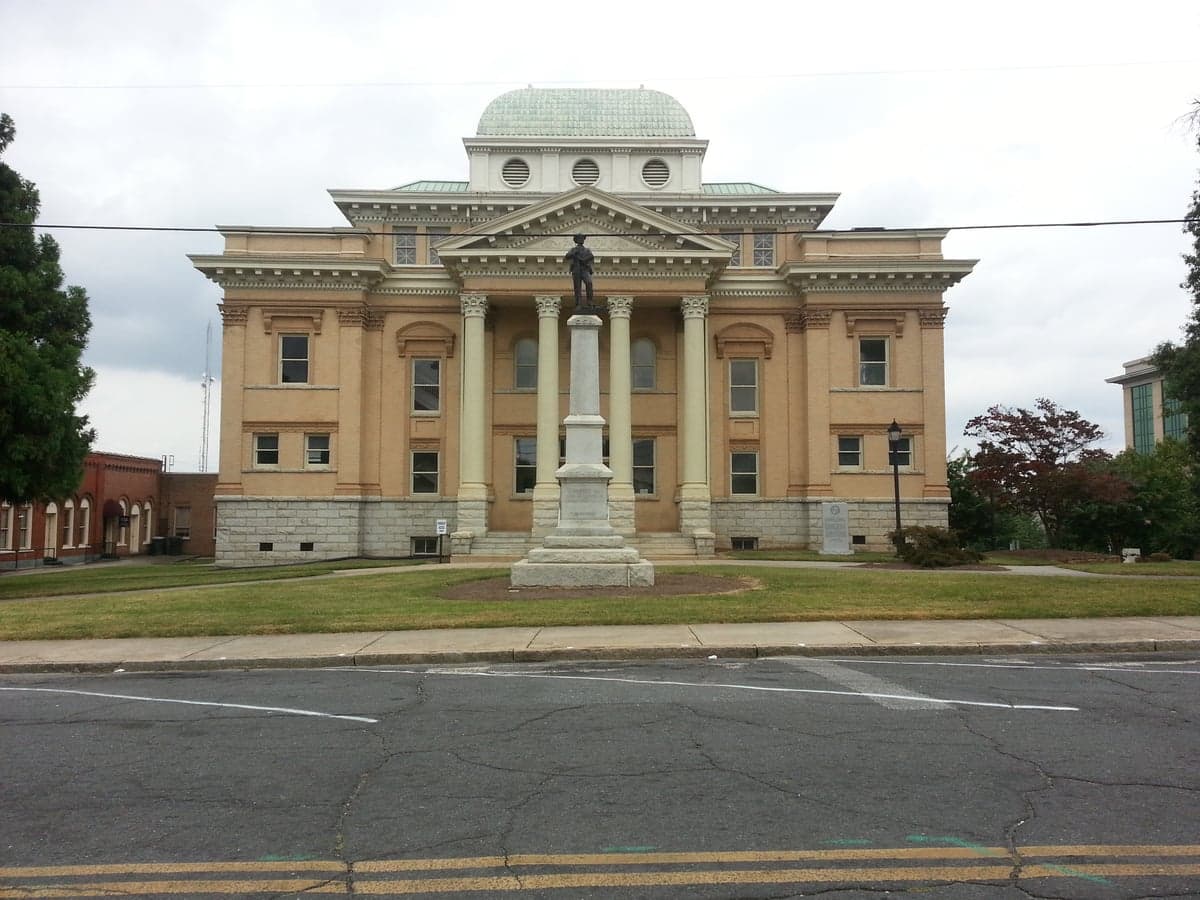
Photo: Wikipedia
Political ClimatePolitical Climate in Randolph County
Showing district-level results — no local-only data available.
Local Political AnalysisPolitical Analysis of Randolph County
Randolph County has been a reliably Republican stronghold for decades, and that hasn't changed. The county’s Cook Partisan Voting Index (PVI) of R+8 puts it significantly to the right of North Carolina as a whole, which sits at R+1. This isn't a new trend; it's a deep-rooted political identity that has only solidified over the last few election cycles, even as the state has become more competitive. The county consistently delivers double-digit margins for GOP candidates, and that pattern shows no signs of weakening.
How it compares
The difference between Randolph County and the state average is stark. While North Carolina is a true swing state—capable of flipping between parties in presidential and gubernatorial races—Randolph County is a safe bet for Republicans. In 2024, the county voted for Donald Trump by a margin of roughly 40 points, far exceeding the statewide spread. This isn't just a rural vs. urban divide, though that's part of it. The county seat, Asheboro, is the largest population center and tends to be more moderate, with pockets of Democratic voters near downtown and around the Randolph Community College area. However, even Asheboro leans right overall. The real contrast is between the small towns. Franklinville and Ramseur in the eastern part of the county are historically more conservative, with strong ties to the textile and furniture industries. Liberty and Staley in the north are deeply red, driven by agricultural and manufacturing communities. Seagrove, known for its pottery, is also solidly Republican. There are no true "blue" towns in Randolph County; the political variation is more a matter of degree of redness. The swing precincts, if you can call them that, are in the more suburban areas around Asheboro and along the Highway 64 corridor, where growth from the Piedmont Triad region is bringing in new residents who may be less entrenched in local party politics.
What this means for residents
For conservative residents, the political climate is comfortable and affirming. Local elections are dominated by Republicans, and the county commission, school board, and most municipal councils reflect that majority. Policy priorities tend to focus on low taxes, limited government, and support for traditional values. For liberal or moderate residents, the reality is different. They are a clear minority, and their influence on local governance is limited. However, the county is not a political monolith. There are active Democratic and unaffiliated voter groups, particularly in Asheboro, and the growing diversity of the county—driven by an increasing Hispanic population in the furniture and manufacturing sectors—is slowly shifting the conversation. The practical effect is that while state-level races are fiercely contested, local politics in Randolph County are largely settled. This can be a draw for those seeking stability and predictability, or a frustration for those who want more competitive debate.
Culturally, Randolph County's political lean is woven into daily life. You'll see more "In God We Trust" signs in government buildings than in many other parts of the state, and the county's stance on issues like gun rights and religious freedom is unambiguous. The area is also home to a significant Quaker population, particularly in the southern part of the county around Sophia and Trinity, which historically brought a more pacifist and community-oriented perspective to local politics—though that influence has waned in recent decades as the county has grown more uniformly conservative. The biggest policy distinction from the rest of North Carolina is the county's approach to growth and development. Randolph County has been more resistant to rapid urbanization than neighboring Guilford or Wake counties, preferring to maintain its rural character and small-town feel. This is a deliberate political choice, and it shapes everything from zoning laws to school funding. For anyone moving here, understanding that this is a place where tradition and local control are paramount is key to fitting in, regardless of your personal politics.

State Political ClimatePolitical Climate in North Carolina
State Political AnalysisPolitical Environment in the State
North Carolina is a classic swing state, with a Cook PVI of R+1 that barely hints at the internal tension pulling it in opposite directions. Over the last 20 years, the state has shifted from a reliably Republican stronghold in presidential elections to a true battleground, with Democrats winning the governorship in every election since 2016 and the state legislature remaining firmly under GOP control. The result is a state that feels politically schizophrenic — a booming Research Triangle and Charlotte metro area pulling it left, while vast rural and exurban stretches keep it anchored right. For a relocator, this means you get a mix of purple pragmatism and red policy, depending on exactly where you land.
Urban vs. rural divide
The political map of North Carolina is a study in contrasts. The urban crescent — Charlotte, the Raleigh-Durham-Chapel Hill Research Triangle, Greensboro, and Winston-Salem — votes overwhelmingly Democratic. Mecklenburg and Wake Counties alone account for nearly a quarter of the state's population and reliably deliver margins of 20-30 points for Democratic candidates. Meanwhile, the rural east, the Sandhills, and the mountain counties west of Asheville are deeply Republican. The real action is in the suburbs: places like Union County (southeast of Charlotte) and Johnston County (southeast of Raleigh) are growing fast and trending right, while Buncombe County (Asheville) is a blue island in a red sea. The 2024 presidential race saw the state go for Trump by roughly 3 points, but down-ballot races remain hyper-competitive — the 2024 governor's race was a blowout for Democrat Josh Stein, while the Council of State races split nearly evenly.
Policy environment
North Carolina's policy landscape reflects its divided government. The state has a flat income tax rate of 4.5%, which is scheduled to decline to 3.99% by 2027 under legislation passed in 2021. The corporate tax rate is already a flat 2.5%, among the lowest in the country. There is no state property tax — that's levied at the county level — and sales tax rates vary by county, typically landing between 6.75% and 7.5%. On education, the state funds a voucher program (the Opportunity Scholarship Program) that has expanded significantly since 2023, now available to all families regardless of income. Charter schools are plentiful, and homeschooling is lightly regulated. Healthcare policy is a mixed bag: the state expanded Medicaid in 2023 under a bipartisan deal, adding roughly 600,000 low-income adults to the rolls, but the state also maintains some of the strictest certificate-of-need laws in the country, limiting new hospital and clinic construction. Election laws have been a flashpoint: the state requires photo ID to vote, has strict absentee ballot witness requirements, and in 2024 passed a law shortening the mail-in ballot return window. Early voting remains generous, with 17 days of in-person early voting available.
Recent policy direction
The last five years have seen North Carolina move decisively in a conservative direction on several fronts, even as Democratic governors have wielded veto power. In 2023, the GOP supermajority overrode Governor Roy Cooper's veto to pass a 12-week abortion ban (down from the previous 20-week limit), with exceptions for rape, incest, and fetal anomalies. The same session saw the passage of a permitless carry law for concealed handguns, making North Carolina the 25th state to allow it. On education, the legislature passed the Parents' Bill of Rights in 2023, requiring schools to notify parents about instructional materials involving sexuality and to obtain parental consent before a child's name or pronouns can be changed in school records. On property rights, the state has a strong right-to-farm law and has resisted most forms of rent control. On privacy and surveillance, the state has no comprehensive data privacy law, though a bill has been debated. On voting, the 2024 election law changes — including stricter chain-of-custody rules for absentee ballots and a ban on private funding of election administration — were passed along party lines. The overall direction is toward lower taxes, expanded gun rights, parental control in schools, and tighter abortion restrictions, all while maintaining a business-friendly regulatory posture.
Civil unrest & political movements
North Carolina has seen its share of political flashpoints. The 2020 protests in Charlotte and Raleigh following the murder of George Floyd were large but largely peaceful, though there were instances of property damage and looting. The state has a long history of organized labor activity, particularly in the textile and furniture industries of the Piedmont Triad, though union membership remains low (around 3% of private-sector workers) due to the state's right-to-work law. Immigration politics are less heated than in border states, but Charlotte and Durham have declared themselves sanctuary cities, refusing to hold immigrants for federal authorities without a warrant — a stance that has drawn legislative pushback. Election integrity remains a live issue: the 2020 election in North Carolina was close but not seriously contested, though the state's 2024 election saw allegations of voter roll irregularities from conservative groups. The "Moral Monday" movement, led by the NAACP, has staged regular protests at the state legislature since 2013, focusing on voting rights, Medicaid expansion, and education funding. On the right, the "We the People" movement and local Republican activist groups are active in county-level politics, particularly around school board races and election administration. A new resident would notice that political bumper stickers and yard signs are common, and that local news covers state politics obsessively.
Projection
Over the next 5-10 years, North Carolina is likely to become even more competitive, with the potential to flip to a lean-Democratic presidential state by the early 2030s. The key driver is in-migration: the state is adding roughly 100,000 new residents per year, and the plurality of them are coming from blue states like New York, California, and New Jersey. These newcomers tend to be younger, more educated, and more Democratic-leaning, and they are clustering in the urban crescent. However, the state's rural and exurban areas are also growing, and the GOP's structural advantages — gerrymandered legislative maps, a Republican-majority Supreme Court, and a strong rural turnout machine — will keep the state legislature red for the foreseeable future. The wild card is the state's growing Hispanic population, which is concentrated in Charlotte, the Triangle, and the Siler City area, and which leans Democratic but is not monolithic. A relocator moving in now should expect a state that remains politically divided but where the center of gravity is slowly shifting left on cultural issues while staying right on fiscal and regulatory ones. The practical effect is that your experience will depend heavily on your county: a conservative family in Union County will feel at home in a deep-red environment, while a liberal family in Orange County will find a blue bubble with all the amenities of progressive governance.
For a new resident, the bottom line is that North Carolina offers a genuine choice of political environments within a single state. If you want low taxes, gun rights, and school choice, you can find that in the exurbs and rural areas. If you want a more progressive environment with strong public services and cultural amenities, the cities deliver. The state's divided government means that neither side gets everything it wants, but the overall trajectory is toward a more competitive, more diverse, and more politically engaged population. The key is to pick your county carefully — your daily experience of politics in North Carolina will be shaped far more by your local government than by what happens in Raleigh.
* Values derived from national, state, county, city and local statistics and may differ in a specific area. Last updated: 2026-07-05T08:05:22.000Z
Narrative content on this page is AI-generated and may contain mistakes. Verify any details that matter before acting on them.
ReloMaps may earn a commission from affiliate links at no extra cost to you.

