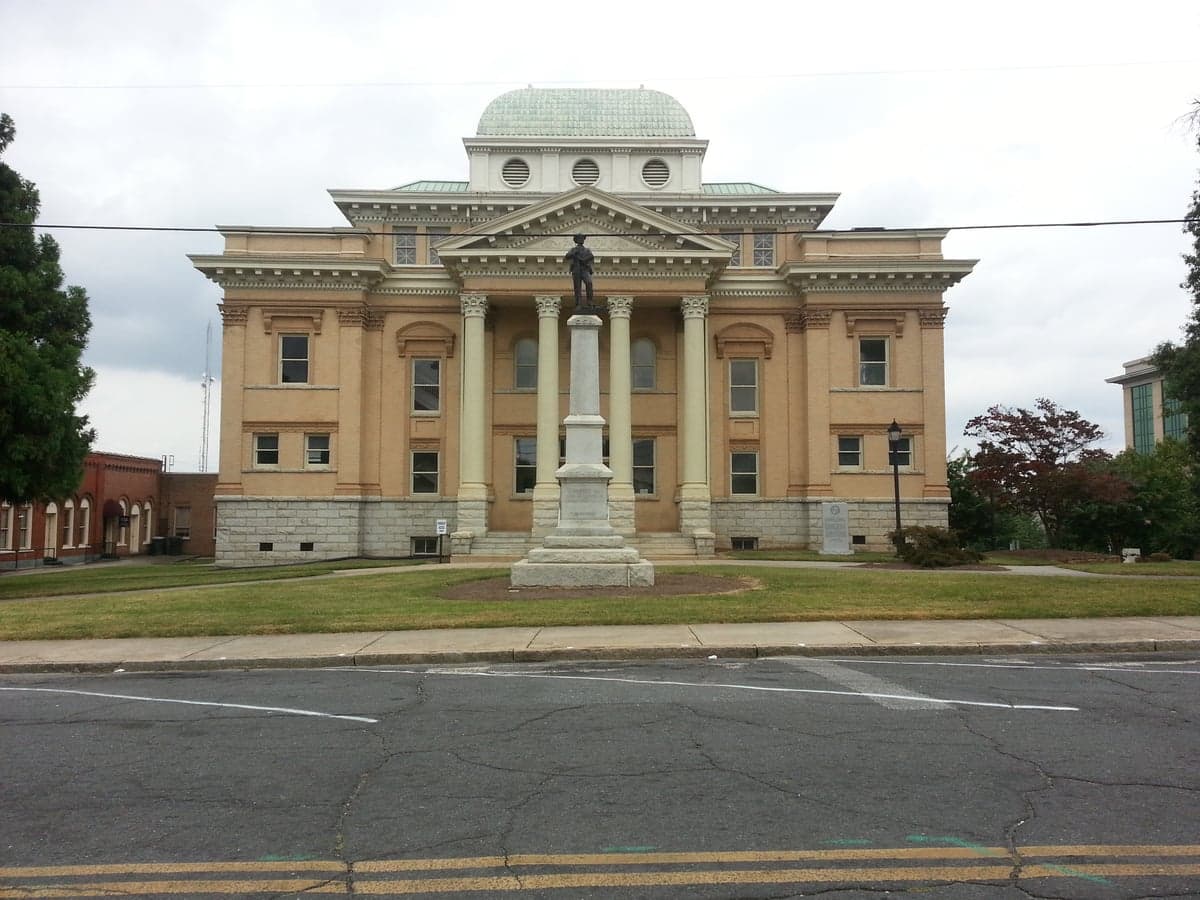
Photo: Wikipedia
Demographics of Randolph County
Affluence Level in Randolph County
A middle-class area roughly in line with national averages across income, home values, education, and employment.
People of Randolph County
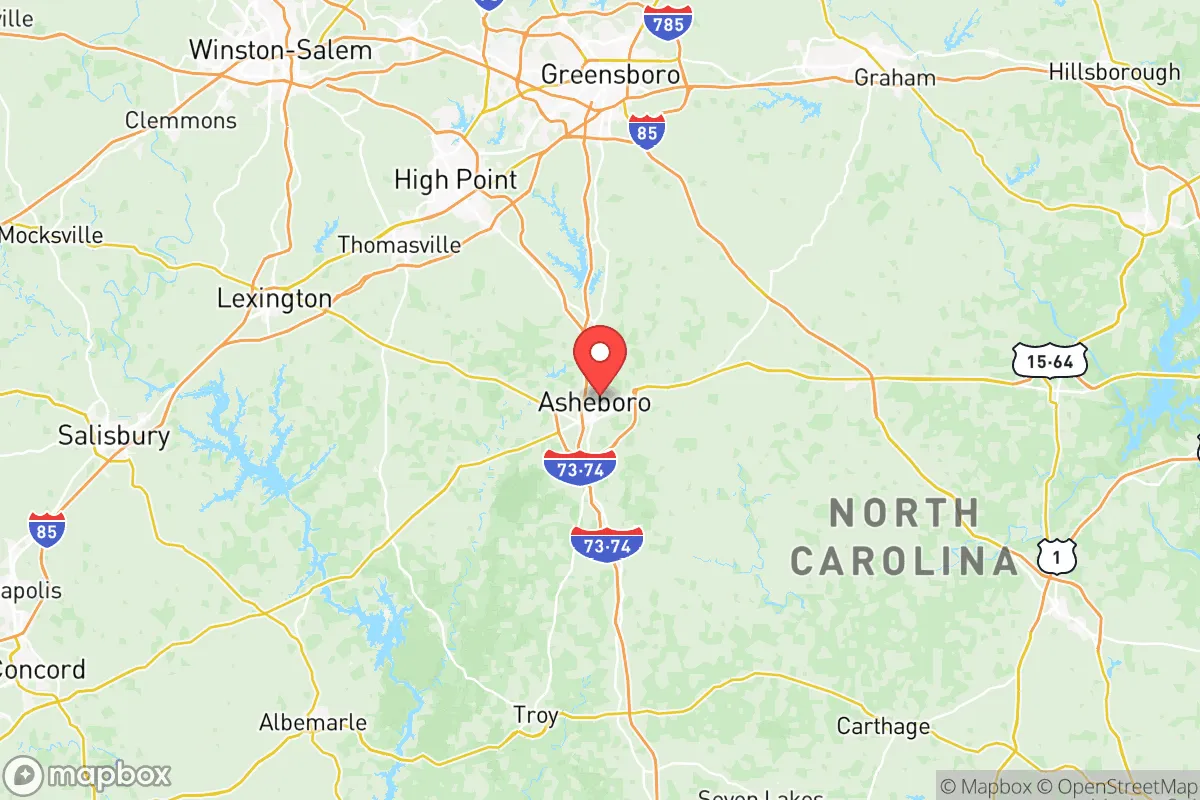
Randolph County, North Carolina, is home to 145,322 residents who reflect a deeply rooted Southern identity shaped by generations of agricultural life, furniture manufacturing, and a strong tradition of religious conservatism. The population is 75.9% white, 13.6% Hispanic, 5.9% Black, and 0.8% East/Southeast Asian, with a small Indian-subcontinent community at 0.3% and only 4.7% foreign-born overall. With just 17.6% of adults holding a bachelor's degree or higher, the county remains a working-class stronghold where family ties, church attendance, and local manufacturing still define daily life. The county seat of Asheboro anchors the region, while the towns of Archdale, Trinity, Randleman, Liberty, and Franklinville each carry distinct settlement histories that continue to shape their character today.
Settlement & growth (pre-1960)
Long before European settlers arrived, the land that became Randolph County was part of the vast territory of the Keyauwee and Saura peoples, Siouan-speaking tribes who lived along the Uwharrie River and its tributaries. By the early 1700s, disease and displacement from colonial expansion had largely emptied the region, leaving a sparsely populated frontier that attracted the first wave of European migrants. The county itself was formed in 1779 from Guilford County, named after Peyton Randolph, the first President of the Continental Congress, and its early population was overwhelmingly of English, Scots-Irish, and German descent.
The first major wave of settlers arrived between 1750 and 1790, primarily Scots-Irish Presbyterians and German Lutherans pushing south and west from Pennsylvania and Virginia along the Great Wagon Road. These families were drawn by the promise of cheap, fertile land in the Piedmont's rolling hills, and they established small farms and crossroads communities that would become the towns of Asheboro (founded 1796 as the county seat), Liberty (settled in the 1780s), and Franklinville (originally called "Franklin's Mills" after a local gristmill). The German influence remains visible today in the Lutheran churches that dot the county's rural landscape, particularly around the Trinity area, which was named for the German Evangelical Trinity Church founded there in 1752.
The Quaker community also played an outsize role in Randolph County's early history. English Quakers from Nantucket and Pennsylvania settled around what is now Randleman and New Salem in the late 1700s, establishing a pacifist tradition that made the county a notable center of abolitionist sentiment before the Civil War. The Quaker influence is still felt in the county's historic Underground Railroad sites and in the quiet, self-reliant character of the rural communities south of Asheboro. After the Civil War, the county's Black population grew modestly as freedmen and their families settled in small enclaves near Asheboro and Randleman, working as sharecroppers and later as laborers in the emerging furniture mills.
The industrial transformation of Randolph County began in earnest around 1900, when the furniture and textile industries exploded across the North Carolina Piedmont. The town of Archdale, originally called "Bush Creek," was renamed in 1885 after a Quaker minister and grew rapidly as a railroad hub for the region's furniture factories. Trinity became home to the Acme-McCrary Hosiery Mills, one of the largest textile operations in the state, drawing workers from the surrounding countryside and from neighboring counties. This industrial boom pulled in a new wave of domestic migrants: white farm families from the North Carolina mountains and foothills who left subsistence agriculture for steady mill wages, as well as a smaller number of Black workers who found employment in the county's furniture plants. By 1950, Randolph County's population had reached roughly 50,000, with Asheboro, Archdale, and Trinity emerging as the primary population centers.
Modern era (post-1965)
The 1965 Hart-Cellar Act had a relatively muted effect on Randolph County compared to urban areas of North Carolina, but it did set the stage for the county's most significant demographic shift of the late 20th century: the arrival of Hispanic immigrants. Beginning in the 1980s and accelerating through the 1990s, Mexican and Central American workers came to fill labor shortages in the county's poultry processing plants, furniture factories, and agricultural operations. The town of Asheboro became the primary destination, with a growing Hispanic neighborhood emerging along the Fayetteville Street corridor and around the industrial parks on the city's south side. Archdale and Randleman also saw smaller but steady Hispanic settlement, particularly in mobile home parks and rental housing near the major manufacturing employers.
By 2020, the Hispanic share of Randolph County's population had reached 13.6%, making it the largest minority group and the primary driver of the county's population growth over the past three decades. This wave has been almost entirely domestic in origin — the foreign-born share of the county remains low at 4.7% — as many Hispanic residents are U.S.-born children of earlier immigrants or migrants from other parts of North Carolina. The county's Black population, by contrast, has remained relatively stable at 5.9%, concentrated in historic neighborhoods in Asheboro and in the rural communities south of the city. The East/Southeast Asian community (0.8%) and Indian-subcontinent community (0.3%) are very small, mostly consisting of professionals employed at the county's hospitals and manufacturing management offices in Asheboro and Archdale.
The post-1965 period also saw the beginning of suburban spillover from the Piedmont Triad metro area. As Greensboro and High Point expanded southward, bedroom communities like Trinity and Archdale began attracting white middle-class families seeking lower taxes, larger lots, and a more conservative political environment. This domestic migration from the north has accelerated since 2010, with new subdivisions sprouting along the U.S. 311 corridor and around the Randolph County line near High Point. The county's population grew by roughly 8% between 2010 and 2020, with most of that growth concentrated in the northern towns closest to the Triad.
The future
Randolph County is projected to continue growing at a moderate pace over the next 10-20 years, driven primarily by two forces: continued Hispanic population growth through natural increase and domestic migration, and white suburban spillover from the Greensboro-High Point metro area. The Hispanic share of the population is likely to rise from 13.6% toward 18-20% by 2040, particularly in Asheboro and the southern half of the county, where housing is more affordable and manufacturing jobs remain available. The white share will continue to decline gradually, though the county will remain majority white and culturally conservative for the foreseeable future.
The most significant demographic wild card is the potential for accelerated suburbanization along the U.S. 311 and I-73/I-74 corridors. If the Triad's job growth continues and housing prices in Guilford County push further upward, Randolph County could see a wave of middle-class families — including a small but growing number of Black and Asian professionals — moving into new subdivisions around Trinity, Archdale, and northern Asheboro. This would slowly diversify the county's northern tier while leaving the rural southern and eastern parts of the county, including Liberty and Franklinville, more demographically stable and predominantly white.
The county's cultural identity is likely to remain a blend of traditional Southern conservatism and a growing Hispanic influence, particularly in Asheboro, where bilingual services, Hispanic-owned businesses, and Catholic congregations are becoming more visible. The furniture and textile industries that once defined the county's economy have largely moved offshore, but the manufacturing tradition persists in newer sectors like aviation components and food processing, which continue to attract working-class families of all backgrounds. The low college attainment rate (17.6%) suggests that the county will remain a blue-collar community, with economic opportunity tied more to skilled trades and manufacturing than to the knowledge economy.
For someone moving to Randolph County today, the reality is a place in gradual transition: still overwhelmingly white and culturally conservative, but with a growing Hispanic presence that is reshaping Asheboro and the southern towns. The northern communities of Trinity and Archdale are becoming more suburban and connected to the Triad, while Liberty, Randleman, and Franklinville remain quieter, more rural, and more resistant to change. The county offers affordable housing, low taxes, and a strong sense of community for those who value those things, but it is not a place of rapid diversification or urban energy — it is a working-class Piedmont county finding its way through the slow demographic currents of the 21st century.

* Values derived from national, state, county, city and local statistics and may differ in a specific area. Last updated: 2026-07-05T08:05:22.000Z
Narrative content on this page is AI-generated and may contain mistakes. Verify any details that matter before acting on them.
ReloMaps may earn a commission from affiliate links at no extra cost to you.

