Photo: Wikipedia
Political ClimatePolitical Climate in New Hanover County
Showing district-level results — no local-only data available.
Local Political AnalysisPolitical Analysis of New Hanover County
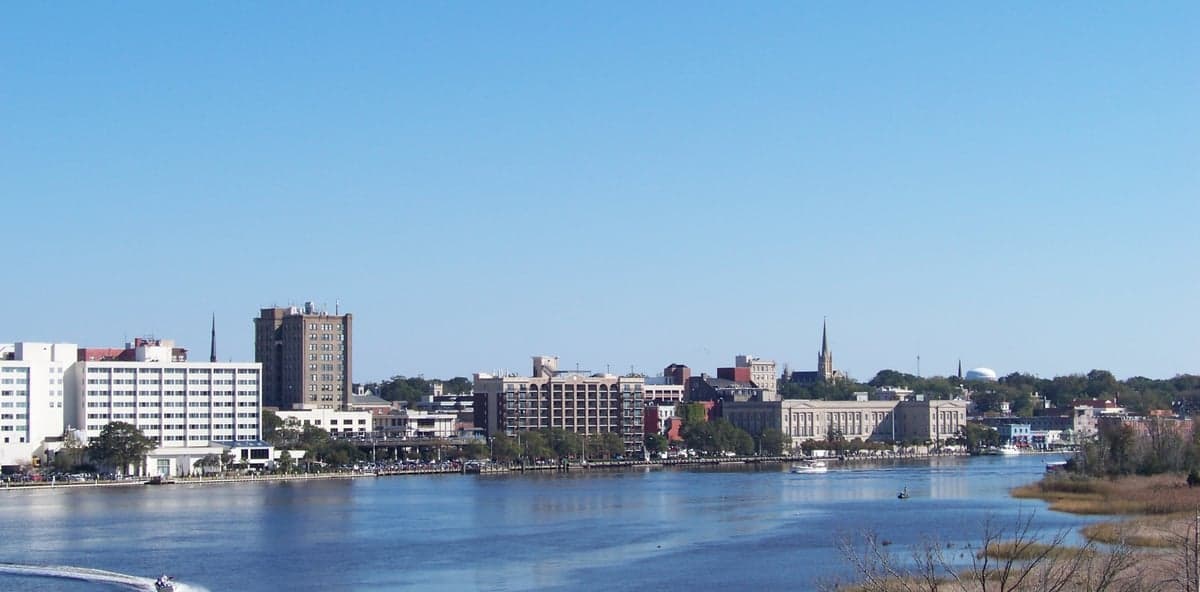
New Hanover County has shifted noticeably to the right over the past decade, settling into a solidly Republican lean with a Cook PVI of R+7. That’s a full six points more conservative than North Carolina as a whole, which sits at R+1. The county hasn’t voted for a Democratic presidential candidate since 2008, when Barack Obama narrowly carried it, and the margin has widened in every election since — Donald Trump won it by 12 points in 2020 and by roughly 14 points in 2024. But the county is far from a monolith. Wilmington, the county seat and largest city, is the main blue dot, with its downtown and historic districts consistently voting Democratic. The more suburban and rural areas — Landfall, Ogden, and the fast-growing northern end around Castle Hayne — lean heavily red. The swing precincts are in the mid-county corridor along Market Street and around the University of North Carolina Wilmington (UNCW), where student turnout can tip local races by a few points in either direction.
How it compares to North Carolina as a whole
Statewide, North Carolina is a classic purple battleground, with a Cook PVI of R+1 and elections decided by razor-thin margins — Trump won the state by just 1.3 points in 2024. New Hanover County is significantly more Republican than the state average, but it’s not an outlier. It sits in the same conservative coastal corridor as Brunswick (R+11) and Pender (R+14) counties, forming a reliably red bloc from the South Carolina line up to Jacksonville. What sets New Hanover apart is its urban core. Wilmington’s left-leaning precincts produce enough Democratic votes to keep the county from flipping as deep red as its neighbors, but not enough to make it competitive at the presidential level. In state legislative races, the county’s state House and Senate seats are all held by Republicans, and the county commission has a 4-1 Republican majority as of 2025. That’s a sharper partisan tilt than you’d see in Wake or Mecklenburg counties, but it’s milder than the rural eastern counties.
What this means for residents
For conservative residents, the political climate is comfortable. Local government is reliably Republican, tax policy leans pro-business, and the county has been aggressive in limiting new residential density — a stance that resonates with voters who want to slow growth. For liberal residents, the picture is more mixed. Wilmington’s city council is nonpartisan but leans progressive on issues like affordable housing and environmental protection, so there’s a local outlet for Democratic priorities. But county-level decisions — on school funding, land use, and public health mandates — often frustrate progressive voters. The practical effect is that political engagement in New Hanover tends to be hyperlocal. Turnout in municipal elections is high for a county this size, and precinct-level organizing is active on both sides.
Culturally, the county’s politics show up in a few distinct ways. The growth debate is the dominant local issue: the population has swelled by roughly 15% since 2020, and the tension between development-friendly conservatives and slow-growth conservatives (and the environmentalist left) cuts across party lines. Gun policy is another marker — the county is a Second Amendment sanctuary, and open carry is common in rural areas, though Wilmington has stricter local ordinances on concealed carry in parks. Socially, the county is more traditional than the state’s urban centers but less rigid than the inland rural counties. You’ll find a visible LGBTQ+ community in Wilmington, a handful of progressive churches, and a growing Hispanic population that’s beginning to shift precinct demographics in the southern part of the county. The long-term trajectory points toward a slow purple shift as Wilmington expands and attracts younger, more diverse residents, but for the foreseeable future, New Hanover County remains a solidly Republican stronghold with a blue urban core.

State Political ClimatePolitical Climate in North Carolina
State Political AnalysisPolitical Environment in the State
North Carolina is the quintessential swing state in 2026, with a Cook Partisan Voting Index of R+1 that barely hints at the internal tension pulling it in opposite directions. Over the past 20 years, the state has shifted from a reliably Republican stronghold in presidential elections to a true battleground, driven by explosive growth in the Research Triangle and Charlotte metros that has flooded the electorate with out-of-state transplants. The result is a state that votes for Donald Trump by a whisper-thin margin in 2024 while simultaneously electing a Democratic governor, attorney general, and council of state, creating a political environment where neither side can fully dominate and every policy fight is a knife fight.
Urban vs. rural divide
The political map of North Carolina is a textbook study in geographic polarization. The urban crescent stretching from Charlotte through the Piedmont Triad (Greensboro, Winston-Salem, High Point) to the Research Triangle (Raleigh, Durham, Chapel Hill) is the engine of Democratic growth. Mecklenburg County (Charlotte) and Wake County (Raleigh) alone now cast roughly a quarter of all votes in the state, and both have shifted dramatically blue over the past decade as tech and finance workers poured in. Durham is the most reliably liberal city in the South, while Chapel Hill is a classic college-town stronghold. Meanwhile, the rural east — places like Robeson County and the old textile towns along I-95 — and the rural west, including the mountain counties around Asheville's exurbs, remain deeply Republican. The suburbs are the true battleground: Union County (southeast of Charlotte) and Johnston County (southeast of Raleigh) are rapidly growing and trending right, while Orange County and Buncombe County (Asheville) are solidly blue. The state's 16 electoral votes will likely remain competitive for the foreseeable future, but the demographic tide favors Democrats in presidential years and Republicans in midterms.
Policy environment
North Carolina operates under a divided government that produces a moderate-to-conservative policy environment tempered by the governor's veto pen. The state has a flat income tax rate that was cut to 4.5% in 2024 and is scheduled to decline further to 3.99% by 2027, making it increasingly attractive for high-earners relocating from high-tax states. The corporate income tax is being phased out entirely by 2030. There is no state property tax — that's levied at the county level — and the state sales tax is 4.75%, with local options pushing it to around 7% in most areas. Education policy is a major flashpoint: the state has one of the strongest school choice programs in the nation, with universal private school vouchers (the Opportunity Scholarship Program) expanded in 2023 to all families regardless of income, while traditional public schools remain underfunded relative to national averages. Healthcare is a mixed bag — the state expanded Medicaid in 2023 under a bipartisan deal, adding roughly 600,000 low-income adults to the rolls, but certificate-of-need laws still restrict hospital and clinic construction, keeping healthcare costs higher than in deregulated states. Election laws are moderately restrictive: voter ID is required (implemented in 2023 after years of litigation), early voting is generous at 17 days, and same-day registration is available during early voting but not on Election Day.
Recent policy direction
The last three years have seen North Carolina lurch rightward on cultural and regulatory issues while maintaining a pragmatic center on economics. The 2023 session produced a 12-week abortion ban that replaced the previous 20-week limit, with exceptions for rape, incest, and life of the mother — a significant shift that has made the state a destination for abortion access from the South while also driving some progressive relocators to reconsider. Gun laws remain among the most permissive in the country: permitless carry (constitutional carry) was enacted in 2023, and the state preempts all local gun ordinances, meaning cities like Raleigh and Charlotte cannot enact their own restrictions. The Parents' Bill of Rights, passed in 2023, requires schools to notify parents of any changes to a student's health or well-being and restricts instruction on gender identity and sexuality in K-4 classrooms. Property rights are strongly protected — North Carolina is a "Dillon's Rule" state for counties but grants broad authority to cities, and there is no statewide rent control preemption because rent control is already banned by statute. On privacy and surveillance, the state has no comprehensive data privacy law, though a bill is under consideration in 2025. Voting access has been a perennial battleground: the 2023 omnibus election law shortened the mail-in ballot return window and expanded voter ID requirements, but the state still ranks in the middle of the pack nationally for ease of voting.
Civil unrest & political movements
North Carolina has a long history of political activism that remains visible today. The Moral Monday movement, launched in 2013 by the NAACP, continues to organize around voting rights, education funding, and criminal justice reform, with regular protests at the General Assembly in Raleigh. The 2020 protests following George Floyd's murder were particularly intense in Charlotte and Durham, where statues were toppled and property damage occurred, leading to ongoing debates about policing and public safety. On the right, the state has seen a surge in county-level activism around election integrity, with several rural counties passing resolutions calling for hand-counting of ballots or questioning electronic voting machines — though none have been implemented. Immigration politics are relatively muted compared to border states: North Carolina has no sanctuary cities, and the 2023 budget included funding for additional ICE cooperation, but the state's growing Latino population (now over 10% of residents) has made immigration a quieter issue than in Texas or Arizona. There is no serious secession or nullification movement, though some rural counties have passed Second Amendment sanctuary resolutions. The most visible flashpoint for a new resident would be the constant presence of political yard signs and the intensity of local school board races, which have become proxy wars over curriculum and parental rights.
Projection
Over the next 5-10 years, North Carolina will likely remain a competitive swing state with a slight rightward tilt on cultural issues and a leftward drift on demographics. The in-migration pattern — roughly 100,000 new residents per year, mostly from New York, New Jersey, California, and Florida — is politically mixed: the tech workers moving to the Triangle tend to be moderate-to-liberal, while the retirees and remote workers settling in the mountains and coastal areas lean conservative. The state's Republican-controlled General Assembly is likely to continue pushing on school choice, tax cuts, and cultural legislation, while the Democratic governor's office will remain a check on the most aggressive proposals. The wild card is the 2030 redistricting cycle: if Republicans maintain control of the legislature, they will draw congressional maps that could lock in a 10-4 or 11-3 Republican advantage in the U.S. House, even as the state's overall partisan balance remains near 50-50. For a new resident, the practical implication is that North Carolina will not swing dramatically in either direction — it will remain a place where your experience depends heavily on which county you live in, with deep-blue cities offering a progressive enclave and red-leaning suburbs and rural areas providing a conservative haven, all under a state government that leans center-right on economics and culturally conservative on social issues.
For someone moving to North Carolina in 2026, the bottom line is that you are choosing a state where your day-to-day political reality is determined more by your zip code than by the governor's mansion. If you are conservative, you will find a welcoming policy environment at the state level — low taxes, strong gun rights, school choice, and parental control in education — but you will need to accept that your neighbors in the cities will vote differently and that the state will never be a deep-red Texas or Florida. If you are liberal, you will find vibrant progressive communities in Durham, Chapel Hill, Asheville, and parts of Charlotte and Raleigh, but you will be living under a state government that is actively hostile to many of your priorities on abortion, guns, and education. The state's famous "North Carolina nice" extends to politics — people are generally civil, and the constant competition between the two sides keeps extremism in check. You will not find the culture war intensity of a state like Florida or the monolithic conservatism of a state like Alabama. What you will find is a state that is genuinely contested, where your vote matters, and where the outcome of every election is genuinely uncertain.
* Values derived from national, state, county, city and local statistics and may differ in a specific area. Last updated: 2026-07-02T17:24:37.000Z
Narrative content on this page is AI-generated and may contain mistakes. Verify any details that matter before acting on them.
ReloMaps may earn a commission from affiliate links at no extra cost to you.

