
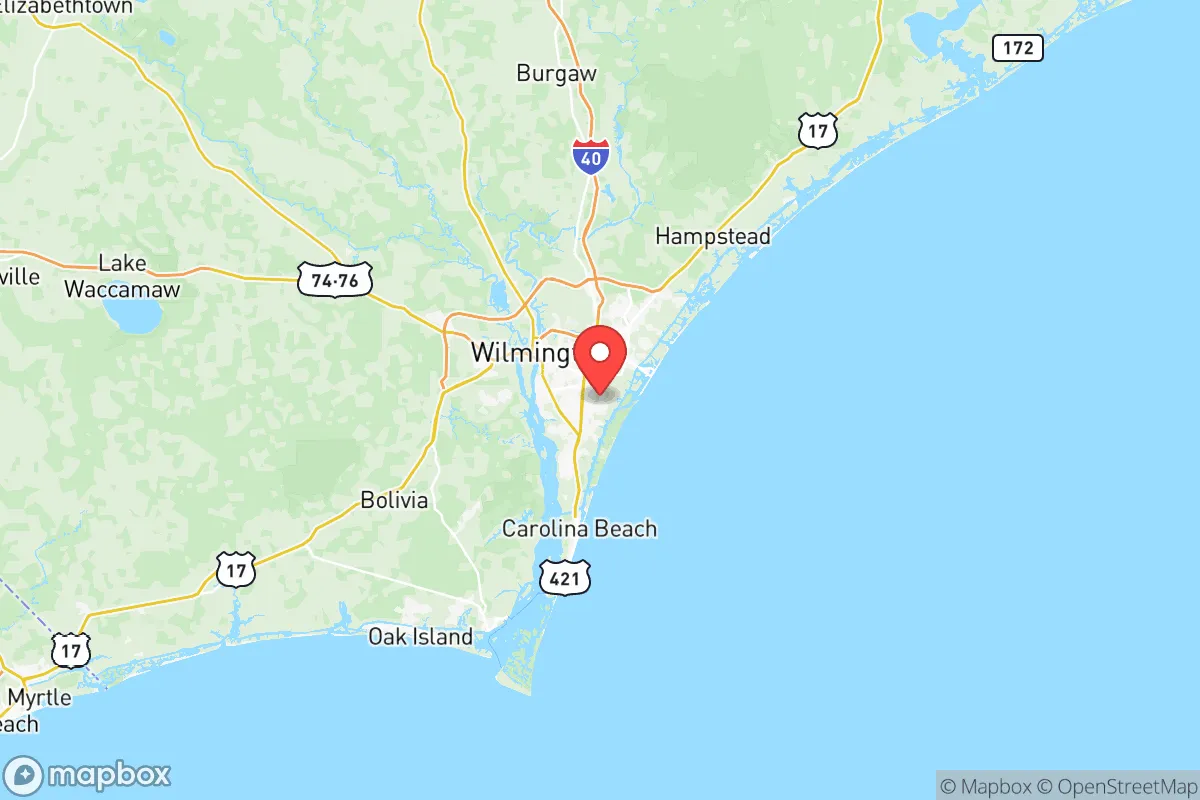
Photo: Wikipedia
Personal Sovereignty in New Hanover County
Viable for self-reliance. Generally workable, though some barriers may limit total independence.
What does Personal Sovereignty tell us?
Personal Sovereignty measures your capacity for self-reliance and independence with minimal government friction. Higher scores mean fewer barriers between you and the way you want to live... but it assumes you have the space you need and good neighbors.
What does this tell us?
Personal Sovereignty measures your capacity for self-reliance and independence with minimal government friction. Higher scores mean fewer barriers between you and the way you want to live... but it assumes you have the space you need and good neighbors.
State Policy
Energy independence: Importer (15% of energy produced in-state)
Personal Liberty
Homesteading

Personal Liberty Analysis
New Hanover County, anchored by Wilmington, presents a nuanced personal sovereignty environment where state-level protections for gun rights and property rights coexist with a moderately active local regulatory apparatus, particularly within the city limits. For individuals and families prioritizing autonomy, the county offers a meaningful degree of self-determination, though the experience varies sharply between the urbanized coastal areas and the more rural western and northern reaches. The balance of power leans toward individual liberty on core constitutional issues, but local zoning and development codes impose real constraints on how that liberty can be exercised, especially regarding land use and housing.
Tax burden and regulatory posture in New Hanover County
North Carolina's state-level framework provides a favorable baseline for personal sovereignty. The state's flat income tax rate of 4.5% and a maximum corporate tax rate of 2.5% are among the lowest in the Southeast, and there is no state-level property tax on intangible personal property. New Hanover County's property tax rate for fiscal year 2025-2026 is approximately $0.5325 per $100 of assessed value, which is moderate for the region but higher than in neighboring Pender County ($0.575) and significantly higher than in rural Columbus County. The county also levies a local sales tax of 2.25% on top of the state's 4.75%, bringing the total to 7% in most areas. The regulatory posture is generally business-friendly at the county level, but the City of Wilmington enforces stricter zoning and building codes, particularly in the historic district and along the Cape Fear River. For a reader seeking minimal government interference, the unincorporated areas of Castle Hayne and Murraysville offer a lighter touch than the city core, with fewer permitting hurdles for home-based businesses and accessory structures.
Self-defense and gun law specifics in the area
North Carolina is a "shall-issue" state for concealed carry permits, and New Hanover County reflects that commitment to the Second Amendment. The sheriff's office processes permits efficiently, with typical wait times under 90 days for qualified applicants. The state does not require a permit to purchase a rifle or shotgun, and private firearm sales between individuals are legal without a background check. Open carry of handguns is legal without a permit for anyone who can legally possess a firearm. The county has no local ordinances that restrict firearm possession beyond state law, meaning no additional waiting periods or magazine capacity bans. Shooting ranges are available in the area, including the New Hanover County Sheriff's Office Public Shooting Range on Castle Hayne Road, which is open to the public. Stand-your-ground laws apply statewide, and there is no duty to retreat in any place where the individual has a lawful right to be. For those living in Carolina Beach or Kure Beach, the same state-level protections apply, though discharging a firearm within town limits is generally prohibited except at designated ranges.
Self-reliance and homesteading viability across the county
Homesteading and off-grid living are feasible in New Hanover County, but the degree of feasibility depends heavily on location. The county's minimum lot size in most unincorporated areas is 10,000 square feet for a single-family home on a septic system, which is smaller than the acreage typically associated with serious homesteading. In the more rural western sections near Rocky Point and Currie, larger parcels of 1 to 5 acres are available, and the county does not prohibit keeping chickens, goats, or bees on residential lots, though specific setback requirements apply. Rainwater collection is legal and encouraged, but the county requires a permit for any system that supplies potable water to a dwelling. Solar panel installation is permitted without special county-level restrictions, though homeowners' associations in subdivisions like Landfall and Porters Neck may impose aesthetic covenants that limit visibility. Off-grid living in the sense of disconnecting entirely from the electrical grid is legal, but the county's building code requires a minimum standard of sanitation and structural safety, so a completely unpermitted dwelling is not feasible. For the most permissive environment, look to the Scotts Hill area near the Pender County line, where zoning is less restrictive and larger agricultural parcels are more common.
Personal liberties in daily life: parental rights, medical autonomy, and property
North Carolina has strong statutory protections for parental rights, including a Parents' Bill of Rights enacted in 2023 that requires school districts to notify parents of medical services offered at school and to obtain consent before administering any non-emergency health care. New Hanover County Schools have complied with these requirements, and parental involvement in curriculum decisions is generally respected. Medical autonomy is more constrained: the state requires parental consent for minors seeking most medical treatments, including vaccinations and reproductive health services, but does not allow parents to opt out of mandatory school vaccinations on philosophical grounds—only medical or religious exemptions are recognized. Property rights are well-protected under state law, with North Carolina's "right to farm" act shielding agricultural operations from nuisance lawsuits, though this applies more to established farms than to new homesteaders. The county does not have rent control, and short-term rental regulations in Wilmington are moderately restrictive, requiring a permit and limiting the number of rental nights per year. Speech and assembly rights are fully protected under the First Amendment, and the county has no local ordinances that restrict political signage or public gathering beyond standard time, place, and manner regulations.
Overall, New Hanover County offers a solid foundation for personal sovereignty relative to other coastal counties in the Southeast, particularly when compared to the more heavily regulated environments of Charleston County, South Carolina, or the urban centers of the Northeast. The state-level protections for gun rights, parental authority, and low taxation create a favorable baseline, while the local regulatory environment is moderate rather than intrusive. For a reader who values maximum autonomy, the unincorporated areas of Castle Hayne, Rocky Point, and Scotts Hill provide the most breathing room, while the city of Wilmington and the beach towns impose more constraints on land use and daily life. The county is not a libertarian paradise, but it is a place where a self-reliant individual or family can live with a high degree of personal freedom without constant friction with local government.

* Values derived from national, state, county, city and local statistics and may differ in a specific area. Last updated: 2026-07-02T17:24:37.000Z
Narrative content on this page is AI-generated and may contain mistakes. Verify any details that matter before acting on them.
ReloMaps may earn a commission from affiliate links at no extra cost to you.

