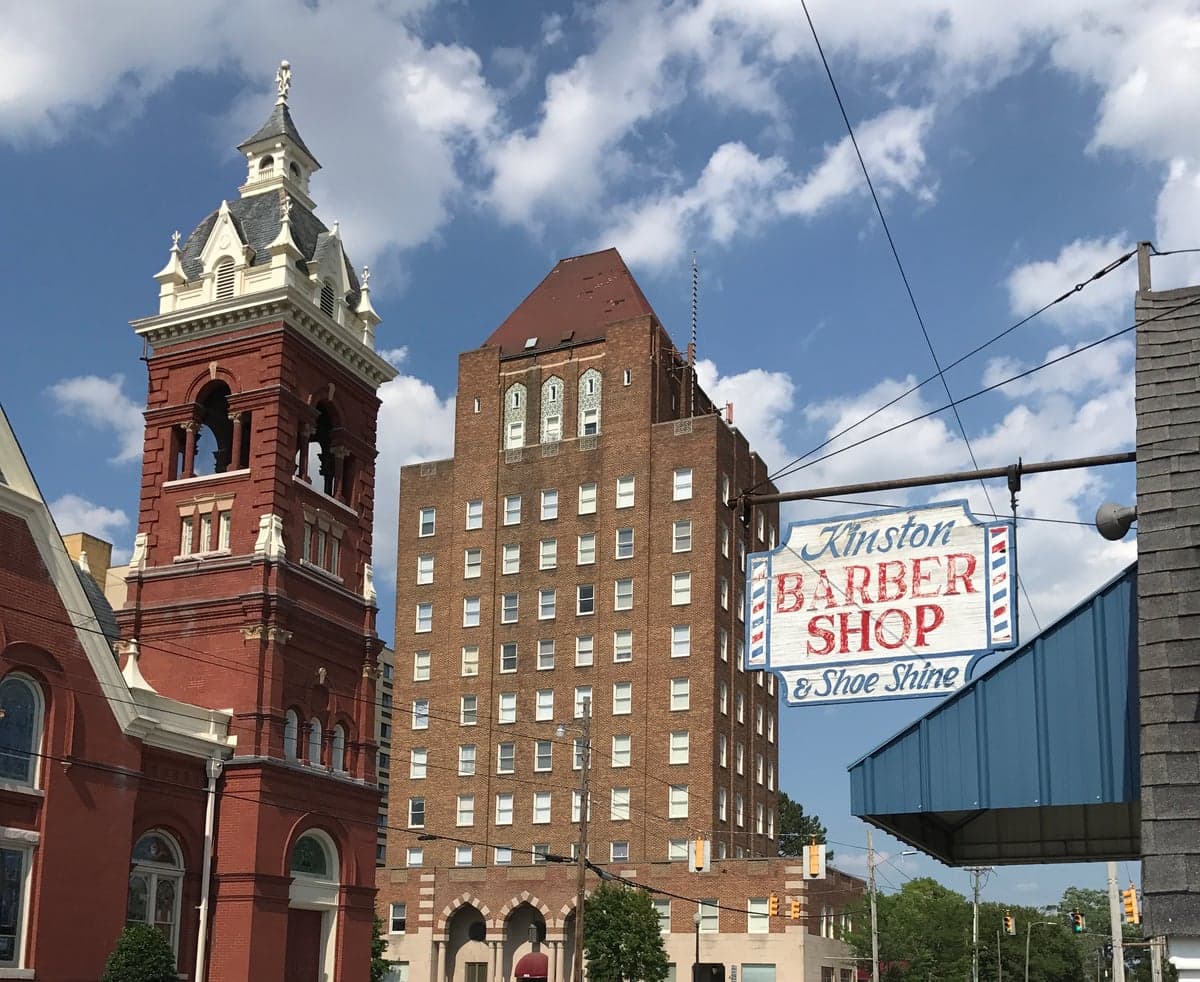
Photo: Wikipedia
Political ClimatePolitical Climate in Kinston, NC
District shown is the primary district for this city’s centroid. Cities may span multiple districts.
Local Political AnalysisPolitical Analysis of Kinston, NC
Kinston and surrounding Lenoir County lean solidly Republican, with a Cook Partisan Voting Index of R+10, meaning the area votes about ten points more conservative than the national average. That’s a stark contrast to the state of North Carolina as a whole, which sits at R+1—a true purple state where elections are often decided by razor-thin margins. In practice, this means Kinston has been a reliable red stronghold for decades, and while the state has swung back and forth between parties in presidential races, Lenoir County has consistently favored GOP candidates by double digits. If you’re moving here from a blue area, you’ll notice the difference quickly; if you’re coming from a deep-red rural county, it’ll feel familiar.
How it compares
To understand Kinston’s political climate, look at its neighbors. Just 30 miles west, Goldsboro (Wayne County) is also R+10, while Greenville (Pitt County) to the north leans R+8—both similarly conservative. But drive 45 minutes south to Wilmington (New Hanover County), and you’ll find a county that’s shifted from red to purple, now R+4, reflecting the coastal growth and influx of retirees and remote workers. The real contrast is with the state’s urban centers: Raleigh (Wake County) is D+16, and Charlotte (Mecklenburg County) is D+14. So Kinston isn’t just redder than the state average—it’s a world apart from the Research Triangle or the Queen City. Locally, the city itself is more diverse than the surrounding county, with a significant African American population (roughly 65% of Kinston residents), which means Democratic candidates can win the city limits while losing the county by wide margins. In the 2024 presidential race, Lenoir County went for Trump by about 25 points, while the state overall was decided by less than 3 points.
What this means for residents
For conservative residents, Kinston’s lean means local elections are rarely competitive in the GOP primary, and policy tends to reflect traditional values: lower taxes, limited government, and a strong focus on agriculture and small business. The city council and county commission are dominated by Republicans, so zoning, school funding, and economic development decisions generally align with conservative priorities. For liberal residents, it can feel isolating—there’s no active Democratic Party infrastructure in the county, and progressive candidates rarely bother campaigning here. That said, Kinston is not a place of open hostility; people are polite and neighborly across party lines, and the biggest political fights tend to be about local issues like the future of the former DuPont plant site or the struggling downtown revitalization. Statewide issues like abortion or gun rights are discussed but rarely dominate local conversation the way they do in Raleigh or Charlotte.
One cultural distinction worth noting: Kinston has a strong sense of community identity that transcends politics. The city’s revival efforts—like the Mother Earth Brewing taproom, the CSS Neuse Civil War museum, and the annual BBQ festival—draw people from both sides of the aisle. You won’t see many yard signs for local races, but you will see a shared pride in the area’s history and a pragmatic, “let’s get things done” attitude. The long-term trajectory is likely to stay red, as the county’s population is aging and not attracting the kind of young, diverse influx that’s shifting places like Wilmington or Asheville. If you’re conservative, you’ll feel right at home; if you’re liberal, you’ll find your voice is quieter here, but not silenced. It’s a place where politics takes a backseat to knowing your neighbors and supporting the local high school football team on Friday nights.

State Political ClimatePolitical Climate in North Carolina
State Political AnalysisPolitical Environment in the State
North Carolina is a classic purple state that has been trending rightward in recent cycles, with a Cook PVI of R+1 that undersells just how competitive it remains at the top of the ticket. The state voted for Donald Trump in 2024 by a margin of roughly 1.5 points, continuing a pattern where no Democrat has won the presidential vote here since Barack Obama in 2008. Over the past 10-20 years, the dominant coalition has been a mix of rural conservatives, suburban moderates, and a growing population of transplants from the Northeast and Midwest who often bring more conservative fiscal views but socially moderate leanings. The state legislature has been firmly Republican since 2011, and the GOP holds a supermajority in both chambers as of 2025, giving them the ability to override gubernatorial vetoes. That said, the governor’s mansion has been held by Democrats since 2017, creating a persistent tug-of-war that defines much of the state’s policy landscape.
Urban vs. rural divide
The political map of North Carolina is a textbook study in geographic polarization. The major urban centers—Charlotte (Mecklenburg County), Raleigh and Durham (Wake and Durham Counties), and Greensboro and Winston-Salem (Guilford and Forsyth Counties)—are solidly Democratic, often delivering 60-70% of the vote for Democratic candidates. These metros are driven by a mix of university populations, tech and finance workers, and a growing number of out-of-state transplants. In contrast, the vast rural and exurban areas—places like Hickory in Catawba County, Fayetteville in Cumberland County (which is more of a military town with a purple tilt), and the northeastern counties along the coast—are deeply Republican. The real battlegrounds are the fast-growing suburban counties that ring the metros: Union County (southeast of Charlotte) flipped from red to deep red, while Wake County itself has become a Democratic stronghold. The Research Triangle area (Raleigh-Durham-Chapel Hill) is the state’s most liberal region, with Chapel Hill’s Orange County regularly voting 80%+ Democratic. Meanwhile, the western mountain counties like Asheville (Buncombe County) are a blue island in a sea of red, with the city itself being a progressive haven while the surrounding rural areas vote heavily Republican.
Policy environment
North Carolina’s policy environment is a study in divided government. The state has a flat income tax rate of 4.5% as of 2025, down from a progressive rate of 7% in 2013, with further cuts scheduled to bring it to 3.99% by 2027. The corporate tax rate is 2.5%, among the lowest in the nation. There is no state-level sales tax on groceries or prescription drugs, but local option sales taxes can push the total to 7.5% in some counties. Education policy is a major flashpoint: the state has a robust school choice program, including the Opportunity Scholarship Program, which provides vouchers for private school tuition, and charter schools are plentiful. The state also has a controversial “Parents’ Bill of Rights” (HB 755, passed in 2023) that requires schools to notify parents of any changes to a student’s health or well-being, including gender identity. Healthcare is a mixed bag: the state expanded Medicaid in 2023 under a bipartisan deal, covering roughly 600,000 additional low-income adults, but the expansion came with work requirements for able-bodied adults. Election laws have been tightened: voter ID is required (SB 824, 2018), early voting has been reduced from 17 to 10 days in some counties, and same-day registration is not allowed. The state also has a strict 9 p.m. curfew on Election Day for mail-in ballots to be received.
Recent policy direction
Over the past five years, North Carolina has moved decisively in a conservative direction on several fronts. Gun and self-defense law: the state is a “shall-issue” state for concealed carry permits, and in 2023, the legislature passed HB 48, which eliminated the requirement for a permit to purchase a handgun (permitless purchase). Open carry is legal without a permit for anyone 18 or older. Parental and education rights: the 2023 Parents’ Bill of Rights (HB 755) requires schools to adopt policies on parental notification for any changes in a student’s health or well-being, and it bans instruction on gender identity and sexual orientation in K-4 classrooms (the “Don’t Say Gay” law). Speech and privacy: the state has no broad shield law for journalists, but it does have a strong anti-SLAPP statute. There is no state-level data privacy law akin to California’s, though a bill (HB 982) is pending. Medical and bodily autonomy: abortion is legal up to 12 weeks of pregnancy (as of 2023’s SB 20), with a 72-hour waiting period and mandatory counseling. After 12 weeks, it is only allowed in cases of rape, incest, or life endangerment. The state has a 20-week ban on abortion for sex-selection or genetic anomaly reasons. Property rights: the state has a strong “right to farm” law that protects agricultural operations from nuisance lawsuits, and it is a “Dillon’s Rule” state, meaning local governments only have powers explicitly granted by the state. Taxation: as noted, the flat income tax is being phased down, and there is no estate tax. Voting and ballot access: voter ID is in effect, and the state has a strict photo ID requirement. Early voting is 10 days, and absentee voting requires a witness signature. The state also purges inactive voters from rolls every two years.
Civil unrest & political movements
North Carolina has a history of visible political activism on both sides. The Moral Monday protests, which began in 2013 in Raleigh, were a sustained series of civil disobedience actions against the Republican legislature’s policies on voting rights, education, and healthcare. These have largely subsided but left a legacy of organized progressive activism, particularly around voting rights and abortion access. On the right, the “We the People” movement and local Tea Party groups remain active, particularly in rural counties and in the Charlotte suburbs. Immigration politics are a flashpoint: the state has no “sanctuary city” laws, and in 2015, the legislature passed HB 318, which requires sheriffs to honor ICE detainer requests. Several counties, including Wake and Mecklenburg, have been sued by the state for refusing to fully comply. Election integrity has been a major issue since 2020, with the state’s 2020 election being one of the closest in the nation (Trump won by 1.3 points). The legislature created a bipartisan election integrity committee in 2021, and there have been ongoing disputes over absentee ballot drop boxes and voter ID implementation. The Confederate monument debates in Durham and Chapel Hill in 2017-2018 led to violent clashes, and the state’s 2015 law protecting monuments (HB 2) was partially repealed in 2020. A new resident would notice that political yard signs and bumper stickers are common, and that local news covers state politics heavily.
Projection
Over the next 5-10 years, North Carolina is likely to remain a competitive purple state, but with a slight rightward tilt. The key demographic driver is in-migration: the state is growing by roughly 100,000 people per year, with most new arrivals coming from blue states like New York, California, and New Jersey. However, these transplants are not uniformly liberal—many are retirees or remote workers who are fiscally conservative and socially moderate. The Charlotte and Raleigh metros are growing fastest, and as they become more diverse and educated, they are likely to become more Democratic, but the rural areas are also growing (albeit more slowly) and are becoming more Republican. The state’s legislative maps are gerrymandered to favor Republicans, and the GOP’s supermajority is likely to persist through the 2030 census. Expect continued fights over abortion access (with a potential 6-week ban if the GOP wins the governorship in 2028), further tax cuts, and ongoing battles over school choice and public education funding. The state’s political culture will remain a mix of Southern conservatism and Sun Belt pragmatism, with a growing libertarian streak among younger voters. A new resident moving in now should expect a state where politics is a constant background hum, but where daily life is generally stable and business-friendly.
For a new resident, the bottom line is that North Carolina offers a politically balanced environment where your experience will depend heavily on where you live. If you’re conservative, you’ll find a state government that generally aligns with your views on taxes, guns, and education, and you’ll feel at home in the suburbs and rural areas. If you’re liberal, you’ll find vibrant blue cities and a governor who can veto the worst excesses, but you’ll need to accept that the legislature will continue to push conservative policies. The state’s growth means that political battles will intensify, but the overall quality of life—low taxes, good weather, and a strong economy—tends to keep things civil. Just don’t expect your vote to be taken for granted in either direction.
* Values derived from national, state, county, city and local statistics and may differ in a specific area. Last updated: 2026-11-08T22:29:04.000Z
Narrative content on this page is AI-generated and may contain mistakes. Verify any details that matter before acting on them.
ReloMaps may earn a commission from affiliate links at no extra cost to you.

