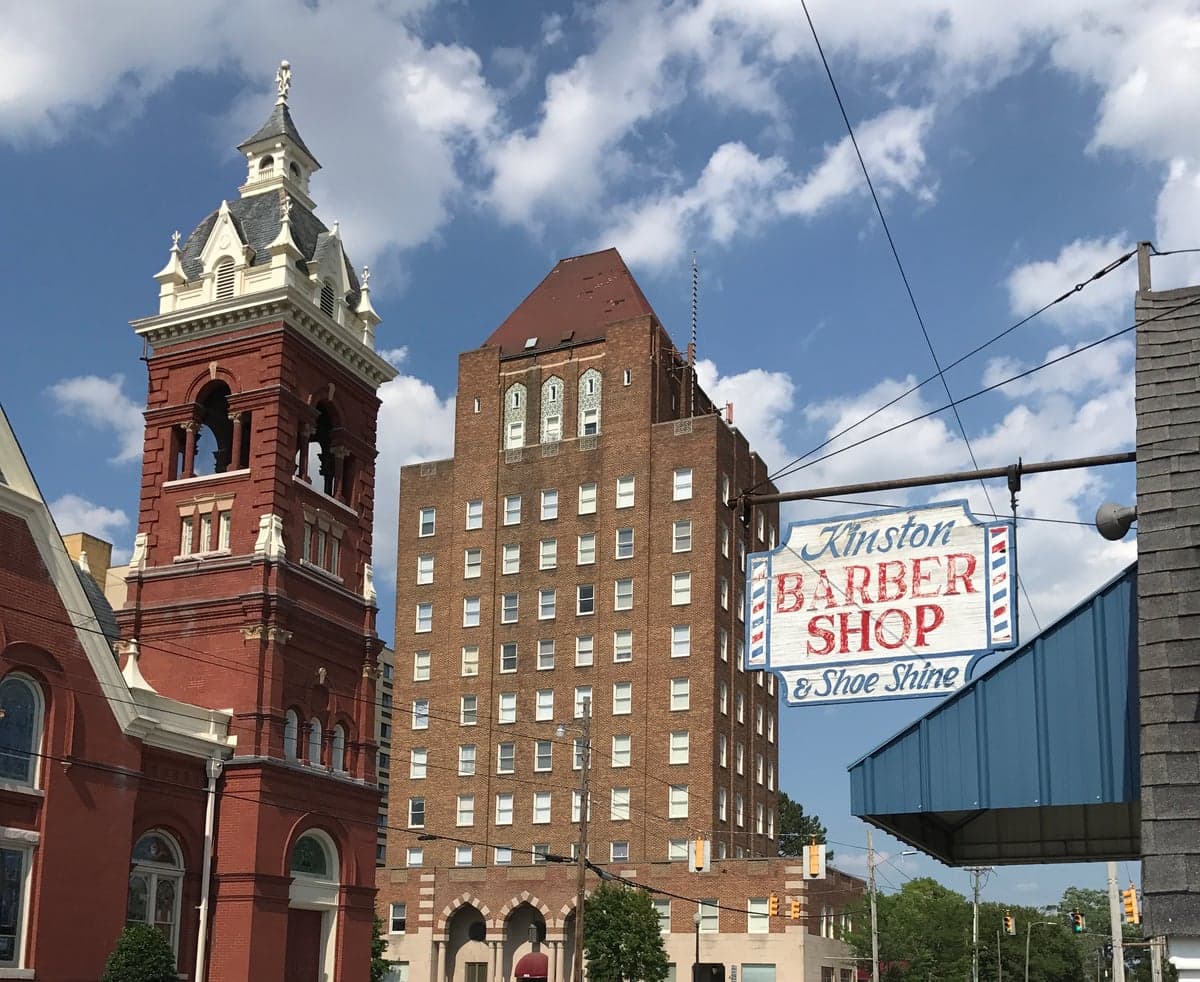
Photo: Wikipedia
Personal Sovereignty in Kinston, NC
Viable for self-reliance. Generally workable, though some barriers may limit total independence.
What does Personal Sovereignty tell us?
Personal Sovereignty measures your capacity for self-reliance and independence with minimal government friction. Higher scores mean fewer barriers between you and the way you want to live... but it assumes you have the space you need and good neighbors.
What does this tell us?
Personal Sovereignty measures your capacity for self-reliance and independence with minimal government friction. Higher scores mean fewer barriers between you and the way you want to live... but it assumes you have the space you need and good neighbors.
State Policy
Energy independence: Importer (24% of energy produced in-state)
Personal Liberty
Homesteading

Personal Liberty Analysis
Kinston, North Carolina, offers a personal sovereignty environment shaped by a blend of state-level preemption laws and local economic realities, creating a landscape where individual autonomy is generally respected but constrained by the area's post-industrial challenges. As a small city in Lenoir County, Kinston sits within a state that has moved decisively toward limiting local government overreach in several key areas, including firearms regulation and property rights, while maintaining a relatively low tax burden compared to the national average. For a relocation reader prioritizing personal freedom, Kinston presents a mixed picture: strong legal protections for self-defense and parental rights coexist with a local economy that limits the practical scope of self-reliance, making it a viable but not exceptional choice for those seeking maximum independence.
Tax burden and regulatory posture in Lenoir County
North Carolina's tax structure is moderately favorable for personal sovereignty, with a flat state income tax rate of 4.75% as of 2026 and no state-level tax on Social Security benefits. Kinston residents face a combined state and local sales tax rate of 7%, which is slightly above the national median but typical for the region. Property taxes in Lenoir County are assessed at a rate of approximately $0.82 per $100 of valuation, meaning a $150,000 home carries an annual tax bill of roughly $1,230—well below the national average. The regulatory posture in Kinston is light-touch for most personal activities: there are no county-level business license requirements for home-based enterprises, and zoning ordinances in the city limits are generally permissive for small-scale operations like gardening, small animal husbandry, and home-based services. However, the state's building codes and environmental regulations (particularly regarding septic systems and well water) are enforced uniformly, which can add cost and complexity for those seeking fully off-grid living. The overall tax and regulatory environment in Kinston is best described as moderately light, with the state's preemption laws preventing local governments from enacting more restrictive measures on issues like firearms and short-term rentals, though the city's own ordinances on noise, property maintenance, and land use are typical for a small Southern municipality.
Self-defense and gun law specifics in Kinston
North Carolina is a shall-issue state for concealed carry permits, meaning that as long as an applicant meets statutory requirements (age 21, no disqualifying criminal history, completion of a firearms safety course), the sheriff's office must issue the permit. Kinston residents benefit from the state's preemption law, which explicitly prohibits local governments from enacting ordinances that regulate the possession, ownership, or carrying of firearms—meaning city council cannot impose its own restrictions beyond state law. Open carry is legal without a permit for anyone who can legally possess a firearm, and concealed carry requires a permit that is valid statewide. Stand-your-ground laws are in effect, with no duty to retreat in any place where the individual is lawfully present. Castle doctrine protections apply to both residences and occupied vehicles. Kinston's violent crime rate is higher than the national average (approximately 800 incidents per 100,000 residents, compared to the national rate of about 380), which makes the practical importance of self-defense law more acute for residents. The Lenoir County Sheriff's Office is known for being supportive of Second Amendment rights, and there are multiple gun shops and ranges within a 30-minute drive, including the Kinston Gun Club. For a relocation reader, the legal framework for self-defense in Kinston is strong and unambiguous, with no local ordinances to navigate and a state-level commitment to preemption that ensures consistency.
Self-reliance and homesteading viability in the area
Kinston's rural surroundings and relatively affordable land make it a plausible location for homesteading and self-reliance, though with important caveats. Within Lenoir County, undeveloped lots of 1 to 5 acres are available for $5,000 to $15,000 per acre, with larger parcels (10+ acres) often priced lower per acre. Zoning in unincorporated areas of the county is minimal, with no county-wide building codes for agricultural structures, though any primary residence must meet state minimum housing standards. Off-grid feasibility is moderate: well water is common and generally accessible at depths of 50-150 feet, with drilling costs around $30-$50 per foot. Septic systems are required and must be permitted through the county health department, which can be a hurdle for those seeking fully self-contained systems. Solar panel installation is permitted without special county approval, and net metering is available through Duke Energy, the dominant utility, though the rates are not particularly favorable for small producers. The growing season in eastern North Carolina is long (approximately 220 days), supporting year-round vegetable production, and local ordinances do not restrict keeping chickens, goats, or bees on residential lots of half an acre or more within the city limits. However, the area's economic base is weak, with a median household income around $35,000 and a poverty rate near 30%, meaning that self-reliance is often a necessity rather than a lifestyle choice for many residents. For a relocation reader with capital to invest in land and infrastructure, Kinston offers a low-cost entry point for homesteading, but the local job market and services are thin, requiring a degree of financial independence to make the lifestyle sustainable.
Personal liberties: parental rights, medical autonomy, speech, and property
North Carolina has enacted several laws that strengthen personal liberties in ways that align with conservative priorities. Parental rights are explicitly protected under state law, with a Parents' Bill of Rights passed in 2023 that requires schools to notify parents of any changes in a student's health or well-being and prohibits instruction on gender identity and sexuality in K-4 classrooms. Medical autonomy is more limited: the state has a certificate-of-need law that restricts the establishment of new healthcare facilities, which can reduce competition and choice, though Kinston's UNC Lenoir Health Care hospital provides basic services. Vaccination mandates for school attendance exist but allow for medical and religious exemptions. Free speech protections are robust, with no local ordinances restricting public assembly or expressive activity beyond standard time, place, and manner regulations. Property rights are strongly protected under state law, with a relatively straightforward process for appealing zoning decisions and a low rate of eminent domain use in Lenoir County. Kinston's local government is generally hands-off regarding personal lifestyle choices, with no local ordinances regulating things like home occupation permits, noise from personal activities, or the display of political signage beyond standard size and setback rules. The city's small size (population approximately 19,000) means that interactions with local officials are often informal and can be navigated on a personal basis, which many residents view as a benefit for preserving individual autonomy.
Overall, Kinston offers a personal sovereignty environment that is solid but not exceptional relative to other areas in the Southeast. The state-level legal framework provides strong protections for gun rights, parental authority, and property ownership, while the local tax burden is low and regulatory touch is light. However, the area's economic struggles and limited healthcare infrastructure mean that true self-reliance requires significant personal resources and a willingness to travel for specialized services. For a relocation reader who values legal autonomy and is prepared to be financially self-sufficient, Kinston represents a viable option that avoids the overreach seen in more urbanized or progressive jurisdictions, though it lacks the robust homesteading infrastructure found in parts of the Mountain West or upper Midwest.

* Values derived from national, state, county, city and local statistics and may differ in a specific area. Last updated: 2026-11-08T22:29:04.000Z
Narrative content on this page is AI-generated and may contain mistakes. Verify any details that matter before acting on them.
ReloMaps may earn a commission from affiliate links at no extra cost to you.

