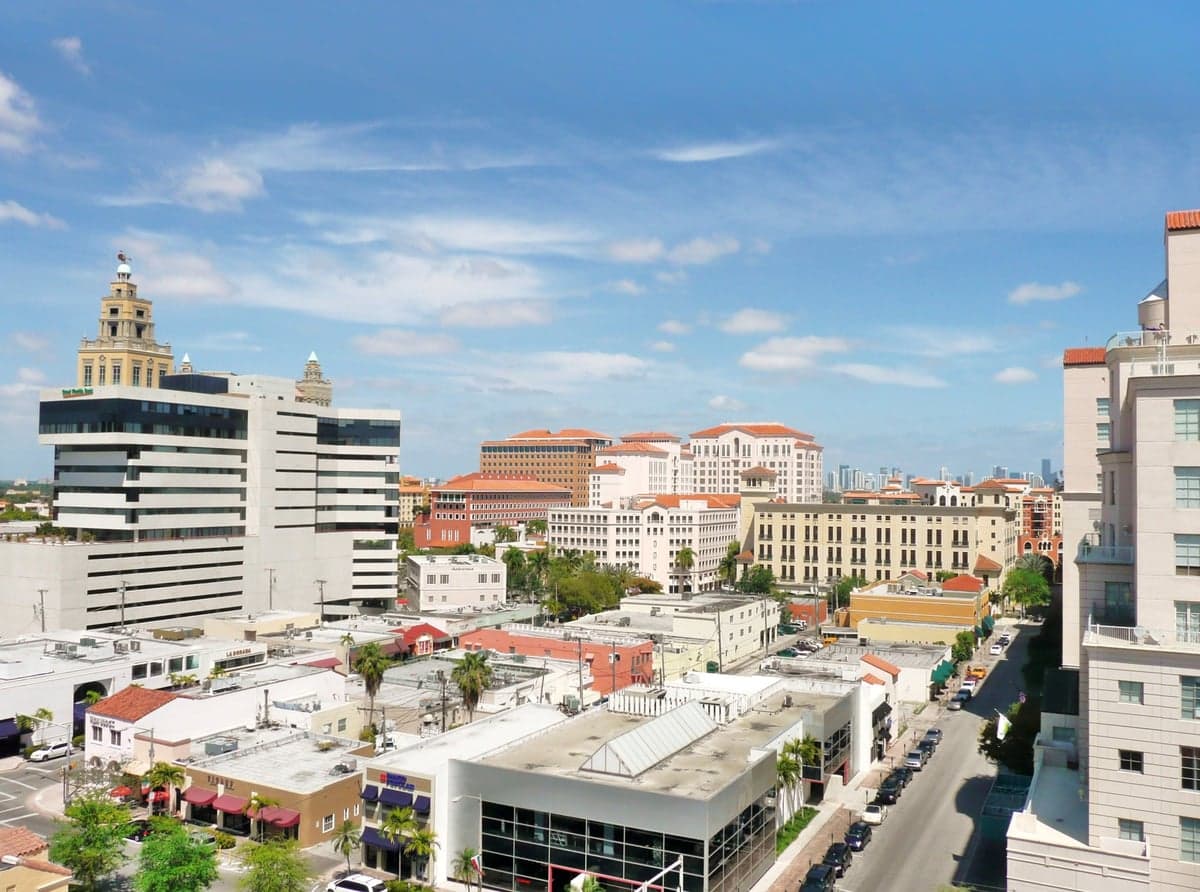
Photo: Wikipedia
Political ClimatePolitical Climate in Coral Gables, FL
District shown is the primary district for this city’s centroid. Cities may span multiple districts.
* Lean and PVI are calculated from Coral Gables, FL’s own 2020 presidential results (precinct returns summed to the city), with 2024 estimated from the surrounding county’s 2020–2024 shift, Cook-style. Sources: state election offices; VEST 2020 precinct results (CC BY 4.0).
Political rankings in Florida
- Most Conservative Cities in Florida
- Most Liberal Cities in Florida
- Best Liberal-Leaning Towns in the South
- Safest Liberal-Leaning Towns in the South
- Safest Conservative-Leaning Towns in the South
- Safest Liberal-Leaning Towns on the East Coast
- Safest Conservative-Leaning Towns on the East Coast
- Affordable Small Towns for Conservatives
- Most Conservative Counties in Florida
- Most Liberal Counties in Florida
Local Political AnalysisPolitical Analysis of Coral Gables, FL
Coral Gables has long been a moderate-to-conservative stronghold within Miami-Dade County, a county that itself leans Democratic in statewide races. The city’s Cook Partisan Voting Index (PVI) of R+6 means it votes about six points more Republican than the national average, placing it squarely in the center-right column. Over the past decade, the Gables has shifted slightly rightward, mirroring the broader trend of Cuban-American and other Hispanic voters in South Florida moving away from the Democratic Party. While the city still elects some Democrats to local office, particularly in nonpartisan races, the overall trajectory is toward a more reliably Republican tilt in federal and state contests.
How it compares
Compared to Florida as a whole, Coral Gables is noticeably more conservative. The state’s overall PVI is unknown, but Florida has voted Republican in the last three presidential elections by margins ranging from 1.2 to 3.4 points—making it a lean-Republican state. Coral Gables’ R+6 PVI puts it about 3–5 points to the right of the state average. For context, nearby Miami Beach leans heavily Democratic (roughly D+15), while Hialeah is one of the most Republican cities in the state (around R+20). Coral Gables sits in the middle: more conservative than the county’s coastal liberal enclaves but less so than the deep-red suburbs of western Miami-Dade. The contrast is starkest in local elections: Coral Gables’ commission races often center on development and zoning, not the culture-war issues that dominate state politics.
What this means for residents
For conservative residents, Coral Gables offers a comfortable environment where their views are mainstream in local discourse. Republican candidates routinely win city precincts by double digits, and the local Republican club is active. For liberal residents, the city is not hostile—it’s just not a progressive stronghold. You’ll find plenty of Democratic voters, especially among younger professionals and newcomers from the Northeast, but they’re usually outnumbered. The practical effect is that local policy stays moderate: the city has a strong environmental record (tree preservation, sea-level rise planning) but also keeps taxes low and development business-friendly. Neither side gets everything they want, which is typical for a purple-ish city in a red-leaning state.
Culturally, Coral Gables stands apart from both the hyper-partisan tone of state politics and the more laid-back vibe of neighboring Coconut Grove or South Miami. The city’s identity is rooted in its historic Mediterranean architecture, the University of Miami, and a professional-class population that values stability over political drama. You won’t see many yard signs for national candidates, but you will see active debate over issues like short-term rentals and traffic calming. The political climate here is less about red vs. blue and more about how to manage growth without losing the city’s character. That’s the Coral Gables way: pragmatic, slightly conservative, and deeply local.

State Political ClimatePolitical Climate in Florida
State Political AnalysisPolitical Environment in the State
Florida has transformed from a quintessential swing state into a solidly Republican-leaning powerhouse over the past decade, with a registered Republican voter advantage of over 800,000 as of 2025 and a 13-point margin for Donald Trump in the 2024 presidential election. The shift has been driven by a massive influx of conservative-leaning transplants from the Northeast and Midwest, coupled with a rightward lurch among Hispanic voters, particularly in Miami-Dade County. This isn't your grandfather's Florida — the state has moved from a purple battleground to a red stronghold in roughly 15 years, and the policy environment has followed suit.
Urban vs. rural divide
The political map of Florida is a study in stark contrasts. The major metro areas of Miami-Dade, Broward, and Palm Beach counties in the southeast remain the Democratic stronghold, but even there the margins have shrunk dramatically. Miami-Dade, which Obama won by 20 points in 2012, went for Trump by 11 points in 2024 — a stunning 31-point swing. Orlando (Orange County) and Tampa (Hillsborough County) are the remaining blue islands, but they're surrounded by a sea of red. The I-4 corridor, once the ultimate swing region, now leans reliably Republican outside the urban cores. The Panhandle, from Pensacola to Tallahassee, is deeply conservative, with counties like Santa Rosa and Okaloosa routinely delivering 70-80% Republican votes. The rural interior — places like Ocala (Marion County) and Lake City (Columbia County) — is as red as anywhere in the Deep South. The Gainesville area (Alachua County) remains a liberal outlier thanks to the University of Florida, but it's an island in a conservative region. What's notable is the suburban shift: once-purple suburbs like St. Johns County (south of Jacksonville) and Lee County (Fort Myers) have become deeply Republican as new arrivals from blue states settle in.
Policy environment
Florida's policy environment is defined by a low-tax, low-regulation posture that has been aggressively expanded under Governor Ron DeSantis. There is no state income tax, which is the single biggest draw for relocators from high-tax states. Property taxes are around 0.8% of assessed value, slightly below the national average, but homeowners insurance has become a crisis — rates have more than doubled since 2020 due to litigation and hurricane risk. The regulatory climate is business-friendly: Florida is a "right-to-work" state with minimal labor protections, and occupational licensing has been streamlined. Education policy is a flashpoint: the state has the nation's largest school voucher program (the Family Empowerment Scholarship), and the "Don't Say Gay" law (HB 1557) restricts classroom instruction on sexual orientation and gender identity through 12th grade. Healthcare is mixed — Florida did not expand Medicaid under the ACA, leaving roughly 800,000 residents in the coverage gap, but the state has relatively high insurance market competition. Election laws have been tightened: there are stricter voter ID requirements, limits on drop boxes, and a ban on private funding for elections. The state also has a "stand your ground" self-defense law and constitutional carry (permitless carry) for firearms, enacted in 2023.
Recent policy direction
The last five years have seen a cascade of legislation that signals where Florida is headed. On gun and self-defense law, the state passed permitless carry (HB 543) in 2023, allowing concealed carry without a license, and maintains a strong "stand your ground" statute. On parental and education rights, the "Parental Rights in Education" law (HB 1557, 2022) and the "Stop WOKE Act" (HB 7, 2022) restrict how race and gender are taught in schools and workplaces — the latter was partially blocked by courts but signals intent. On speech and privacy, the state passed a social media "deplatforming" law (SB 7072, 2021) targeting Big Tech censorship, though it's been tied up in litigation. On medical and bodily autonomy, Florida banned abortion after six weeks (HB 5, 2023), with exceptions for rape, incest, and the life of the mother — one of the strictest laws in the Southeast. On property rights, the state has strong homestead protections (unlimited exemption from creditors) and has preempted local rent control ordinances. On taxation, the trend is toward further cuts: the corporate income tax rate was reduced from 5.5% to 4.5% in 2024, and there's talk of eliminating it entirely. On voting and ballot access, SB 90 (2021) added restrictions on mail-in voting and drop boxes, and the state has aggressively purged voter rolls of non-citizens.
Civil unrest & political movements
Florida has seen its share of political flashpoints, but they've been more organized and less chaotic than in some other states. The Parkland school shooting in 2018 sparked the March for Our Lives movement, originating in South Florida, and led to the state raising the gun purchase age to 21 and enacting a "red flag" law — a rare gun restriction in a conservative state. Immigration politics are front and center: Governor DeSantis made national headlines by flying migrants from Texas to Martha's Vineyard in 2022, and the state passed SB 1718 (2023), which requires hospitals to ask about immigration status and makes it a felony to transport undocumented immigrants into the state. There are no sanctuary cities in Florida — the state banned them in 2019. Election integrity controversies have been muted compared to 2020, but the state's aggressive voter roll maintenance has drawn lawsuits from voting rights groups. The "Don't Say Gay" law sparked protests and boycotts, including from Disney, which led to the state dissolving the Reedy Creek Improvement District (Disney's special tax district) in 2022 — a move seen as political retaliation. Right-wing activist groups like Moms for Liberty are highly active, particularly in school board elections, while left-wing groups like the Dream Defenders organize around criminal justice reform. A new resident would notice the political polarization in everyday life — yard signs, bumper stickers, and local news coverage are heavily partisan.
Projection
Over the next 5-10 years, Florida is likely to become even more Republican, but the nature of that conservatism may shift. The in-migration from blue states — roughly 1,000 new residents per day — is disproportionately older, wealthier, and conservative-leaning, which will continue to push the state rightward. The Hispanic vote, particularly among Cuban-Americans and Venezuelan-Americans in Miami-Dade, is trending Republican, and this could make the state competitive for Democrats only in the most favorable national environments. However, the state's growth is also bringing strains: the insurance crisis, housing affordability (especially in Miami and Naples), and climate change concerns (sea-level rise in South Florida) could create new political fault lines. The Republican Party in Florida is likely to remain dominated by the DeSantis faction — culturally conservative, pro-business, and aggressively anti-"woke" — rather than the more libertarian or establishment wings. Democrats will remain competitive in state legislative races only in a handful of districts, and the party's best hope is to hold the line in the state Supreme Court, where DeSantis appointees now hold a 6-1 conservative majority. A new resident moving in now should expect a state where conservative policy is the default, and where liberal residents will find themselves increasingly in the minority, especially outside of Miami, Orlando, and Tampa.
For a new resident, the bottom line is straightforward: Florida offers a low-tax, business-friendly environment with a strong conservative cultural and political tilt. If you're a conservative, you'll find a state government that shares your values on guns, education, abortion, and immigration, and a growing community of like-minded transplants. If you're a liberal, you'll find a state where your vote carries less weight, where your preferred policies are unlikely to pass, and where you'll need to seek out blue enclaves like St. Petersburg or Tallahassee for like-minded community. Either way, the state's trajectory is clear: Florida is doubling down on its red identity, and the next decade will see that identity deepen. The practical takeaway is to understand that this is not a swing state anymore — it's a Republican state with Democratic cities, and the policy environment reflects that reality.
* Values derived from national, state, county, city and local statistics and may differ in a specific area. Last updated: 2026-11-08T01:58:22.000Z
Narrative content on this page is AI-generated and may contain mistakes. Verify any details that matter before acting on them.
ReloMaps may earn a commission from affiliate links at no extra cost to you.

