Photo: Wikipedia
Demographics of Coral Gables, FL
Affluence Level in Coral Gables, FL
A wealthy area with high-earning, well-educated households. Incomes, home values, and educational attainment meaningfully outpace national averages.
People of Coral Gables, FL
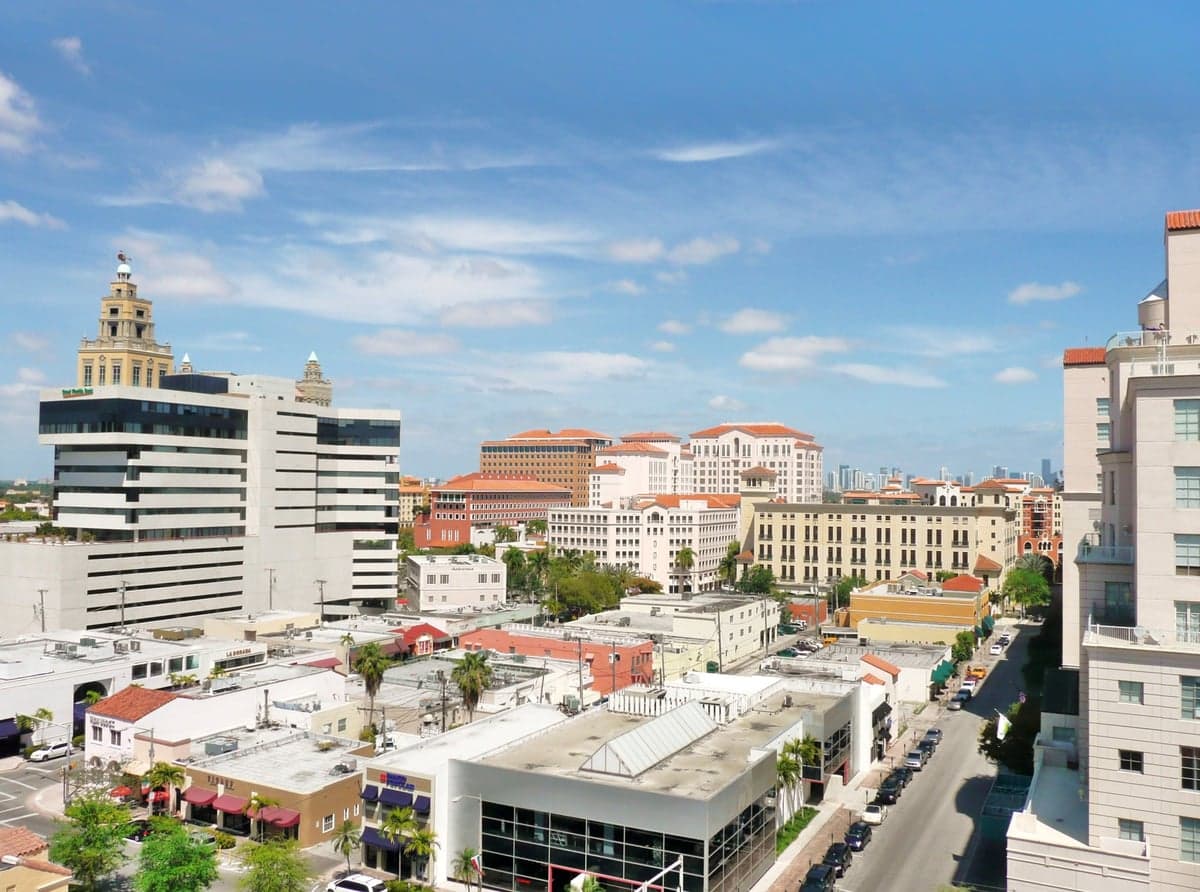
The people of Coral Gables today form a densely populated, highly educated, and majority-Hispanic community of 49,243 residents. With a 71.9% college-educated rate—nearly triple the national average—and a foreign-born share of 12.8%, the city is a magnet for professionals and families drawn to its planned elegance, top-tier schools, and proximity to Miami’s job centers. Its identity is distinctly cosmopolitan yet rooted in a century-old vision of Mediterranean-revival order, where Spanish-language fluency is common but English remains the dominant public language.
How the city was settled and grew
Coral Gables is a planned city, founded in the 1920s by developer George Merrick on former citrus groves and pine flatlands. Unlike older American cities, it has no colonial or 19th-century settlement layer. Merrick’s original vision attracted wealthy Midwesterners and Northeasterners seeking a subtropical paradise with strict architectural covenants—Spanish-style homes, tree-lined boulevards, and a central business district. The first wave of residents were largely white, Protestant, and upper-middle-class, settling in the Historic Mediterranean Revival core around Granada Boulevard and the Biltmore Hotel. During the 1940s and 1950s, the city expanded south and west with the development of Coral Gables Riviera and South Gables, attracting a mix of white professionals and Jewish families fleeing urban Miami. The University of Miami, founded in 1925, anchored a steady influx of faculty and students, adding a transient academic layer to the permanent population.
Modern era (post-1965)
The 1965 Hart-Cellar Act and the subsequent Mariel boatlift (1980) transformed Coral Gables’ demographics. Cuban exiles, many of them educated professionals, began buying homes in North Gables and Ponce Davis, drawn by the city’s good schools and low crime. By 1990, the Hispanic share had risen above 40%, and it now stands at 56.4%. This wave was not poor refugees but largely middle- and upper-class Cubans, Venezuelans, and later Colombians and Nicaraguans, who integrated into the city’s civic and business life. The white non-Hispanic share fell from over 80% in 1970 to 33.2% today, though many older white families remain in the French Country Village and Gables Estates enclaves. The Black population has remained small (3.5%), concentrated in the South Gables area near the city’s southern border. East/Southeast Asian communities (2.4%) and Indian-subcontinent residents (1.1%) are dispersed but visible in the professional class, often working in finance, tech, and medicine. The city’s foreign-born share (12.8%) is lower than Miami’s 58%, reflecting a population that is largely U.S.-born Hispanic or long-established white.
The future
Coral Gables is becoming slightly more diverse but remains economically exclusive. The Hispanic share is projected to stabilize or grow modestly as younger, second-generation Cuban-Americans and other Latino professionals move in, while the white non-Hispanic share may continue a slow decline. New luxury condominium towers along Ponce de Leon Boulevard and Miracle Mile are attracting empty-nesters and international buyers, particularly from Venezuela and Argentina, who are adding a transient, high-net-worth layer. The city’s strict zoning and historic preservation rules limit large-scale new construction, so population growth is capped—the city has added only about 2,000 residents since 2010. The University of Miami continues to inject a young, temporary population, but most students leave after graduation. The cultural identity is evolving from a quiet, old-money suburb into a bilingual, globally connected hub where Spanish is heard in coffee shops but English dominates in boardrooms and schools.
For someone moving in now, Coral Gables offers a stable, safe, and highly educated environment with a distinctly Latin-inflected character. It is not a melting pot but a layered city where established white families, upwardly mobile Hispanic professionals, and international newcomers coexist in well-defined neighborhoods. The future points toward continued affluence, slow demographic drift toward Hispanic majority, and a cultural identity that blends Old Florida charm with modern Latin American influence—a place where tradition and change are both carefully managed.

* Values derived from national, state, county, city and local statistics and may differ in a specific area. Last updated: 2026-11-08T01:58:22.000Z
Narrative content on this page is AI-generated and may contain mistakes. Verify any details that matter before acting on them.
ReloMaps may earn a commission from affiliate links at no extra cost to you.

