Photo: Wikipedia
Personal Sovereignty in Coral Gables, FL
Viable for self-reliance. Generally workable, though some barriers may limit total independence.
What does Personal Sovereignty tell us?
Personal Sovereignty measures your capacity for self-reliance and independence with minimal government friction. Higher scores mean fewer barriers between you and the way you want to live... but it assumes you have the space you need and good neighbors.
What does this tell us?
Personal Sovereignty measures your capacity for self-reliance and independence with minimal government friction. Higher scores mean fewer barriers between you and the way you want to live... but it assumes you have the space you need and good neighbors.
State Policy
Energy independence: Importer (12% of energy produced in-state)
Personal Liberty
Homesteading

Personal Liberty Analysis
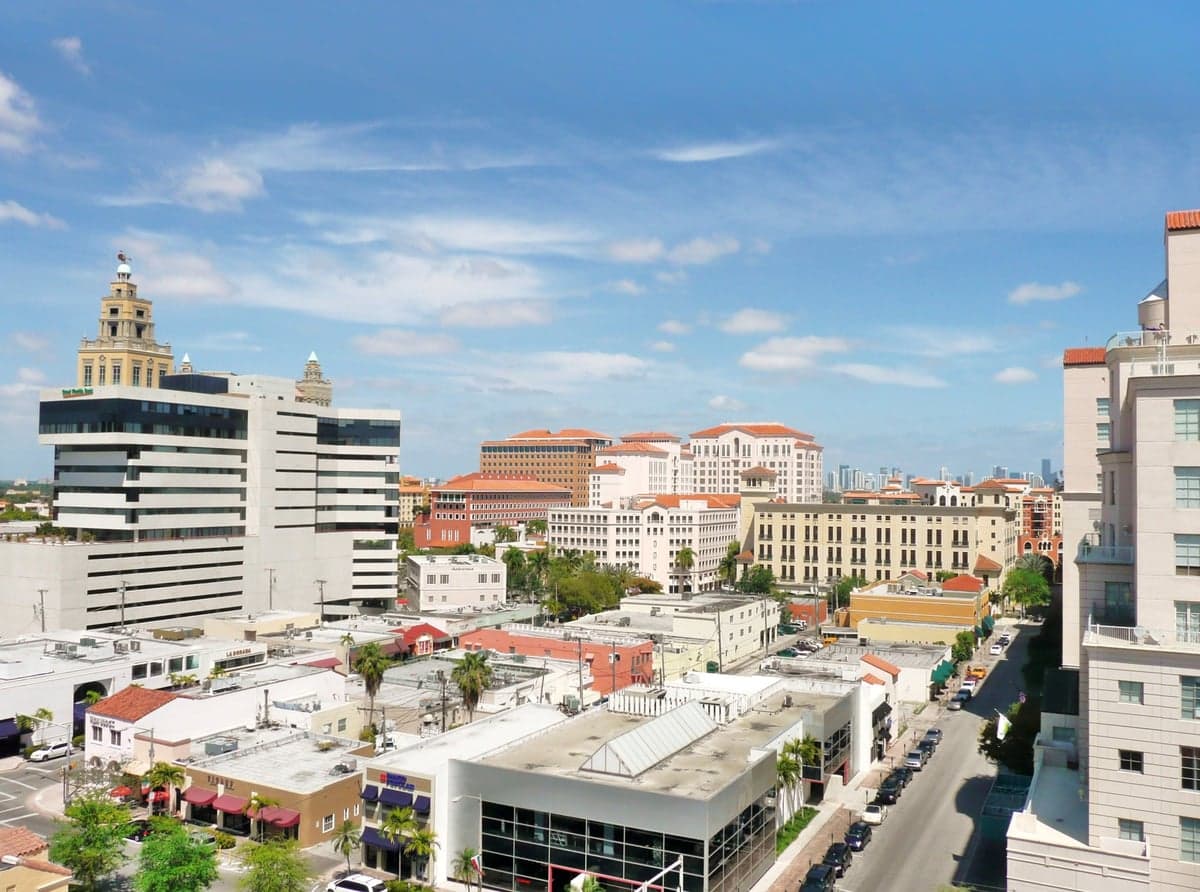
Coral Gables presents a nuanced personal sovereignty environment that blends Florida's strong state-level preemption laws and low tax burden with a highly structured municipal code that governs property aesthetics, land use, and daily life. For the relocation researcher prioritizing autonomy, the city offers significant financial and legal freedoms—no state income tax, robust self-defense protections, and broad parental rights—but imposes strict local regulations on housing, landscaping, and commercial activity that can feel heavy-handed to those accustomed to rural or less restrictive suburban settings. The net effect is a trade-off: substantial personal liberty in financial and legal matters, constrained by a meticulously managed urban landscape designed to preserve property values and a specific community character.
Tax burden and regulatory posture: what you keep and what you follow
Florida's absence of a state personal income tax is the single most powerful driver of financial sovereignty in Coral Gables. Residents retain 100% of their earned income at the state level, a direct contrast to high-tax states like New York or California. The city's property tax rate, however, is not negligible. For 2025, the combined millage rate in Coral Gables (including city, county, school board, and other districts) typically falls between 18 and 20 mills, meaning a homeowner with a $600,000 assessed property (after the $50,000 homestead exemption) pays roughly $10,000 to $12,000 annually in property taxes. While this is lower than many Northeast or Midwest suburbs, it is higher than unincorporated Miami-Dade County areas or more rural Florida counties. The regulatory posture is decidedly heavy-touch at the local level. Coral Gables enforces a famously strict zoning code—the city's "Building and Zoning Code" is over 400 pages—governing everything from permissible paint colors and roof tile materials to tree removal permits and the height of hedges. Any exterior modification to a home, including replacing windows or adding a fence, requires a permit and often a review by the city's Historic Preservation or Planning Department. This creates a predictable, high-property-value environment but significantly limits a homeowner's ability to alter their property without bureaucratic approval. Sales tax in Coral Gables is the state rate of 6% plus a 1% Miami-Dade County surcharge, totaling 7%—moderate by national standards. There is no local city sales tax. For a business owner, the regulatory burden is similarly mixed: no state corporate income tax is a major plus, but the city's business licensing, sign ordinances, and parking requirements are among the most stringent in South Florida.
Self-defense and gun law specifics: Florida's framework in a city context
Personal sovereignty in self-defense is governed by Florida state law, which preempts local ordinances. Coral Gables cannot enact its own gun control measures stricter than state law. Florida is a "shall-issue" state for concealed carry licenses, meaning the county sheriff must issue a license to any qualified applicant who meets statutory requirements (age 21, no disqualifying criminal history, completion of a training course). As of July 2023, Florida also became a permitless (constitutional) carry state, allowing any legal firearm owner aged 21 or older to carry a concealed weapon without a permit. Open carry of handguns remains generally prohibited except in specific circumstances (hunting, fishing, camping, or while on one's own property). The state's "Stand Your Ground" law, codified in Florida Statute 776.013, removes any duty to retreat before using deadly force in self-defense when a person is in a place they have a legal right to be. This applies fully within Coral Gables. However, practical considerations matter. Carrying a firearm into a city park, a restaurant that serves alcohol, or a school zone (including the University of Miami campus) carries specific legal restrictions that require careful attention. Coral Gables Police Department is active and professional; interactions with law enforcement are generally routine, but the city's dense, affluent environment means that a firearm-related incident—even a lawful defensive one—will receive intense scrutiny. For the self-reliant individual, the legal framework is strongly pro-self-defense, but the urban context demands a higher level of legal awareness than a rural setting.
Self-reliance and homesteading viability: lot sizes, zoning, and off-grid feasibility
Coral Gables is fundamentally an urban and suburban environment, not a homesteading locale. The city's minimum lot sizes vary by zoning district, but the most common single-family residential zones (R-1, R-1A, R-1B) require lots of 5,000 to 10,000 square feet—roughly one-eighth to one-quarter of an acre. Some larger estate areas (R-1C, R-1D) have minimums of 15,000 to 20,000 square feet. While these lots are larger than typical new subdivisions, they are far too small for serious food production or livestock. The city's zoning code explicitly prohibits the keeping of horses, cattle, goats, sheep, swine, or poultry (except for a limited number of hens in certain districts with a permit, and no roosters). Beekeeping is allowed with registration and adherence to setback rules. Off-grid living is effectively impossible within city limits. The city requires connection to municipal water and sewer systems. Solar panels are permitted but must comply with strict aesthetic guidelines—they cannot be visible from the street in many historic districts, and ground-mounted systems are heavily restricted. Rainwater harvesting for irrigation is allowed but not for potable use without a complex permitting process. Vegetable gardening is permitted in rear yards, but front-yard gardens are subject to the city's "landscaping" standards, which mandate turf and specific plantings. For a family seeking genuine self-reliance—growing a significant portion of their own food, generating their own power, or living without municipal utilities—Coral Gables is a poor fit. The city's regulatory DNA is built around curated, manicured neighborhoods, not agrarian independence. The trade-off is that the city's infrastructure is highly reliable, and the need for self-reliance in basic utilities is minimal.
Personal liberties: parental rights, medical autonomy, speech, and property
Florida has been a national leader in codifying certain personal liberties in recent years, and these apply fully in Coral Gables. Parental rights in education are explicitly protected under Florida's "Parents' Bill of Rights" (F.S. 1014), which affirms that parents have the fundamental right to direct the upbringing, education, and health care of their minor children. This includes the right to access all educational and medical records, to opt children out of certain instructional materials, and to be notified of any changes in a child's mental or physical health. The law has been tested in court and largely upheld. Medical autonomy is more complex. Florida law prohibits gender-affirming care for minors (as of 2024), a restriction that some view as protecting parental rights and others as limiting them. For adults, medical decision-making is generally free, though Florida's medical malpractice environment and insurance costs can limit access to certain specialists. Vaccine mandates by private employers are restricted under state law, giving individuals more freedom to decline vaccination without losing employment. Speech is protected under the First Amendment, and Florida has passed laws limiting "deplatforming" by social media companies and restricting certain types of public protest (e.g., around critical infrastructure). In Coral Gables, local ordinances regulate noise, signage, and public gatherings, but these are typical municipal codes, not exceptional restrictions. Property rights are strong in theory—Florida is a "property rights" state with robust eminent domain protections—but in Coral Gables, the city's zoning and historic preservation ordinances significantly constrain what an owner can do with their land. The city's "Mediterranean Revival" architectural style is not a suggestion; it is a legal requirement in many districts. This means that the right to use your property as you see fit is heavily circumscribed by design and use regulations.
Overall, personal sovereignty in Coral Gables is a study in contrasts. The financial autonomy from no state income tax, the strong self-defense legal framework, and the state-level protections for parental rights and medical choice are genuine advantages that place Coral Gables well ahead of most cities in high-tax, high-regulation states like California, New York, or Illinois. However, the city's own regulatory apparatus—its zoning code, historic preservation rules, and aesthetic mandates—imposes a level of control over property and daily life that is far more intrusive than what you would find in unincorporated Florida counties, smaller towns, or even many other Miami suburbs. For the individual or family whose primary sovereignty concern is financial freedom and legal self-defense, Coral Gables offers a favorable environment. For those whose vision of personal liberty includes the ability to modify their home without a permit, keep chickens, grow a front-yard vegetable garden, or live off-grid, the city will feel restrictive. The strategic choice is clear: Coral Gables rewards those who value predictable, high-value property and low state taxes, but it demands compliance with a detailed, non-negotiable local code that leaves little room for individual expression in the built environment.

* Values derived from national, state, county, city and local statistics and may differ in a specific area. Last updated: 2026-11-08T01:58:22.000Z
Narrative content on this page is AI-generated and may contain mistakes. Verify any details that matter before acting on them.
ReloMaps may earn a commission from affiliate links at no extra cost to you.

