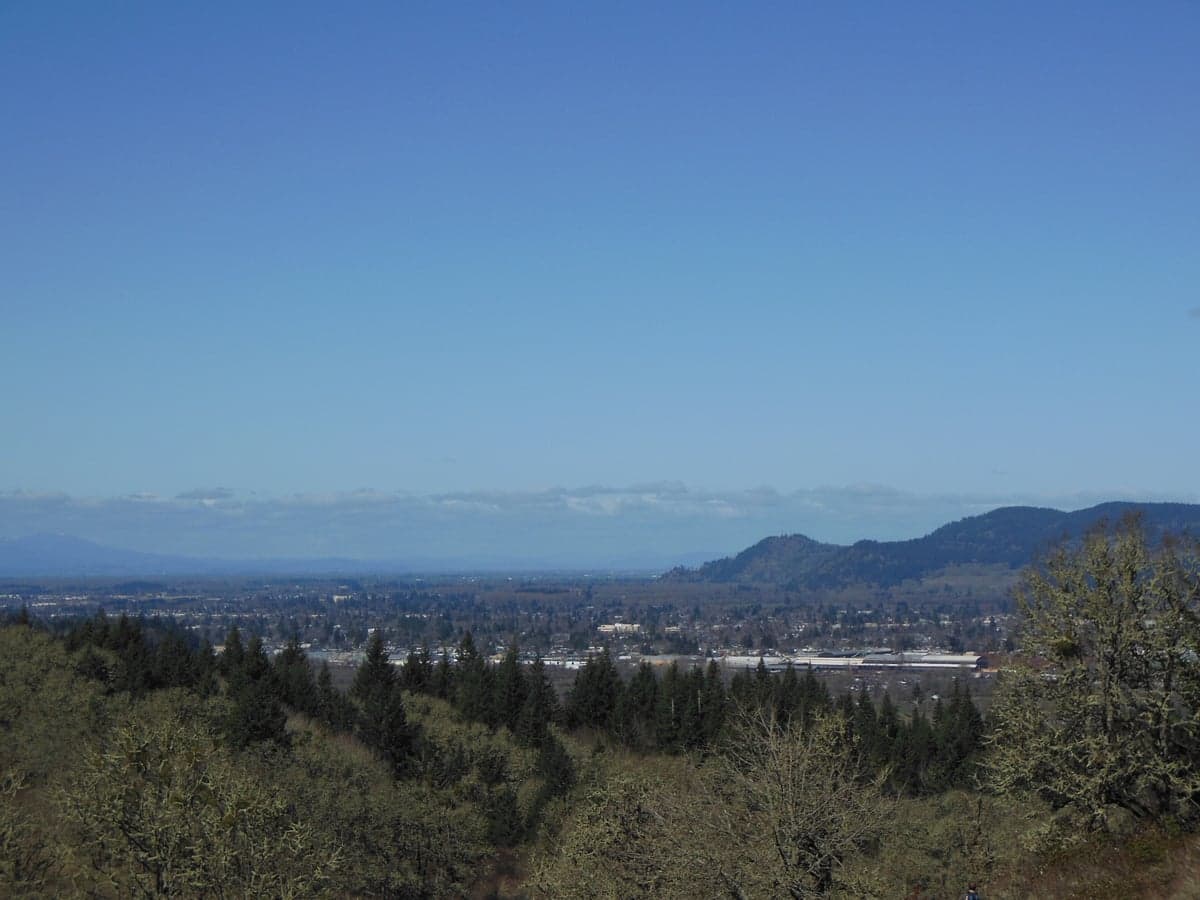
Photo: Wikipedia
Political ClimatePolitical Climate in Springfield, OR
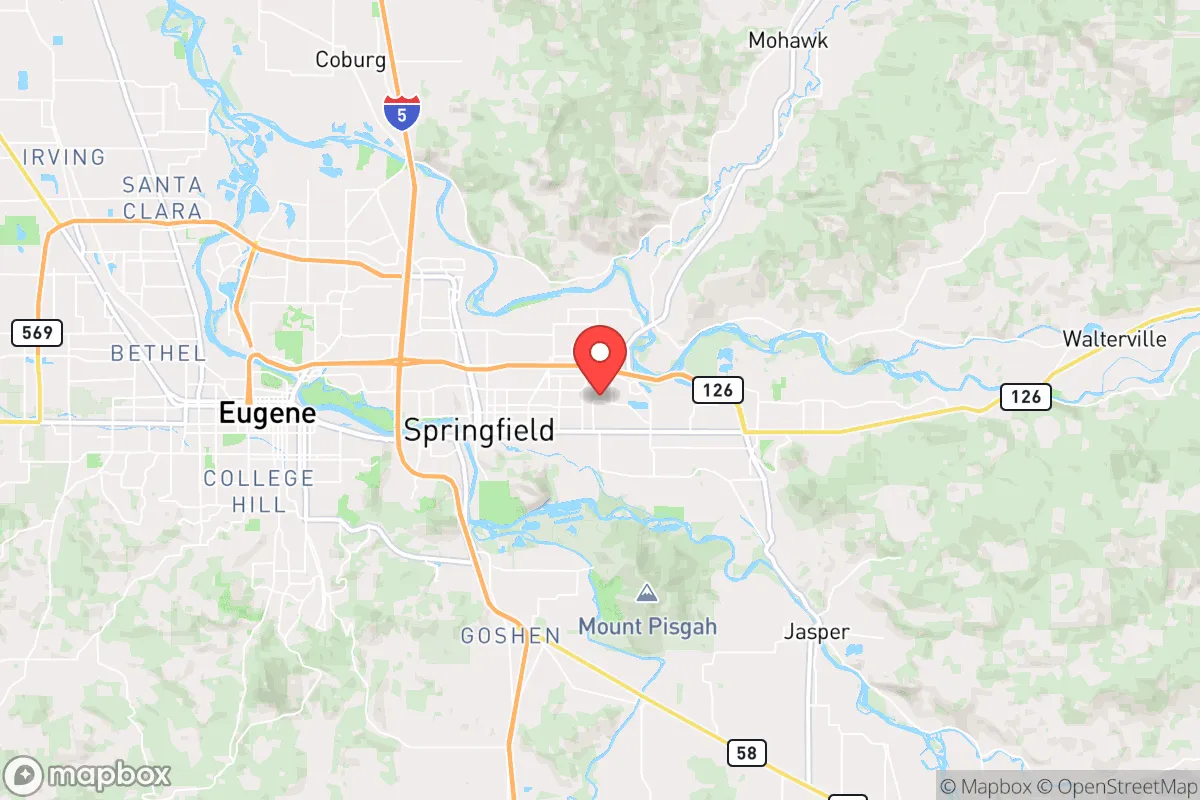
District shown is the primary district for this city’s centroid. Cities may span multiple districts.
Local Political AnalysisPolitical Analysis of Springfield, OR
Springfield, Oregon, leans reliably Democratic, but it’s a bit more purple than the state as a whole. The city’s Cook Partisan Voting Index (PVI) is D+6, meaning it votes about six points more Democratic than the national average, while Oregon overall sits at D+8. That two-point gap might not sound huge, but it reflects a real political tension here—Springfield has a stronger working-class, blue-collar streak than the Portland metro area, and that shows up in local elections and everyday conversations. Over the past decade, the city has shifted leftward, but it’s still a place where you’ll see both Biden and Trump signs in the same neighborhood, especially in the older parts of town near the Willamette River.
How it compares
Compared to Oregon as a whole, Springfield is a little more conservative, but the difference is subtle. The state’s D+8 PVI is driven heavily by the Portland metro area, which is deep blue—Multnomah County went +35 for Biden in 2020. Springfield, by contrast, sits in Lane County, which is D+10 overall, but the city itself is the more conservative anchor of the Eugene-Springfield metro. Eugene, just across the river, is a classic college town with a strong progressive activist scene, while Springfield has historically been a mill town with a more pragmatic, union-oriented Democratic base. That dynamic creates a noticeable cultural divide: Eugene’s politics are often about climate policy and social justice, while Springfield’s lean is more about jobs, public safety, and keeping taxes reasonable. Nearby towns like Cottage Grove (further south) and Creswell (to the south) lean more Republican, often voting R+5 to R+10, so Springfield sits in a kind of political buffer zone between the deep blue of Eugene and the redder rural areas.
What this means for residents
For conservative residents, Springfield is a relatively comfortable place to live compared to Eugene or Portland. You won’t feel like a pariah at the local coffee shop, and city council races often feature moderate Democrats who are willing to talk about police funding and business development. That said, the city’s overall Democratic lean means that statewide policies—like Oregon’s strict land-use laws, its high minimum wage, and its progressive tax structure—still shape daily life. For liberal residents, Springfield offers a more affordable alternative to Eugene, with a growing arts scene and a younger demographic moving in, but you’ll still encounter more Trump voters at the hardware store than you would in the Whitaker neighborhood. The practical reality is that local governance here is pragmatic: the city focuses on infrastructure, housing, and public safety, while the more ideological battles play out at the state level. Both sides can find common ground on issues like improving the downtown core and supporting the local school district, which has a strong vocational program that appeals to families across the political spectrum.
One cultural distinction that stands out is Springfield’s relationship with the timber industry. The city’s identity is still tied to Weyerhaeuser and the old mill economy, which gives it a more “Oregon working class” vibe than the tech-and-coffee culture of Eugene. That history shapes local politics: there’s more skepticism about environmental regulations that could affect jobs, and less enthusiasm for the kind of urban density policies you see in Portland. At the same time, the city has been diversifying its economy—the PeaceHealth medical center is now a major employer—and the political climate is slowly becoming more moderate as new residents arrive. In the long term, Springfield will likely continue to drift left, but it’ll do so at a slower pace than the rest of Oregon, keeping that D+6 lean intact for the foreseeable future.

State Political ClimatePolitical Climate in Oregon
State Political AnalysisPolitical Environment in the State
Oregon is a reliably Democratic state at the presidential level, with a Cook PVI of D+8, but that label hides a deeply fractured political reality. The state has voted for the Democratic presidential candidate in every election since 1988, but the margin has narrowed from double digits in 2008 and 2012 to single digits in 2020 and 2024, driven by a massive urban-rural split and a growing independent streak. Over the last 20 years, the Portland metro area has become a Democratic stronghold, while much of the rest of the state has shifted hard right, creating one of the most politically polarized landscapes in the country.
Urban vs. rural divide
The political map of Oregon is essentially a tale of two states. The Willamette Valley, anchored by Portland, Salem, and Eugene, is the engine of Democratic power. Multnomah County (Portland) alone delivers roughly 20% of the state's total vote, and it consistently votes 75-80% Democratic. Lane County (Eugene) and Marion County (Salem) are more moderate but still lean blue. In contrast, the rest of the state — from the conservative timber towns of Grants Pass and Roseburg in the south to the high desert ranching communities of Bend, Redmond, and Klamath Falls — votes overwhelmingly Republican. Bend is a notable exception: Deschutes County has been a swing county for a decade, flipping from Obama in 2012 to Trump in 2016 and 2020, then back to Biden in 2024 by a razor-thin margin, reflecting its rapid growth and influx of out-of-state transplants. The rural counties east of the Cascades, like Lake County and Harney County, routinely vote 75-80% Republican, making them some of the reddest places in the entire Pacific Northwest.
Policy environment
Oregon's policy environment is a mix of progressive leadership and practical constraints. The state has no sales tax, which is a major draw for conservatives, but it has high personal income taxes (top marginal rate of 9.9%) and high property taxes, especially in the Portland metro area. The regulatory posture is generally business-friendly in name but heavily environmental in practice, with strict land-use laws (the famous Urban Growth Boundary) that limit development and drive up housing costs. Education policy is a flashpoint: Oregon ranks near the bottom nationally in high school graduation rates and test scores, and the state's teachers' union is powerful. School choice is limited, with no voucher program and only a handful of charter schools. Healthcare is dominated by the Oregon Health Plan, the state's Medicaid expansion, which covers about 30% of residents. Election laws are among the most accessible in the country: Oregon was the first state to vote entirely by mail (1998), and it has automatic voter registration, same-day registration, and no voter ID requirement. This low-barrier system is popular with progressives but a source of concern for conservatives who worry about election integrity.
Recent policy direction
Oregon's recent legislative direction has been a roller coaster. In 2019, the state passed the Student Success Act, a $2 billion corporate tax hike to fund education, and the Oregon Family Leave Act, which provides 12 weeks of paid family leave. In 2020, it decriminalized possession of small amounts of all drugs (Measure 110), a policy that was widely seen as a failure and partially rolled back in 2024 with the recriminalization of possession. On gun policy, Oregon passed a strict permit-to-purchase law (Measure 114) in 2022, which requires a permit, a background check, and a completed safety course to buy a firearm. The law is currently tied up in court and has not been fully implemented. On parental rights, the state passed the Oregon Student Success Act in 2021, which includes ethnic studies and LGBTQ+ inclusive curriculum requirements, sparking backlash from conservative parents. On property rights, the state's land-use system remains a major constraint, with the Oregon Land Use Board of Appeals (LUBA) frequently overturning local development decisions. On privacy, Oregon has strong data privacy laws (the Oregon Consumer Privacy Act, effective 2024) and a ban on facial recognition by government agencies. On medical autonomy, the state has no restrictions on abortion and allows physician-assisted suicide (the Death with Dignity Act, 1997). On voting, the state continues to expand access, including automatic voter registration for anyone getting a driver's license.
Civil unrest & political movements
Oregon has a long history of political activism, from the 2020 Portland protests (which saw nightly clashes between protesters and federal agents) to the Malheur National Wildlife Refuge occupation in 2016, a 41-day armed standoff led by the Bundy family. The state is a hotbed for both left-wing and right-wing movements. Portland is a national symbol of progressive activism, with groups like Rose City Antifa and the Portland General Defense Committee active. On the right, the Oregon Republican Party has become increasingly populist and anti-establishment, with a strong base in rural counties. The state has a sanctuary law (1987) that limits local cooperation with federal immigration enforcement, and Portland and Salem are designated sanctuary cities. There have been multiple attempts at secession or county realignment, with rural counties like Jefferson County and Union County voting to join Idaho (the "Greater Idaho" movement), though these are symbolic and have no legal force. Election integrity is a persistent issue: the 2020 election saw widespread allegations of fraud from the right, though no evidence of widespread fraud was found. The 2022 election saw a high-profile incident where a ballot drop box in Portland was set on fire, destroying hundreds of ballots.
Projection
Over the next 5-10 years, Oregon's political trajectory is likely to remain polarized but with a slight rightward drift. The state's population growth is slowing, and the in-migration from California (which once boosted Democratic numbers) has shifted to include more conservative-leaning retirees and remote workers moving to Bend, Medford, and the Portland suburbs. The Portland metro area will continue to dominate the state's politics, but the suburbs are becoming more competitive: Clackamas County and Washington County are trending purple, and the 2024 election saw Republicans flip a state Senate seat in a suburban Portland district. The "Greater Idaho" movement will remain a symbolic protest but is unlikely to gain traction. The biggest wildcard is housing: if the state fails to address its housing crisis, it could drive more moderate voters out of the state, further entrenching the urban-rural divide. A new resident moving in now should expect a state that is politically volatile, with a Democratic governor and legislature but a strong and vocal Republican minority, and a policy environment that is constantly in flux.
For a conservative-leaning relocator, Oregon offers a mixed bag: no sales tax and beautiful natural surroundings, but high income taxes, strict gun laws, and a progressive cultural environment in the cities. The practical takeaway is that you can find a political home in Oregon, but you'll need to choose your location carefully. The rural areas and smaller cities like Grants Pass, Redmond, and Klamath Falls are solidly conservative, while the Portland metro and college towns like Eugene and Corvallis are deeply progressive. If you're looking for a place where your vote will matter in a competitive race, the suburbs of Portland — Beaverton, Hillsboro, and Gresham — are the battlegrounds. Just be prepared for a state that is constantly debating its own identity, with no sign of that debate cooling down anytime soon.
* Values derived from national, state, county, city and local statistics and may differ in a specific area. Last updated: 2026-07-08T06:21:04.000Z
Narrative content on this page is AI-generated and may contain mistakes. Verify any details that matter before acting on them.
ReloMaps may earn a commission from affiliate links at no extra cost to you.

