
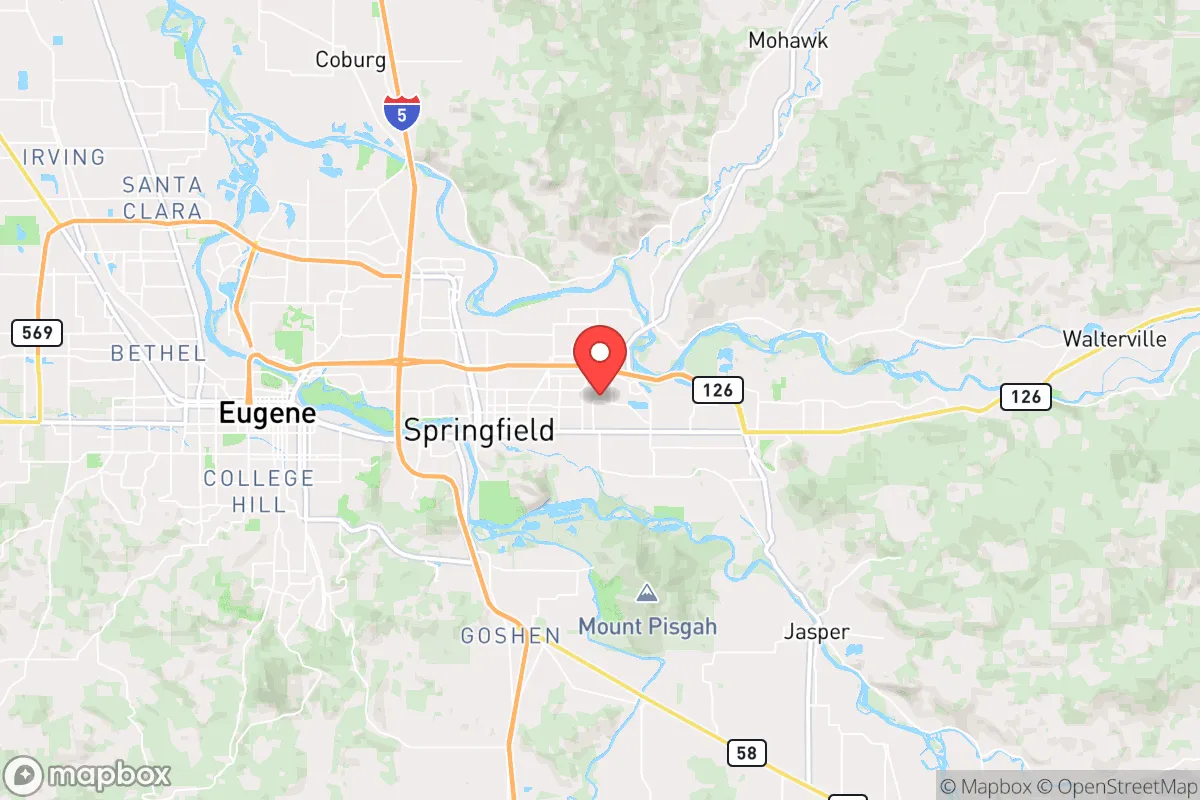
Photo: Wikipedia
Personal Sovereignty in Springfield, OR
Viable for self-reliance. Generally workable, though some barriers may limit total independence.
What does Personal Sovereignty tell us?
Personal Sovereignty measures your capacity for self-reliance and independence with minimal government friction. Higher scores mean fewer barriers between you and the way you want to live... but it assumes you have the space you need and good neighbors.
What does this tell us?
Personal Sovereignty measures your capacity for self-reliance and independence with minimal government friction. Higher scores mean fewer barriers between you and the way you want to live... but it assumes you have the space you need and good neighbors.
State Policy
Energy independence: Importer (35% of energy produced in-state)
Personal Liberty
Homesteading

Personal Liberty Analysis
Springfield, Oregon, offers a mixed environment for personal sovereignty, where state-level progressive policies often clash with local, more independent-minded community norms. While Oregon’s regulatory framework is denser than many Western states, Springfield’s position in Lane County provides a relatively more permissive local culture compared to its neighbor Eugene, particularly regarding property rights and self-reliance. For a relocation researcher focused on autonomy, the key is understanding where state law imposes limits and where local enforcement and community practices create breathing room.
Tax burden and regulatory posture in Lane County
Oregon’s tax structure is a significant factor for sovereignty-minded individuals. The state has no sales tax, which is a clear advantage for controlling daily spending, but it imposes a progressive income tax with a top marginal rate of 9.9% on income over $125,000 (single filers). Property taxes in Springfield are moderate by national standards, averaging around 0.87% of assessed value in 2025, but Oregon’s Measure 5 and Measure 50 caps limit annual increases to 3%, providing predictability. The regulatory posture is heavier than in states like Idaho or Texas. Oregon has a statewide land-use planning system (Senate Bill 100) that restricts urban sprawl and limits development on rural land. In Springfield, this means urban growth boundaries (UGBs) are strictly enforced, making it difficult to buy cheap acreage for self-sufficient living within city limits. However, outside the UGB, in unincorporated Lane County, zoning is more flexible, though still subject to state forest and agricultural land protections. Business licensing is straightforward, but environmental regulations—especially around water rights and building permits—can be time-consuming. For a family or individual, the tax burden is manageable if income is kept below the top bracket, but the regulatory overhead for any land-based enterprise is higher than in less regulated states.
Self-defense and gun law specifics in Oregon
Oregon’s gun laws have tightened significantly in recent years, directly impacting personal sovereignty. In 2023, Measure 114 was passed, requiring a permit to purchase any firearm, a completed background check for all transfers (including private sales), and banning magazines over ten rounds. As of early 2026, the permit-to-purchase provision is being implemented, though legal challenges have delayed full enforcement. Springfield residents must navigate this state-level framework. Open carry is legal without a permit in Oregon, but only in areas not preempted by local ordinances—Springfield itself does not ban open carry. Concealed carry requires a license (CHL), which Lane County issues with a typical turnaround of 30-45 days. The county sheriff’s office is generally supportive of Second Amendment rights, but the state’s red flag law (enacted 2018) allows law enforcement to temporarily seize firearms from individuals deemed a risk. Self-defense law in Oregon follows a “stand your ground” principle in practice, though the state does not have a statutory stand-your-ground law; case law supports the use of deadly force if you are in a place you have a right to be and face imminent threat. For a sovereignty-focused reader, the key takeaway is that while Oregon is not a gun-friendly state like Arizona or Montana, Springfield’s local enforcement is less restrictive than in Portland or Eugene, and the CHL process is straightforward. The magazine ban is the most onerous restriction for those who prioritize self-defense.
Self-reliance and homesteading viability: lot sizes, zoning, and off-grid feasibility
Homesteading in Springfield requires careful attention to zoning and utility regulations. Within city limits, minimum lot sizes are typically 5,000 to 7,000 square feet for single-family homes, which allows for substantial vegetable gardens, small livestock (chickens, rabbits, bees are permitted with limits), but not larger animals like goats or pigs without a special use permit. The city’s zoning code restricts accessory dwelling units (ADUs) to one per lot, which limits multi-generational living or rental income from a separate structure. Off-grid living is legally challenging within the UGB. Oregon’s building codes require connection to municipal water and sewer if available, and solar panels are allowed but must be grid-tied unless you obtain a variance. In unincorporated Lane County, east of Springfield toward the McKenzie River, zoning is more permissive. Rural residential parcels of 2-10 acres are common, and off-grid systems (well, septic, solar) are standard. However, Oregon’s strict water rights laws mean you cannot collect rainwater without a permit in some cases, and any new well requires a water right permit from the state. The county allows composting toilets and graywater systems under specific conditions. For a family wanting to be largely self-sufficient, the best bet is a rural parcel outside Springfield’s UGB, but be prepared for a permitting process that can take 6-12 months for a new dwelling. The local culture in Lane County’s rural areas is strongly self-reliant, with a network of homesteading supply stores and community seed exchanges in nearby Eugene.
Personal liberties: parental rights, medical autonomy, speech, and property
Personal liberties in Springfield are shaped by Oregon’s progressive state laws, which can be a double-edged sword for conservative-leaning individuals. Parental rights are strong in practice but legally limited. Oregon has no parental bill of rights, and the state mandates comprehensive sex education in public schools (Oregon Revised Statute 336.455), which some families find intrusive. Homeschooling is legal with minimal regulation—parents must register with the local Education Service District and provide annual assessments, but there is no curriculum approval. Medical autonomy is a mixed picture. Oregon has no vaccine mandate for adults, but school vaccine requirements are strict (no philosophical exemption for MMR, only medical). The state’s Death with Dignity Act and legalized recreational marijuana (since 2015) reflect a high degree of personal medical choice. However, COVID-19 mandates were enforced more aggressively in Lane County than in rural Oregon, though those are now lifted. Free speech is protected under the Oregon Constitution, which has stronger protections than the First Amendment in some areas (e.g., no “fighting words” exception in public forums). Property rights are constrained by the state’s land-use system; you cannot build whatever you want on your land, and the county can enforce aesthetic standards in some zones. For a sovereignty-minded reader, the most significant liberty concern is the erosion of parental authority in education and healthcare decisions, balanced by strong protections for speech and personal medical choices like cannabis and end-of-life care.
Overall, Springfield offers a moderate level of personal sovereignty compared to other regions in the Pacific Northwest. It is more permissive than Portland or Seattle in terms of local enforcement and community culture, but significantly less autonomous than states like Idaho, Montana, or Texas due to Oregon’s state-level tax burden, gun restrictions, and land-use regulations. For a family or individual who values self-reliance and is willing to navigate a heavier regulatory environment for the benefits of Oregon’s natural beauty and no sales tax, Springfield provides a workable base—especially if you choose a rural parcel outside the UGB. The key is to understand that sovereignty here is not absolute; it is negotiated between state law and local practice, with the latter often offering more breathing room than the former suggests.

* Values derived from national, state, county, city and local statistics and may differ in a specific area. Last updated: 2026-07-08T06:21:04.000Z
Narrative content on this page is AI-generated and may contain mistakes. Verify any details that matter before acting on them.
ReloMaps may earn a commission from affiliate links at no extra cost to you.

