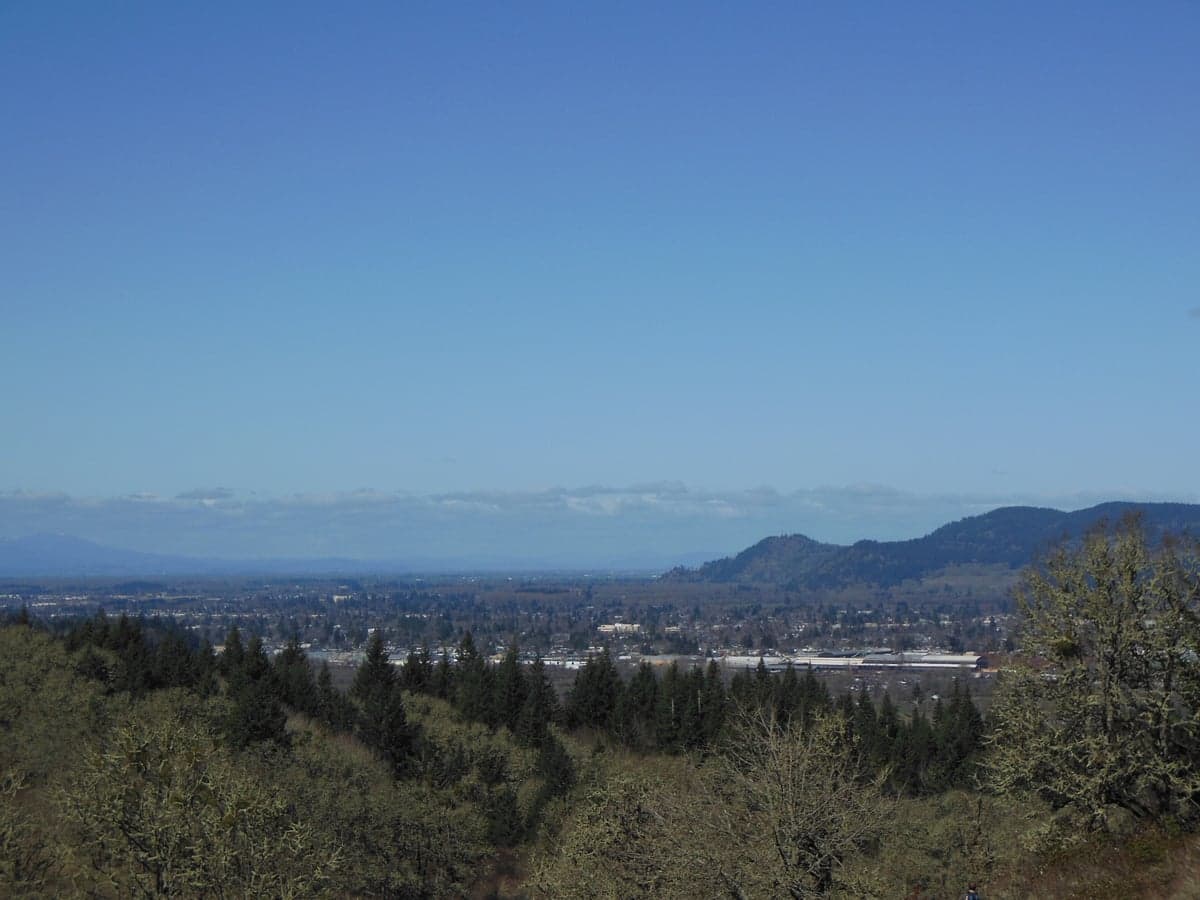
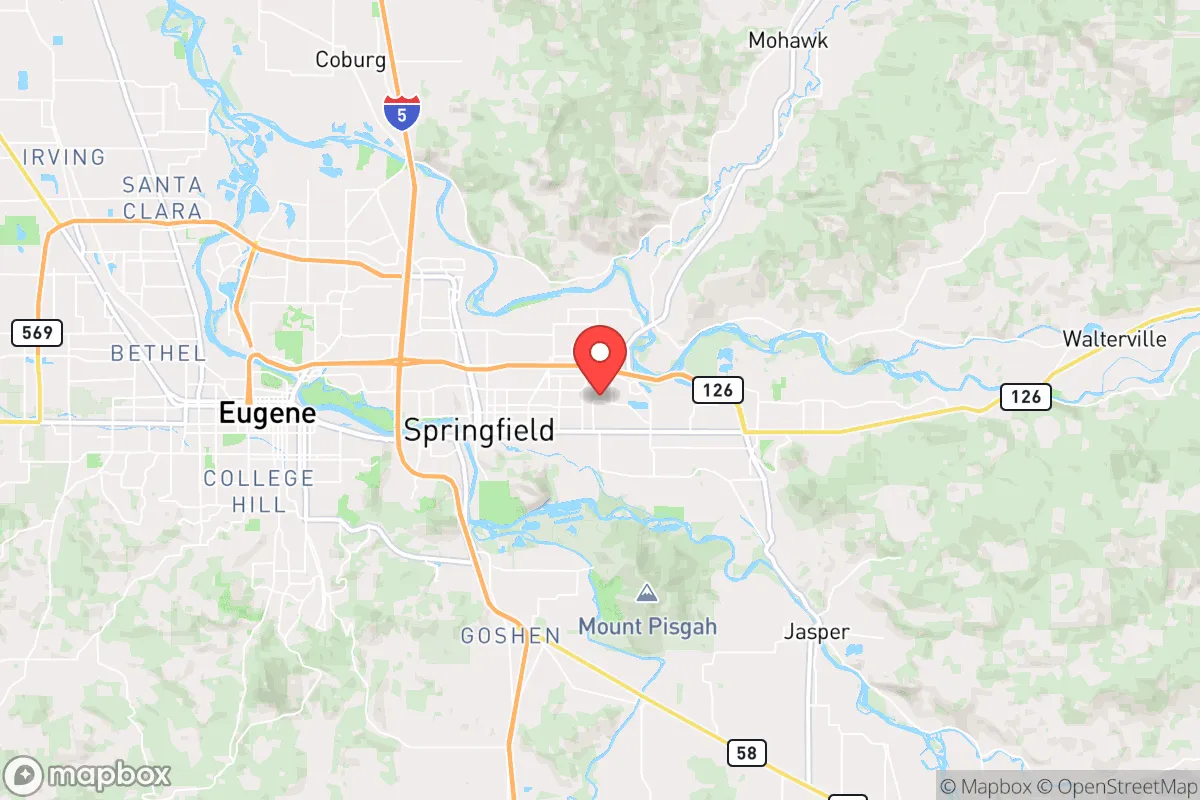
Photo: Wikipedia
Demographics of Springfield, OR
Affluence Level in Springfield, OR
A middle-class area roughly in line with national averages across income, home values, education, and employment.
People of Springfield, OR
The people of Springfield, Oregon today number 61,642, forming a predominantly white (75.3%) and increasingly Hispanic (14.8%) working-class community with a distinctively low foreign-born share of just 3.9%. The city carries a blue-collar character rooted in its timber and mill history, with a college-educated rate of 21.6% that trails both the state average and neighboring Eugene. Springfielders are notably more conservative than their Lane County neighbors, and the population skews toward families and long-term residents rather than the transient student population found across the river.
How the city was settled and grew
Springfield was founded in 1848 by Elias and Mary Briggs, who claimed a Donation Land Claim along the Willamette River. The original settlers were overwhelmingly white homesteaders from the Midwest and Upper South, drawn by the Oregon Trail and the promise of fertile bottomland. The arrival of the Oregon & California Railroad in the 1870s shifted the economy from agriculture to timber, and by the early 20th century, Springfield had become a company town for the Weyerhaeuser mill and later the Springfield Plywood mill. The historic Downtown Springfield district and the Mill Town neighborhood (centered around 5th and Main) were built by these mill-working families, many of whom were second- and third-generation Oregonians. A smaller wave of European immigrants—primarily German, Irish, and Scandinavian—arrived between 1900 and 1920 to work the mills, settling in the North Springfield area near the rail yards. The city remained overwhelmingly white and working-class through the 1950s, with a population that hovered around 10,000 until the post-war housing boom.
Modern era (post-1965)
The 1965 Hart-Cellar Act had a muted effect on Springfield compared to larger Oregon cities. The foreign-born population remains low at 3.9%, and the city did not see the large-scale Asian or Indian immigration that reshaped Portland or Beaverton. Instead, the major demographic shift since the 1970s has been the growth of the Hispanic population, which now stands at 14.8%. This wave began in the 1980s and accelerated in the 1990s, driven by labor demand in the timber industry, nurseries, and agricultural work in the surrounding Willamette Valley. Hispanic families concentrated in the Thurston Hills area and along the Main Street corridor, where older, affordable housing stock and proximity to service jobs made settlement practical. The East/Southeast Asian population (1.1%) and Indian-subcontinent population (0.5%) are small but visible, with families scattered across the Glenwood district and newer subdivisions near Bob Straub Parkway. The Black population remains very small at 0.7%, concentrated in the Downtown and North Springfield areas. Suburbanization since the 1990s has pushed new development eastward into the Thurston area, which is now the city's largest and most family-oriented neighborhood, with newer housing stock and a more suburban character than the older mill-town core.
The future
Springfield's population is projected to grow modestly, reaching roughly 70,000 by 2035, driven by spillover from Eugene's higher housing costs and by the expansion of PeaceHealth's medical campus. The Hispanic share is expected to continue rising, potentially reaching 20-22% by 2040, as younger families age into childbearing years and new arrivals from Latin America settle in the Thurston and Main Street corridors. The white share will decline proportionally but remain the majority. The East/Southeast Asian and Indian populations are likely to grow slowly, as Springfield lacks the tech-sector job base that attracts those groups to the Portland metro area. The city's cultural identity is evolving from a purely white timber town to a more mixed working-class community, but it remains far less diverse than the national average. For a new resident, this means moving into a place where the population is stable, family-oriented, and increasingly Hispanic, but where the overall character remains rooted in its mill-town past. The low foreign-born share and high rate of native-born residents suggest a community that is insular but welcoming to those who put down roots.
Springfield is becoming a more diverse, still predominantly white, working-class suburb of Eugene, with a growing Hispanic population and a stable, family-focused demographic profile. For someone moving in now, the city offers a more affordable and politically conservative alternative to Eugene, with a population that values stability over rapid change.

* Values derived from national, state, county, city and local statistics and may differ in a specific area. Last updated: 2026-07-08T06:21:04.000Z
Narrative content on this page is AI-generated and may contain mistakes. Verify any details that matter before acting on them.
ReloMaps may earn a commission from affiliate links at no extra cost to you.

