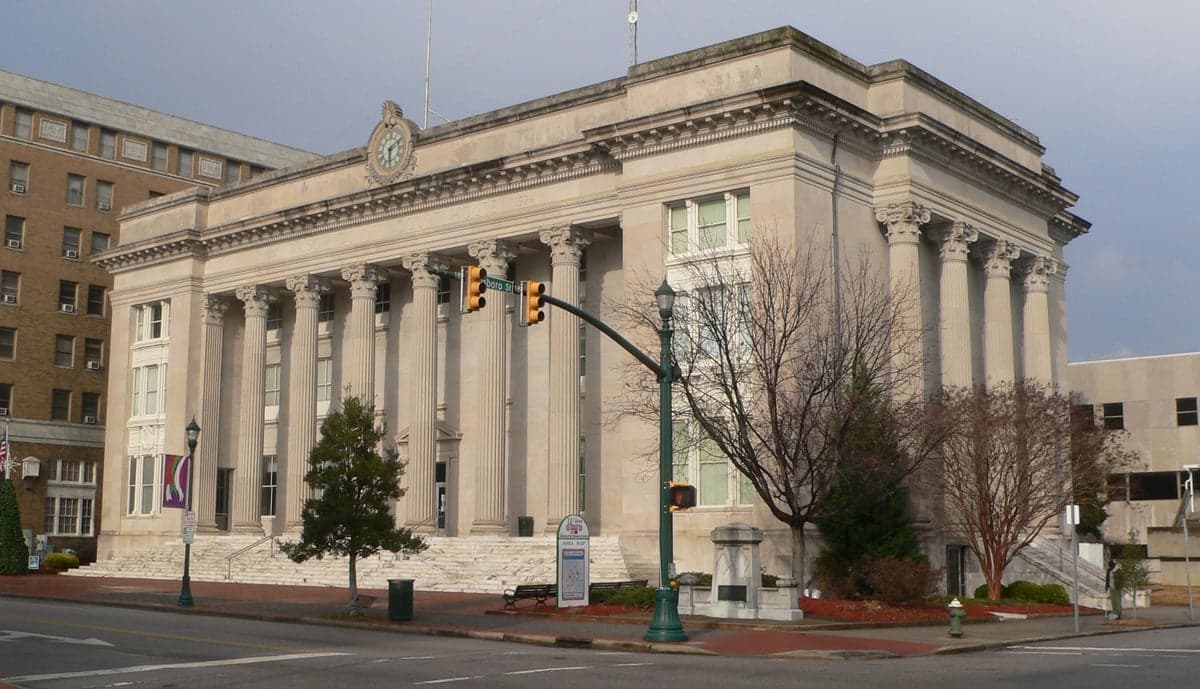
Photo: Wikipedia
Political ClimatePolitical Climate in Wilson County
Showing district-level results — no local-only data available.
Local Political AnalysisPolitical Analysis of Wilson County
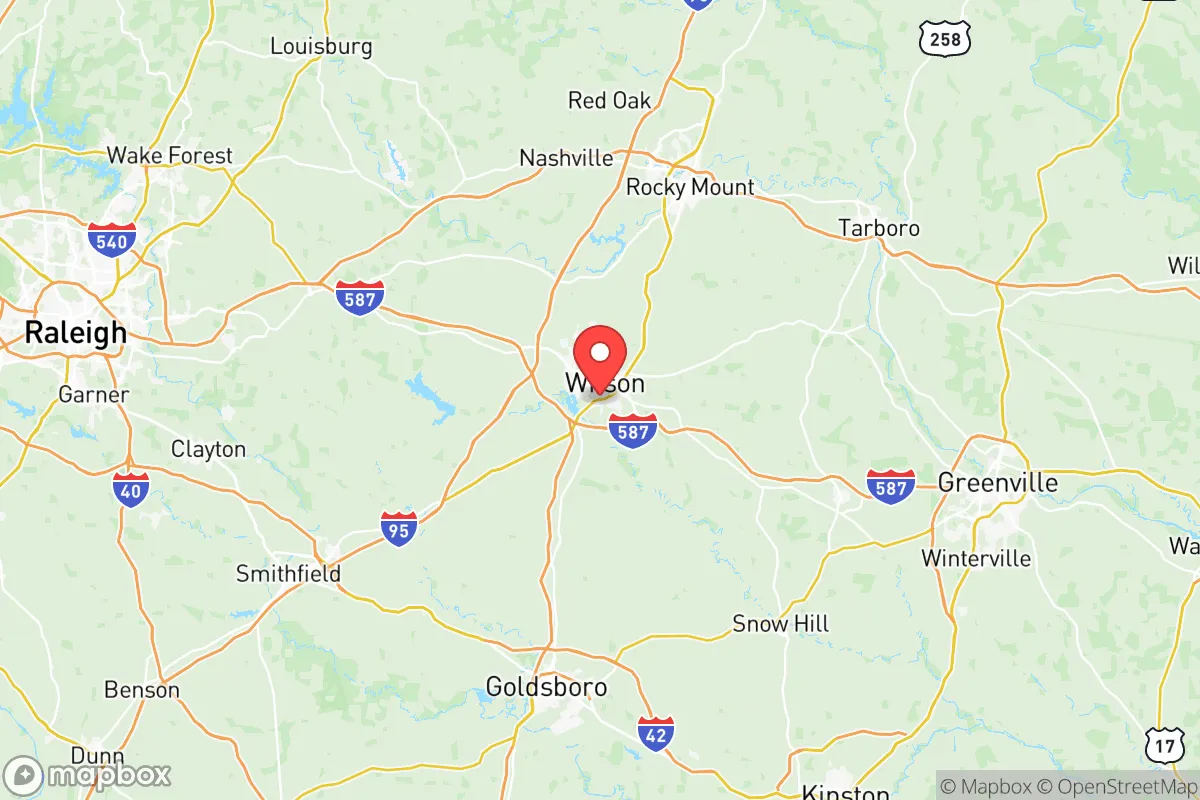
Wilson County, North Carolina, is a genuine political bellwether, with a Cook Partisan Voting Index of R+1 that mirrors the state's overall R+1 rating. This means the county is almost perfectly split, but with a slight and consistent Republican lean in recent presidential elections. However, the story is more nuanced than a single number suggests, as the county's politics are a microcosm of the broader urban-rural divide playing out across the state, with the city of Wilson itself acting as a blue island in a sea of red townships.
How it compares to the rest of North Carolina
Wilson County’s R+1 PVI is identical to North Carolina's statewide rating, making it a perfect proxy for the state's overall political tension. The county’s voting patterns closely track the state's, with the city of Wilson (population ~50,000) consistently voting Democratic, much like Raleigh or Durham. In the 2024 election, the city's precincts, particularly those around the historic downtown and the Barton College area, broke heavily for the Democratic ticket. In contrast, the rural towns and unincorporated areas—such as Black Creek, Lucama, and Sims—are reliably Republican, often voting by margins of 60-70% for GOP candidates. The true swing precincts are found in the suburban fringe around the city limits, especially in the Gardners Township and Taylor Township areas, where ticket-splitting is common and local races can be decided by a few hundred votes. This internal split means that while the county leans red in national races, local offices often remain competitive, with Democrats holding seats on the county commission and school board.
What this means for residents
For conservative residents, the R+1 lean means their values are broadly reflected in the county's representation in the state legislature and Congress, but they cannot take victory for granted. The county is represented by a mix of Republican and Democratic officials, and local policy debates—particularly around land use, school funding, and economic development—are genuine contests. For liberal residents, the city of Wilson provides a solid base of support, but they must contend with a county commission that often tilts right on issues like tax rates and zoning. The practical effect is a community where political compromise is not just a nicety but a necessity. You see this in the county's approach to economic development, where both parties have historically supported the expansion of the Wilson Industrial Air Center and the revitalization of the historic downtown, recognizing that job creation and quality of life are nonpartisan goals.
Culturally, Wilson County feels like a borderland between the Research Triangle's progressive energy and the more traditional, agrarian values of eastern North Carolina. The city of Wilson has a vibrant arts scene and a growing food culture, anchored by the Whirligig Park, which attracts a diverse, younger crowd. Drive 15 minutes outside the city, and you'll find tobacco farms, country churches, and a pace of life that hasn't changed much in decades. This cultural tension is the county's defining feature. Policy-wise, the county has avoided some of the more contentious culture war battles seen elsewhere in the state, focusing instead on practical issues like infrastructure and education. The local school board, for example, has managed to avoid the deep partisan splits that have plagued other districts, largely because both sides recognize that the county's economic future depends on a well-educated workforce. For anyone moving here, the key takeaway is that Wilson County is not a place where one party dominates; it's a place where you have to engage with your neighbors, whether they agree with you or not.

State Political ClimatePolitical Climate in North Carolina
State Political AnalysisPolitical Environment in the State
North Carolina has been the quintessential swing state for the past two decades, but the pendulum has settled with a slight rightward tilt. The state carries a Cook PVI of R+1, meaning it votes about one point more Republican than the national average, but that number masks a volatile and deeply competitive landscape. Over the last 10-20 years, the state has transformed from a reliably Democratic stronghold in the South (it went for Obama in 2008) into a purple battleground where Republicans hold the legislature and governorship, but Democrats win statewide races for Council of State positions and occasionally break through in presidential years. The dominant coalition is a mix of rural, culturally conservative voters in the Piedmont and Coastal Plain, suburban moderates in the Charlotte and Raleigh metros, and a growing, increasingly Democratic-leaning population of transplants and young professionals in the urban crescent.
Urban vs. rural divide
The political map of North Carolina is a textbook case of the urban-rural chasm. The major metros — Charlotte (Mecklenburg County), Raleigh-Durham (Wake and Durham Counties), and Asheville (Buncombe County) — are deep blue islands in a sea of red. Mecklenburg County alone delivered a 30-point margin for Biden in 2020, while Wake County gave him a 25-point win. These areas are powered by banking, tech, and research industries, drawing in educated, younger, and more diverse populations. In contrast, the rural east — places like Robeson County (historically Democratic but shifting right) and the northeastern counties — and the rural west, including Henderson and Rutherford counties, are solidly Republican. The suburbs are the real battleground: Cabarrus County (north of Charlotte) and Johnston County (southeast of Raleigh) have been flipping from red to purple as exurban growth brings in moderates. The state's 14 electoral votes are decided by turnout in these suburban rings, not the deep blue cities or the deep red countryside.
Policy environment
North Carolina's policy environment is a mixed bag that reflects its divided government. The state has a flat income tax rate of 4.5%, which is being phased down to 3.99% by 2027, making it competitive for businesses and high earners. The corporate tax rate is a low 2.5%, one of the lowest in the nation. Sales tax is 4.75% at the state level, with local add-ons that can push it to 7.5% in some counties. Education policy is a flashpoint: the state has a robust school choice program, including Opportunity Scholarships (vouchers) that can be used for private school tuition, and a growing charter school sector. The Leandro court case, which mandates adequate and equitable funding for public schools, remains unresolved after decades of litigation. Healthcare is a sore spot — North Carolina did expand Medicaid in 2023 under a bipartisan deal, but the state still has one of the highest uninsured rates in the country. Election laws are moderately restrictive: voter ID is required (a 2018 law that was upheld after legal challenges), early voting is generous (17 days), and same-day registration is available during early voting. The state does not have a "stand your ground" law, but it does have a Castle Doctrine and a permitless carry law for concealed handguns, passed in 2021.
Recent policy direction
Over the past five years, the Republican-controlled General Assembly has pushed the state in a distinctly conservative direction on several fronts. In 2023, the legislature passed a 12-week abortion ban (down from the previous 20-week limit), overriding Governor Roy Cooper's veto. On gun rights, the 2021 permitless carry law (HB 39) allows any adult who can legally own a firearm to carry a concealed handgun without a permit. Parental rights were strengthened with the 2023 "Parents' Bill of Rights" (HB 755), which requires schools to notify parents about instructional materials involving sexuality and prohibits instruction on gender identity and sexual orientation in K-4 classrooms. On property rights, the state has not enacted any major eminent domain reforms, but it does have a relatively low property tax burden (average effective rate of 0.78%). Privacy and surveillance are less regulated than in blue states — there is no comprehensive data privacy law, and law enforcement has broad access to license plate readers and cell-site simulators. Voting access has been a tug-of-war: the 2018 voter ID law was upheld, but the legislature also passed a law in 2023 that makes it harder for the State Board of Elections to change election rules without legislative approval. For a relocator weighing liberties, the state offers strong gun rights, low taxes, and parental control in schools, but limited abortion access and weaker privacy protections.
Civil unrest & political movements
North Carolina has seen its share of political flashpoints, but nothing approaching the scale of Portland or Seattle. The 2020 George Floyd protests in Charlotte and Raleigh were large but largely peaceful, with some property damage and curfews. The state has a history of organized activism on both sides: the Moral Monday movement, led by the NAACP, has been a fixture since 2013, protesting Republican policies on voting rights, education, and healthcare. On the right, the "Moms for Liberty" chapter in Wake County has been active in school board meetings, pushing for parental rights and book bans. Immigration politics are less heated than in border states — North Carolina does not have a sanctuary city policy, and the 2015 HB 318 (the "bathroom bill") that restricted transgender bathroom access was partially repealed in 2017 after a national backlash. Election integrity has been a recurring theme: the 2020 election in North Carolina was close but not marred by widespread fraud, though the state did see a high-profile absentee ballot fraud case in the 9th Congressional District in 2018, which led to a new election. A new resident would notice the political energy at the local level — school board and county commission meetings can be contentious, especially in fast-growing suburbs like Union County and Harnett County.
Projection
Over the next 5-10 years, North Carolina is likely to remain a competitive swing state, but the demographic trends favor a slow shift toward the center-left. In-migration is a major factor: the state is gaining about 100,000 new residents per year, many from blue states like New York, California, and New Jersey. These transplants tend to be more educated and moderate, and they are settling in the urban crescent — Charlotte, Raleigh, Durham, and the Triad (Greensboro, Winston-Salem, High Point). The rural counties, meanwhile, are losing population and aging, which will gradually erode the Republican base. However, the Republican-controlled General Assembly has shown a willingness to gerrymander congressional and legislative maps aggressively, which could slow the political shift. The wild card is the suburban vote: if the suburbs of Charlotte and Raleigh continue to trend Democratic, the state could become a lean-blue state by 2032. For now, expect continued divided government, with the governorship flipping between parties and the legislature staying Republican. A new resident moving in now should expect a state that is politically competitive, with policy outcomes that swing based on which party controls the governor's mansion and the legislature.
For someone choosing North Carolina, the bottom line is this: you are moving to a state where your vote will genuinely matter in national elections, but where day-to-day governance is firmly center-right on taxes, guns, and education. If you are a conservative, you will find a welcoming policy environment with low taxes, strong gun rights, and a legislature that shares your values. If you are a liberal, you will find vibrant blue cities and a growing activist community, but you will be fighting an uphill battle on state-level policy. The state's political reality is one of constant tension and negotiation — and that is unlikely to change anytime soon.
* Values derived from national, state, county, city and local statistics and may differ in a specific area. Last updated: 2026-06-27T10:53:51.000Z
Narrative content on this page is AI-generated and may contain mistakes. Verify any details that matter before acting on them.
ReloMaps may earn a commission from affiliate links at no extra cost to you.

