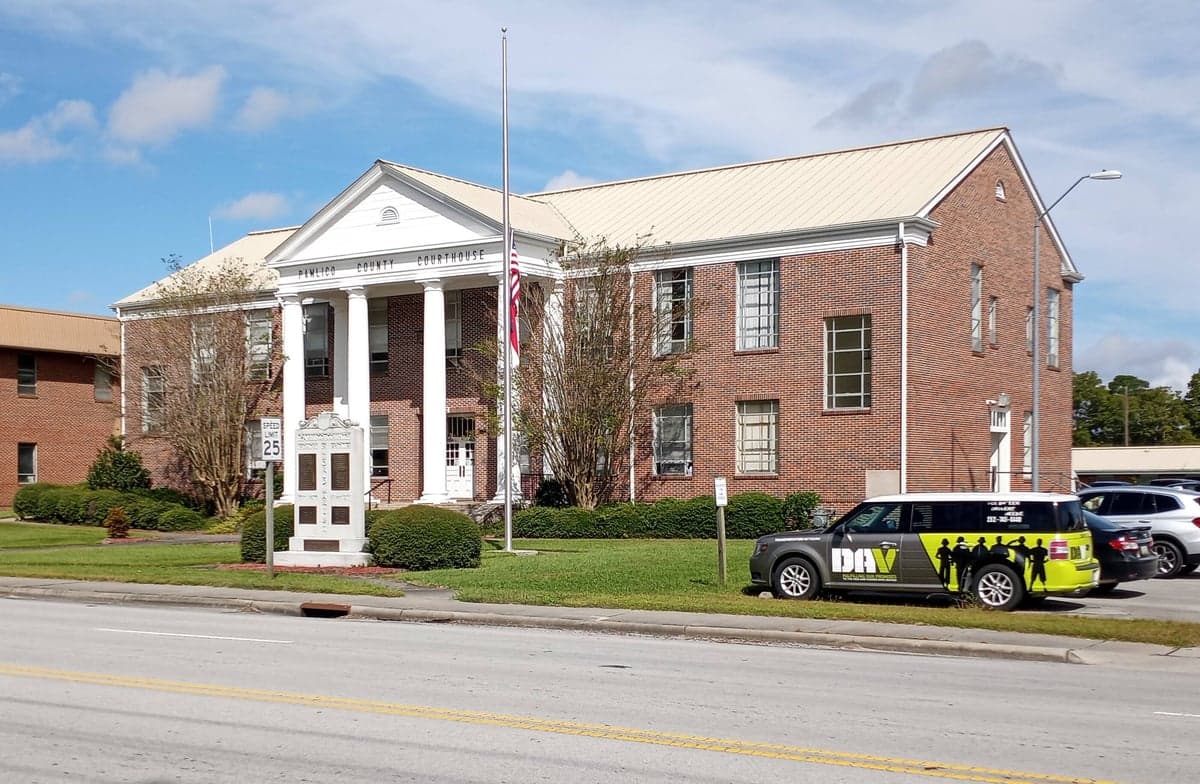
Photo: Wikipedia
Political ClimatePolitical Climate in Pamlico County
Showing county-level results — no local-only data available.
Lean and PVI are calculated from this county’s 2020 and 2024 presidential results, Cook-style.
Political rankings in North Carolina
- Most Conservative Cities in North Carolina
- Most Liberal Cities in North Carolina
- Best Liberal-Leaning Towns in the South
- Best Liberal-Leaning Towns in Appalachia
- Safest Liberal-Leaning Towns in the South
- Safest Conservative-Leaning Towns in the South
- Safest Conservative-Leaning Towns on the East Coast
- Affordable Small Towns for Conservatives
- Most Conservative Counties in North Carolina
- Most Liberal Counties in North Carolina
Local Political AnalysisPolitical Analysis of Pamlico County
Pamlico County, North Carolina, is a classic swing county in a swing state, with a Cook PVI of R+1 that mirrors the state's overall partisan balance. In practice, this means the county is deeply competitive, often flipping between parties in presidential elections and local races, with a slight Republican lean in recent cycles. The political reality here is shaped by a mix of rural conservative values in the unincorporated areas and small towns like Bayboro and Oriental, contrasted with a more moderate-to-liberal tilt in the county seat of Bayboro and the waterfront community of Oriental, where retirees and second-home owners from more progressive areas have settled. Over the past decade, the county has shifted rightward, but not uniformly—precincts around the Neuse River and Pamlico Sound have become more Democratic as new residents arrive, while inland precincts near Grantsboro and Arapahoe have hardened in their Republican voting patterns.
How it compares
Pamlico County's R+1 rating puts it in the same ballpark as North Carolina as a whole, which also carries an R+1 PVI. This means the county is a microcosm of the state's political tug-of-war, but with a few key differences. In statewide races, Pamlico often votes slightly more Republican than the state average—for example, in the 2020 presidential election, Donald Trump won the county by about 4 points, while his statewide margin was just 1.3 points. This gap is driven by the county's older, whiter population and its rural character, which aligns more with the conservative lean of eastern North Carolina than the fast-growing, diversifying suburbs of Charlotte or Raleigh. Locally, the county commission has been reliably Republican since 2016, but the school board and soil and water conservation district races often see competitive Democratic candidates, especially in years with high turnout. The swing precincts are in the central part of the county, around the town of Vandemere, where the vote can flip by 10 points between cycles depending on candidate quality and national mood.
What this means for residents
For conservative residents, Pamlico County offers a comfortable environment where Republican candidates are generally favored, but not guaranteed—meaning their votes matter in a tangible way, especially in local races where a few hundred votes can decide a commission seat. Liberal residents, while outnumbered in most precincts, find their influence concentrated in Bayboro and Oriental, where Democratic candidates can win precinct-level majorities. This creates a dynamic where both sides feel heard, but neither dominates. The practical effect is that policy debates—like zoning for waterfront development, school funding, or hurricane recovery priorities—tend to be pragmatic rather than ideological, because both parties need to build coalitions across the county's small population of about 12,000. The county's low population density means that personal relationships often trump party labels in local governance, with commissioners from both sides working together on issues like maintaining the ferry system to Ocracoke or securing FEMA grants after storms.
Culturally, Pamlico County is distinct from the state's urban centers in its slower pace and deep connection to fishing and farming. The county has no major chain stores or interstate highways, and its politics reflect a wariness of outside influence—whether from Raleigh or Washington. This manifests in policy distinctions like strong opposition to offshore wind energy projects, which both parties in the county have resisted due to concerns about impacts on commercial fishing grounds. At the same time, the county has embraced some progressive initiatives, like a county-wide recycling program and a community college partnership for workforce training, that enjoy bipartisan support. For newcomers, the key is understanding that political labels here are less about ideology and more about trust—a candidate's reputation for showing up at community meetings or helping during a flood matters more than their party registration. The trajectory over the next decade will likely see the county remain a bellwether, with the coastal precincts slowly trending blue as more remote workers and retirees arrive, while the inland areas stay red, keeping Pamlico County in its familiar role as a place where every vote truly counts.

State Political ClimatePolitical Climate in North Carolina
State Political AnalysisPolitical Environment in the State
North Carolina is a classic battleground state with a Cook PVI of R+1, meaning it leans very slightly Republican at the presidential level, but in practice it’s a coin flip. Over the last 10-20 years, the state has shifted from a reliably red southern state to a true purple one, driven by massive in-migration into the Charlotte and Raleigh-Durham metros. The dominant coalitions are a rural, culturally conservative base that turns out heavily for Republicans, and a growing, diverse, college-educated suburban and urban bloc that votes Democratic. The result is a state where statewide races are decided by less than 1.5 points, but the legislature remains firmly Republican due to gerrymandering and the concentration of Democratic votes in a handful of counties.
Urban vs. rural divide
The political map of North Carolina is a textbook study in the urban-rural split. The Democratic strongholds are the state’s three major metro areas: Mecklenburg County (Charlotte), Wake County (Raleigh), and Durham County. In 2024, Mecklenburg went +32 Democratic, Wake +26, and Durham +60. These three counties alone produce a massive Democratic vote margin that forces Republicans to run up the score everywhere else. The rural east—places like Robeson County, Pitt County (Greenville), and the northeastern coastal plain—are ancestrally Democratic but have been trending Republican for a decade, though they still have significant African American and Lumbee Native American populations that keep them competitive. The rural west, including Buncombe County (Asheville), is a blue island in a sea of red, with Asheville itself being one of the most liberal cities in the South. The exurbs and smaller cities like Cary, Apex, and Concord are the true battlegrounds—fast-growing, affluent, and politically split, often deciding statewide races by a few thousand votes.
Policy environment
North Carolina’s policy environment is a mixed bag that reflects its purple status. The state has a flat income tax rate of 4.5%, which is being phased down to 3.99% by 2027 under legislation passed in 2021. The corporate income tax is 2.5% and scheduled to drop to 0% by 2030. Sales tax is 4.75% at the state level, with local add-ons that can push it to 7.5% in some counties. Property taxes are relatively low, with a statewide average effective rate of 0.78%, but they vary widely—Wake County is around 0.85%, while rural counties like Jones County are under 0.6%. Education policy is a flashpoint: the state has a school voucher program (the Opportunity Scholarship Program) that was expanded in 2023 to cover all families regardless of income, and charter schools are plentiful. Healthcare is dominated by the massive Atrium Health and Duke Health systems, but the state has not expanded Medicaid under the Affordable Care Act, leaving roughly 500,000 low-income adults in the coverage gap. Election laws are moderately restrictive: voter ID is required (passed in 2018, implemented in 2023), early voting is generous (17 days), and same-day registration is available during early voting but not on Election Day.
Recent policy direction
The last five years have seen a clear rightward shift on several fronts, tempered by Democratic Governor Roy Cooper’s veto pen until 2023, when Republicans gained a supermajority. On gun and self-defense law, North Carolina is a shall-issue state for concealed carry, and in 2023 the legislature passed a law eliminating the requirement for a permit to purchase a handgun (the “permitless carry” bill, overridden by the legislature after Cooper’s veto). Parental and education rights saw the Parents’ Bill of Rights (HB 755) passed in 2023, requiring schools to notify parents of any changes in a child’s health or well-being and restricting instruction on gender identity and sexuality in K-4. On speech and privacy, the state has no specific law protecting or restricting social media speech, but a 2023 law (HB 347) bans public schools from requiring staff or students to use pronouns that don’t match their biological sex. Medical and bodily autonomy is a major battleground: a 12-week abortion ban was passed in 2023 (SB 20), with exceptions for rape, incest, and life of the mother, but no exceptions for fetal anomalies. Property rights are strong—North Carolina is a “Dillon’s Rule” state, meaning local governments have only the powers explicitly granted by the state, which limits local zoning and rent control. Taxation is trending lower, as noted, with the income tax phase-down and corporate tax elimination. Voting and ballot access saw the 2023 voter ID law upheld, and the state’s 2024 election saw record turnout with no major controversies, though the Republican-controlled State Board of Elections remains a partisan flashpoint.
Civil unrest & political movements
North Carolina has a history of visible political activism on both sides. The Moral Monday protests, which began in 2013 at the state legislature in Raleigh, were a sustained left-wing movement against Republican policies on voting rights, education, and healthcare, drawing thousands of participants. On the right, the “Stop the Steal” movement had a significant presence in 2020-2021, with rallies at the state capitol and in suburban counties like Union County and Cabarrus County. Immigration politics are less heated than in border states, but Charlotte and Durham have sanctuary city policies limiting cooperation with ICE, while the state legislature has repeatedly attempted to ban such policies (HB 10 in 2023, which passed the House but died in the Senate). Election integrity remains a live issue: the 2020 election saw a recount in the presidential race (Trump won by 1.3 points), and the 2024 gubernatorial race was decided by less than 1 point, with both sides alleging irregularities. There is no serious secession or nullification rhetoric, but the state’s rural counties have a strong “local control” movement that resists state mandates on everything from solar farms to school curriculum.
Projection
Over the next 5-10 years, North Carolina is likely to become more competitive, not less. The in-migration from blue states (New York, New Jersey, California) into the Charlotte and Raleigh metros is overwhelmingly Democratic-leaning, and these areas are growing at 2-3% per year. Meanwhile, rural counties are aging and losing population. The 2030 redistricting cycle will be critical—if Democrats can win the governorship and one chamber of the legislature, they could force fairer maps that would likely flip the state to a D+1 or D+2 lean. However, the Republican legislature is likely to continue pushing conservative policies on abortion, education, and taxes, which will keep the base energized. A new resident moving in now should expect a state that remains politically divided, with statewide elections that are too close to call, but with a slow, steady drift toward purple-to-blue over the decade. The practical effect is that your vote will matter more here than in almost any other state.
For a new resident, the bottom line is that North Carolina offers a low-tax, business-friendly environment with a strong economy, but the political climate is volatile and deeply polarized. If you’re conservative, you’ll find a legislature that reflects your values on taxes, guns, and education, but you’ll live in a state where the governor and many local governments are liberal. If you’re liberal, you’ll find vibrant blue cities and a growing coalition, but you’ll face a legislature that consistently overrides your votes on social issues. The key is to choose your county carefully—Wake and Mecklenburg are blue, Union and Cabarrus are red, and the exurbs are the true swing ground. Either way, you’re moving to a state where politics is a contact sport, and your voice will be heard.
* Values derived from national, state, county, city and local statistics and may differ in a specific area. Last updated: 2026-11-05T10:19:56.000Z
Narrative content on this page is AI-generated and may contain mistakes. Verify any details that matter before acting on them.
ReloMaps may earn a commission from affiliate links at no extra cost to you.

