Photo: Wikipedia
Demographics of Pamlico County
Affluence Level in Pamlico County
A middle-class area roughly in line with national averages across income, home values, education, and employment.
People of Pamlico County
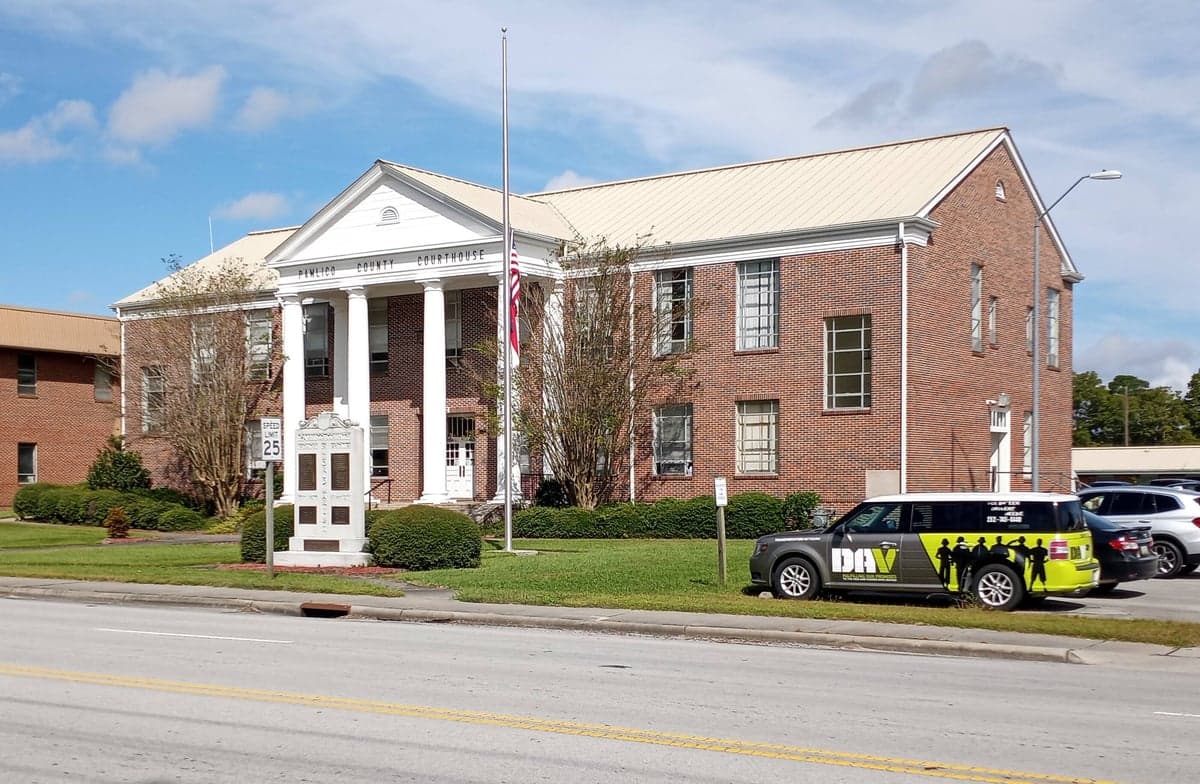
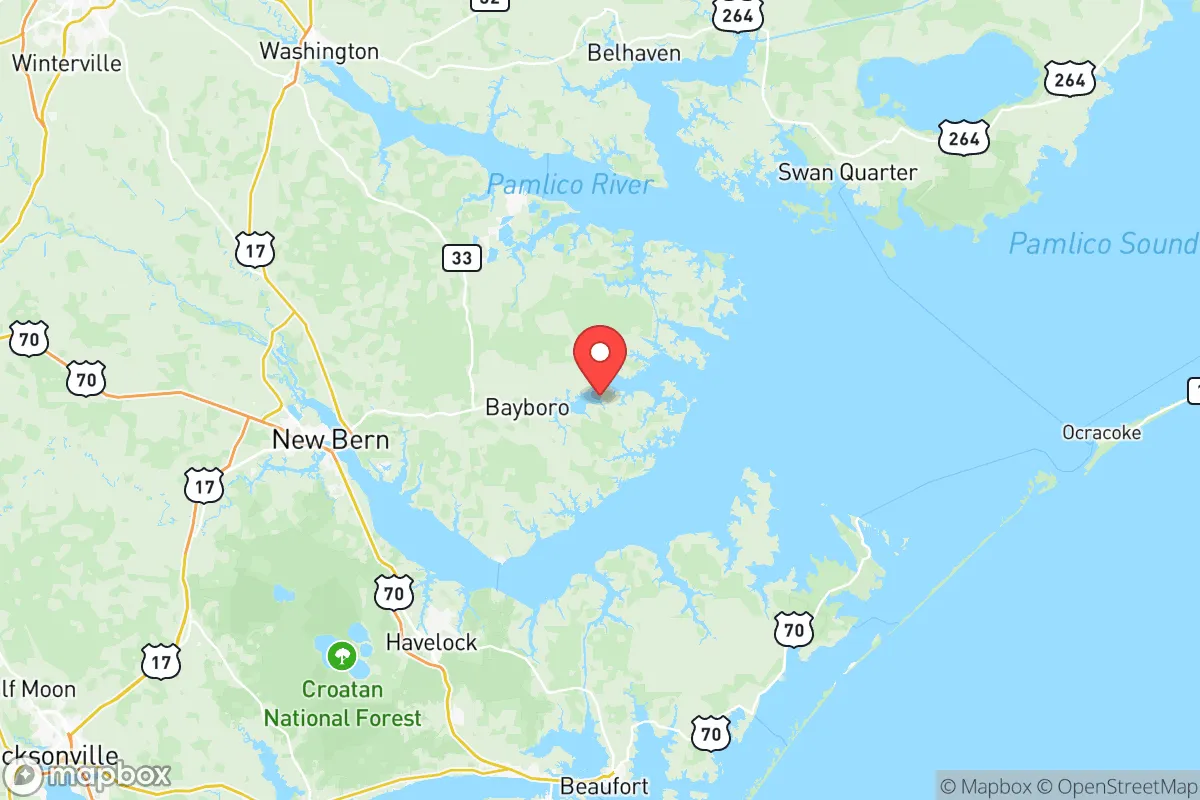
Pamlico County, North Carolina, is home to roughly 12,315 residents spread across a rural, waterfront expanse where the Neuse River meets the Pamlico Sound. The population is 74.0% White, 18.5% Black, and 4.6% Hispanic, with a foreign-born share of just 1.6% — one of the lowest in the state. This is a deeply rooted, native-born community defined by generational family land, commercial fishing, and a slow pace of life that has resisted the rapid growth seen elsewhere in coastal Carolina. The county seat of Bayboro and the unincorporated communities of Grantsboro, Arapahoe, and Oriental anchor a population that remains overwhelmingly local in origin and character.
Settlement & growth (pre-1960)
Long before European arrival, the region was home to the Coree and Neusiok peoples, Algonquian-speaking tribes who fished the sounds and lived along the riverbanks. Their presence was dramatically reduced by the 18th century through disease, conflict, and displacement during the Tuscarora War (1711–1715), which effectively ended organized Native resistance in the area. By the time of the American Revolution, the land that would become Pamlico County was a sparsely settled frontier of the larger Craven County, with a handful of plantations and subsistence farms carved out of the pine forests.
Pamlico County was formally established in 1872, but its population character was set decades earlier by two distinct waves. The first was an influx of English and Scots-Irish settlers in the late 1700s and early 1800s, who arrived via the Neuse River and took up small farms and timber operations. These families — names like the Whitfords, the Allens, and the Carraways — established the county's earliest permanent settlements at Bayboro (the county seat, incorporated 1872) and Vandemere, a river port that became a shipping point for lumber, turpentine, and agricultural goods. The second wave was the forced migration of enslaved Africans, who worked the region's small cotton and corn plantations; by 1860, roughly 40% of the area's population was enslaved, a share that shaped the county's social and economic structure for generations.
After the Civil War and Emancipation, freedmen established their own communities, most notably in the Stonewall area and along the rural roads between Bayboro and Merritt. These Black communities built their own churches, schools, and mutual aid societies, and their descendants remain a significant presence in the county today — the 18.5% Black population is almost entirely native-born and traces its local roots to the post-war era. The late 19th and early 20th centuries brought a third, smaller wave: a scattering of German and Scandinavian families drawn by the timber and naval stores industries, who settled around Arapahoe and Oriental. Oriental, incorporated in 1899, was briefly promoted as a resort town for Northern sportsmen, but its permanent population remained small and overwhelmingly native-born.
Through the first half of the 20th century, Pamlico County's population grew slowly and steadily, driven by natural increase rather than immigration. The county peaked at roughly 14,000 residents in the 1940s, then began a long decline as mechanized agriculture and the collapse of the local timber industry pushed younger generations toward Raleigh, Wilmington, and the shipyards of Norfolk. By 1960, the population had fallen to about 11,000, and the county's character was firmly established: rural, poor, and deeply tied to the water — commercial fishing, oystering, and crabbing had replaced timber as the economic backbone.
Modern era (post-1965)
The 1965 Hart-Cellar Act, which transformed U.S. immigration policy, had virtually no direct effect on Pamlico County. Unlike the booming metros of Charlotte or Raleigh, Pamlico attracted almost no new immigrant communities — the county's foreign-born share of 1.6% is a fraction of the state average of roughly 8%. The demographic shifts that did occur were domestic, not international, and they were modest in scale.
The most significant post-1965 change was the gradual return of retirees and second-home buyers drawn by the county's unspoiled waterfront. Oriental, in particular, reinvented itself as a sailing and boating destination, attracting a wave of affluent newcomers from the Northeast and Midwest starting in the 1980s. This influx brought new money, new construction, and a modestly more educated population, but it did not fundamentally alter the county's racial or ethnic composition — the newcomers were overwhelmingly White, and they concentrated almost exclusively in Oriental and along the waterfront, leaving the inland communities of Grantsboro, Alliance, and Hobucken largely untouched.
The Hispanic population, now 4.6%, is the county's only notable post-1965 immigrant story. Beginning in the 1990s and accelerating in the 2000s, a small but steady flow of Mexican and Central American workers arrived to fill labor shortages in the county's seafood processing plants and agricultural operations, particularly around Bayboro and Lowland. This community remains small, dispersed, and largely Spanish-speaking, with no formal enclave or ethnic neighborhood — a pattern consistent with the county's rural, low-density settlement. The East/Southeast Asian population (0.6%) and Indian-subcontinent population (0.0%) are negligible, reflecting the absence of any professional or tech-driven migration to the area.
Suburbanization, the dominant force reshaping most of North Carolina since 1990, has largely passed Pamlico County by. The county has no interstate highway, no major employer, and no large town — the largest municipality, Bayboro, has fewer than 1,000 residents. The population has remained essentially flat for three decades, hovering between 12,000 and 13,000, even as neighboring Craven and Carteret counties have grown rapidly. The county's college-educated share of 25.4% is below the state average, and its economy remains anchored in fishing, agriculture, and a growing but modest tourism sector.
The future
Pamlico County's demographic trajectory points toward slow, incremental change rather than transformation. The county is projected to remain overwhelmingly White and native-born over the next two decades, with the Hispanic share likely to grow modestly — perhaps to 6-7% by 2040 — as the seafood and agricultural industries continue to rely on immigrant labor. The Black population, deeply rooted and aging, is expected to hold steady or decline slightly as younger residents continue to leave for educational and employment opportunities in larger cities.
The most likely source of future growth is continued retiree migration to Oriental and the waterfront areas, driven by the same factors that have attracted newcomers for the past four decades: relatively affordable waterfront property, a mild climate, and a quiet, safe environment. This trend will gradually raise the county's median age and income, but it will not substantially increase diversity — the county's racial and ethnic composition is likely to remain within a few percentage points of its current profile. The inland communities of Grantsboro, Arapahoe, and Stonewall will likely see little change, remaining the heart of the county's native-born, working-class culture.
One wildcard is the potential for climate-driven migration. As sea levels rise and hurricane risk intensifies along the Outer Banks and low-lying coastal areas, some analysts predict a gradual inland shift of population toward higher ground. Pamlico County, with its mix of waterfront and inland terrain, could see modest inflows from more exposed coastal communities in the coming decades — but this remains speculative, and the county's lack of infrastructure and employment base will likely limit any significant influx.
Pamlico County is, and will likely remain, a place apart — a rural, water-oriented community where family history runs deep and newcomers are few. For someone moving in today, the county offers a genuine small-town coastal lifestyle at a fraction of the cost of more developed areas, but it also means accepting a population that is older, less diverse, and less educated than the state average. The people here are defined less by where they came from than by their connection to the water and the land — a character that has persisted for 150 years and shows no signs of changing soon.

* Values derived from national, state, county, city and local statistics and may differ in a specific area. Last updated: 2026-11-05T10:19:56.000Z
Narrative content on this page is AI-generated and may contain mistakes. Verify any details that matter before acting on them.
ReloMaps may earn a commission from affiliate links at no extra cost to you.

