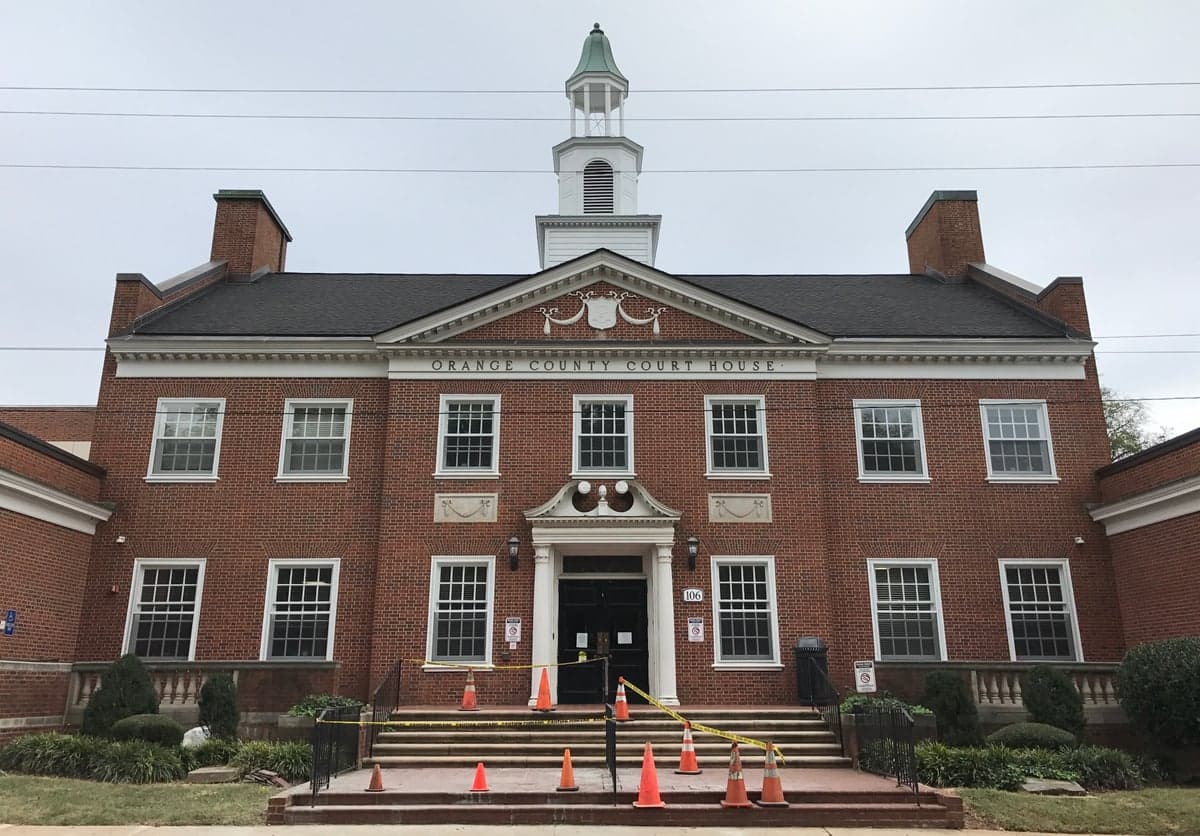
Photo: Wikipedia
Political ClimatePolitical Climate in Orange County
Showing district-level results — no local-only data available.
Local Political AnalysisPolitical Analysis of Orange County
Orange County, North Carolina, is one of the most reliably Democratic strongholds in the state, with a Cook Partisan Voting Index of D+23—a stark contrast to the state's overall R+1 rating. This deep blue lean is driven overwhelmingly by the college town of Chapel Hill and the county seat of Hillsborough, while the more rural, western parts of the county around the towns of Efland and Mebane (which straddles Alamance County) show a more mixed or even conservative tilt. The county has been trending bluer for decades, accelerating after the 2016 election, and shows no signs of reversing course.
How it compares
To put the D+23 PVI in perspective, Orange County is roughly 24 points more Democratic than the state of North Carolina as a whole. This is not a purple county; it's a deep blue island in a state that swung for Donald Trump in 2024 by a narrow margin. Within the county, the political geography is sharply divided. Chapel Hill and Carrboro are among the most liberal municipalities in the Southeast, routinely voting 80-85% Democratic. Hillsborough is reliably blue but slightly more moderate, often voting around 65-70% Democratic. In contrast, the unincorporated areas west of Hillsborough—particularly around Efland and the Orange County portion of Mebane—can swing Republican, with some precincts voting 55-60% for GOP candidates. The swing precincts are generally the rural, lower-density areas along the Alamance County line, where development pressure is lower and the population is older and more rural.
What this means for residents
For liberal residents, Orange County feels like a safe haven. Local government, from the Board of County Commissioners to the school board, is dominated by Democrats or left-leaning independents. Progressive policies on affordable housing, environmental sustainability, and social justice are standard agenda items. For conservative residents, the reality is more isolating. There is no Republican elected official at the county level, and conservative viewpoints are rarely represented in local media or public forums. However, conservative residents do find representation at the state level, as the county's state House and Senate districts are drawn to include more rural, conservative areas. In practice, this means a conservative family in Efland may feel out of step with their county government but can still vote for a state representative who shares their views. The cultural divide is real: a Trump yard sign in Chapel Hill would be a rarity, while in Efland it's unremarkable.
One notable cultural and policy distinction is the county's approach to growth and development. Orange County has some of the strictest land-use regulations in the state, including a 50-foot riparian buffer rule and a transfer of development rights program that funnels growth into designated "compact communities." This is a direct reflection of the county's progressive political lean, prioritizing environmental protection and managed growth over rapid expansion. In contrast, neighboring Alamance County (R+12) has far looser regulations, leading to a stark difference in development patterns—big-box stores and subdivisions cluster just over the county line. For residents, this means higher housing costs in Orange County but also more preserved farmland and open space. The political climate here isn't just about voting; it shapes the very landscape you drive through every day.

State Political ClimatePolitical Climate in North Carolina
State Political AnalysisPolitical Environment in the State
North Carolina has earned its reputation as the ultimate swing state in the South, and after living here for decades, I can tell you the political ground shifts under your feet every election cycle. The state’s overall partisan lean is a razor-thin R+1 on the Cook PVI, meaning it’s essentially tied between the two major coalitions. Over the last 10-20 years, we’ve seen a clear trajectory: the old rural Democratic strongholds have collapsed, the Research Triangle and Charlotte metros have exploded in population and turned blue, and the fast-growing suburbs and exurbs have become the decisive battlegrounds. The result is a state that votes Republican for president by a point or two, but then flips and sends a Democratic governor and a split legislature to Raleigh. It’s a place where both sides feel like they’re winning and losing at the same time.
Urban vs. rural divide
The political map of North Carolina is a textbook study in the urban-rural chasm. The three major metros — Charlotte, the Raleigh-Durham-Chapel Hill Research Triangle, and to a lesser extent Greensboro-Winston-Salem — are the engine of Democratic growth. Mecklenburg County (Charlotte) and Wake County (Raleigh) alone now account for roughly a quarter of the state’s vote, and they’ve been trending blue for a decade. The Triangle is especially dominant: it’s a magnet for out-of-state tech and biotech workers, and it’s where you’ll find the most liberal enclaves, like Carrboro and downtown Durham. Meanwhile, the rural east — places like Robeson County (Lumbee-heavy, ancestrally Democratic but now competitive) and the northeastern counties along the coast — have been bleeding Democratic support as cultural issues take precedence over economic ones. The western mountains, including Buncombe County (Asheville), are a blue island in a sea of red, with Asheville itself being one of the most progressive small cities in the South. The real action, though, is in the exurbs and suburbs: Union County (southeast of Charlotte) and Johnston County (southeast of Raleigh) are growing fast and have become reliably Republican, while Cabarrus County and Harnett County are trending redder as they fill up with families fleeing the cities. The rural-to-suburban shift is the single biggest political story here.
Policy environment
North Carolina’s policy environment is a mixed bag that reflects its split government. On taxes, the state has moved aggressively in a conservative direction: the flat income tax rate has been cut repeatedly and is now 4.5%, with a scheduled drop to 3.99% by 2027. There’s no state tax on Social Security income, and the standard deduction is generous. The corporate tax rate is 2.5% and falling to zero by 2030. That’s a big draw for businesses and retirees. On regulation, the state is generally business-friendly, with a right-to-work law and a relatively low regulatory burden. Education is a flashpoint: the state has a robust charter school and voucher program (the Opportunity Scholarship Program), which has been expanded to all families regardless of income. Public school funding has been a perennial court battle (the Leandro case), and the Republican legislature has resisted court orders to pour more money into the system. Healthcare is a sore spot: North Carolina is one of the few Southern states that expanded Medicaid under the Affordable Care Act, but it only happened in 2023 after a decade of stalemate. Election laws are a constant tug-of-war: voter ID is now in effect (passed by the GOP, upheld by courts), and the state has strict absentee ballot rules. Early voting is popular and bipartisan, with long lines in both red and blue counties.
Recent policy direction
The last five years have seen a clear conservative shift on several fronts, even with a Democratic governor. On gun and self-defense law, North Carolina is a shall-issue state for concealed carry, and in 2023 the legislature passed a law eliminating the permit requirement for concealed carry (the “permitless carry” law, effective immediately). Open carry is legal without a permit. On parental and education rights, the legislature passed the “Parents’ Bill of Rights” in 2023, requiring schools to notify parents about instructional materials involving sexuality and to get parental consent before changing a student’s name or pronouns. On speech, the state has no specific anti-SLAPP law, but campus speech is generally protected. On privacy and surveillance, there’s no comprehensive data privacy law yet, though a bill is pending. On medical and bodily autonomy, abortion is legal up to 12 weeks (as of a 2023 law that replaced a previous 20-week ban), with a 72-hour waiting period and mandatory counseling. The Republican supermajority tried to go further but was blocked by Governor Roy Cooper’s veto. On property rights, the state has strong eminent domain protections, and there’s no statewide rent control. On taxation, the trajectory is clearly downward, as noted. On voting and ballot access, the state has same-day registration during early voting, but the voter ID law is in effect, and the legislature has tightened absentee ballot rules. The overall direction is a state that’s becoming more conservative on cultural and economic issues, but with a Democratic governor who can slow but not stop the trend.
Civil unrest & political movements
North Carolina has seen its share of political flashpoints. The Moral Monday protests of 2013-2014 were a defining moment, with thousands of activists (led by the NAACP’s Rev. William Barber) occupying the state legislature to protest voting restrictions, education cuts, and the refusal to expand Medicaid. That movement gave birth to a lasting progressive infrastructure. On the right, the “We the People” and Tea Party movements were strong here, and the state was an early adopter of election integrity activism after 2020. The LGBTQ+ rights battle was intense: the 2016 “HB2” (the “bathroom bill”) made national headlines, led to boycotts and economic losses, and was eventually repealed in a compromise. Immigration politics are relatively muted compared to border states, but there’s a patchwork of sanctuary policies: some cities (like Durham and Orange County) have declared themselves “welcoming cities,” while the state legislature has passed laws banning sanctuary policies and requiring local law enforcement to cooperate with ICE. There’s no serious secession or nullification rhetoric here — North Carolina is too economically integrated and too purple for that. The most visible flashpoint for a new resident would be the constant campaign ads and the intensity of local politics, especially in the swing counties like Cumberland (Fayetteville) and New Hanover (Wilmington).
Projection
Over the next 5-10 years, I see North Carolina staying purple but shifting slightly to the right on cultural issues while remaining competitive on economics. The in-migration is a wild card: we’re getting a lot of people from the Northeast and California, and early data suggests they’re slightly more Democratic than native-born North Carolinians, but they’re also often fiscally conservative and socially moderate. The Charlotte and Raleigh metros will continue to grow and trend blue, but the exurbs and smaller cities (like Wilmington, Greenville, and Asheville) are growing faster and are more mixed. The rural areas will keep shrinking and getting redder. The big question is whether the Republican legislature can hold its supermajority after the 2024 redistricting cycle — if they do, expect more conservative policy on abortion, education, and taxes. If Democrats break the supermajority, the governor’s veto will have more teeth. Either way, the state is not going to become a deep red Texas or a deep blue Virginia. It’s going to remain a place where every election feels like a knife fight.
For someone moving here now, the bottom line is this: you’ll find a state where your vote actually matters, where the policy environment is broadly conservative on taxes and regulation but contested on social issues, and where the political temperature is high but the actual disruption to daily life is low. If you’re conservative, you’ll appreciate the low taxes, the gun laws, and the school choice options. If you’re liberal, you’ll find vibrant blue cities, a strong progressive activist community, and a governor who can block the worst of what the legislature wants. Just be prepared for the constant campaign ads and the fact that your neighbors might not share your politics — but that’s what makes this place interesting.
* Values derived from national, state, county, city and local statistics and may differ in a specific area. Last updated: 2026-06-22T20:04:09.000Z
Narrative content on this page is AI-generated and may contain mistakes. Verify any details that matter before acting on them.
ReloMaps may earn a commission from affiliate links at no extra cost to you.

