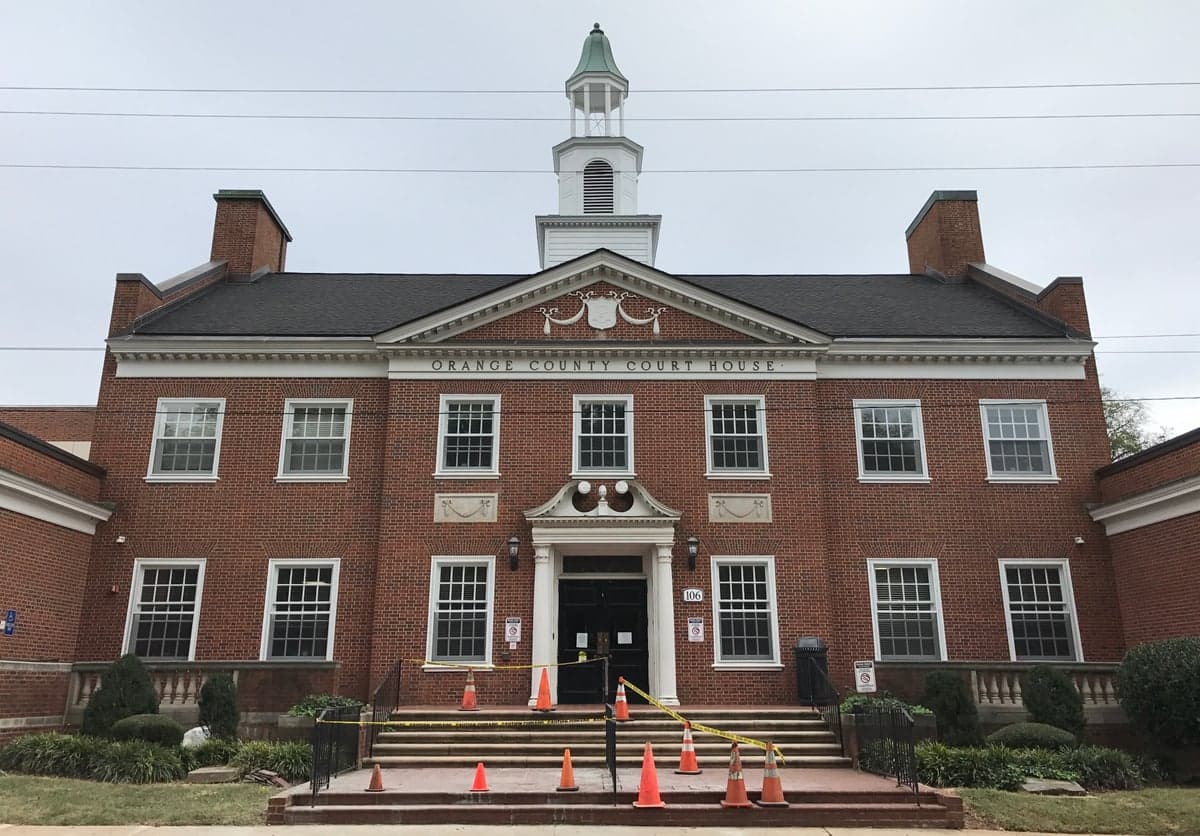
Photo: Wikipedia
Demographics of Orange County
Affluence Level in Orange County
A middle-class area roughly in line with national averages across income, home values, education, and employment.
People of Orange County
Orange County, North Carolina, is home to 147,292 residents who form one of the state’s most educated and politically distinctive populations, with 61.8% holding a college degree and a strong liberal tilt anchored by the University of North Carolina at Chapel Hill. The county’s character is shaped by a blend of historic small towns, university-driven growth, and a slowly diversifying racial makeup that remains majority white at 66.8%, with significant Hispanic (10.6%), Black (10.2%), East/Southeast Asian (5.9%), and Indian-subcontinent (2.0%) communities. The foreign-born share sits at 6.7%, below the national average, reflecting a population shaped more by domestic migration than international immigration. Residents today identify strongly with the county’s progressive politics, its research and education economy, and the tension between Chapel Hill’s urban energy and the rural character of towns like Hillsborough and Carrboro.
Settlement & growth (pre-1960)
Before European settlement, the land that became Orange County was home to the Occaneechi and Sissipahaw peoples, Siouan-speaking tribes who lived along the Eno and Haw Rivers. The Occaneechi maintained a fortified village near present-day Hillsborough, trading with Virginia colonists before being displaced by warfare and disease in the late 1600s and early 1700s. By the mid-1700s, the region was largely depopulated of Native inhabitants, and European settlers began arriving in earnest.
The first major wave of European settlers came from the British Isles, primarily Scots-Irish and English, who moved south from Pennsylvania and Virginia along the Great Wagon Road in the 1740s and 1750s. These settlers were drawn by cheap land grants in the Piedmont, and they established farms and small communities along the Eno River. The town of Hillsborough, originally called Orange, was founded in 1754 as the county seat and became a political and commercial hub. A smaller but notable group of German-speaking settlers from Pennsylvania also arrived in the same period, settling in the northern part of the county near what is now Efland and Mebane, where their descendants remain today.
Orange County was officially formed in 1752 from parts of Granville and Johnston counties, and its early economy was built on tobacco and mixed agriculture worked by a combination of free white farmers and enslaved Black laborers. By 1790, enslaved people made up roughly 25% of the county’s population, a share that grew as tobacco farming expanded. The Black population remained concentrated in rural areas and on plantations, with small free Black communities forming around Hillsborough and Chapel Hill after the Civil War.
The founding of the University of North Carolina in Chapel Hill in 1789 was the single most transformative event in the county’s history. The university drew faculty, students, and support staff from across the state and, later, the nation, creating a small but influential educated class in an otherwise rural county. Chapel Hill grew slowly as a college town through the 19th and early 20th centuries, while Hillsborough remained the commercial and governmental center. The arrival of the North Carolina Railroad in the 1850s, with stops in Hillsborough and later in Chapel Hill via a spur line, connected the county to broader markets and spurred modest growth.
Through the early 1900s, Orange County remained predominantly rural and agricultural, with tobacco, cotton, and timber as economic mainstays. The Great Depression hit the county hard, but the New Deal brought infrastructure improvements, including rural electrification and road paving. World War II brought a small influx of military personnel and defense workers to the region, though Orange County saw less dramatic change than industrializing areas of the state. The post-war period, from 1945 to 1960, saw the beginning of suburbanization around Chapel Hill, driven by the GI Bill-fueled expansion of the university and the growth of research activities. Carrboro, originally a mill town called West End, began its transformation from a working-class industrial village into a bedroom community for university faculty and staff.
Modern era (post-1965)
The 1965 Hart-Cellar Act had a modest direct effect on Orange County compared to major immigrant gateway cities, but it set the stage for the county’s gradual diversification. The most significant demographic shift after 1965 was not international immigration but domestic migration: the explosive growth of the Research Triangle Park (RTP), established in 1959 between Durham, Raleigh, and Chapel Hill. RTP drew highly educated professionals from across the United States and, increasingly, from abroad, transforming Orange County from a quiet college town and rural county into a node of the global knowledge economy.
The East/Southeast Asian population, now 5.9% of the county, grew substantially from the 1980s onward, driven by the recruitment of scientists, engineers, and academics to UNC-Chapel Hill and RTP employers. Chinese, Korean, and Japanese professionals and their families settled primarily in Chapel Hill and southern Orange County, near the university and the park. A smaller but visible Indian-subcontinent community, now 2.0% of the population, followed a similar trajectory, with many Indian professionals working in tech, medicine, and academia. These communities are dispersed rather than concentrated in ethnic enclaves, though Chapel Hill’s central neighborhoods and the area around the Friday Center have notable Asian and Indian populations.
The Hispanic population, now 10.6%, grew rapidly from the 1990s through the 2010s, driven by labor demand in construction, landscaping, agriculture, and the service industry. Hispanic residents, predominantly of Mexican origin, settled in Chapel Hill, Carrboro, and increasingly in Hillsborough and rural areas of northern Orange County. Carrboro’s mobile home parks and older rental neighborhoods became informal hubs for Hispanic families, while Hillsborough saw growth in Hispanic-owned businesses along the Churton Street corridor. The Hispanic population is younger and has higher birth rates than the county’s white population, contributing to its rising share.
The Black population, now 10.2%, has a longer history in Orange County but has seen its relative share decline as the county has grown and diversified. Historically concentrated in rural areas and in the Rogers Road neighborhood of Chapel Hill, Black residents have faced displacement pressures from rising property values and university expansion. The Rogers Road community, settled by freed slaves after the Civil War, has been a focal point of environmental justice activism due to the siting of a county landfill nearby. Younger Black professionals have moved into Chapel Hill and Carrboro, but the Black population is older on average than the Hispanic and Asian populations.
Suburbanization accelerated after 1990, with new subdivisions spreading south and east of Chapel Hill toward the Durham County line and north toward Hillsborough. The town of Mebane, straddling the Orange-Alamance county line, grew rapidly as a commuter suburb for RTP workers, attracting families seeking lower housing costs than Chapel Hill. The rural character of northern Orange County, around the unincorporated communities of Efland and Caldwell, has been partially preserved by the county’s strict land-use policies and the Orange County Rural Buffer, which limits suburban sprawl.
The future
Orange County is projected to continue growing slowly but steadily, constrained by land-use regulations and high housing costs that limit in-migration. The population is becoming more diverse, driven primarily by Hispanic and East/Southeast Asian growth, while the white share is declining gradually from its current 66.8%. The Indian-subcontinent community is small but growing, concentrated in high-skill professional fields. The Black population share is likely to remain stable or decline slightly, as out-migration to more affordable areas offsets in-migration.
New residential development is concentrated in the Chapel Hill-Carrboro urban core, where infill and transit-oriented projects are being built near the new light rail corridor planned to connect Chapel Hill to Durham and Raleigh. Hillsborough is seeing modest growth, with new subdivisions on its outskirts and a revitalizing downtown attracting artists and young families priced out of Chapel Hill. The rural northern part of the county is likely to remain low-density, protected by the Rural Buffer and the county’s conservation easements, though pressure for development will continue as the Triangle region expands.
Culturally, Orange County is becoming more secular, more politically progressive, and more oriented toward the knowledge economy. The university’s influence will remain dominant, shaping both the economy and the social character of the county. The Hispanic and Asian communities are becoming more visible in local politics and civic life, though they remain underrepresented relative to their population shares. The county’s identity as a liberal enclave within a purple state is likely to intensify, potentially creating tension with more conservative areas of the state and with the rural parts of the county itself, where political views are more moderate.
For someone moving in now, Orange County offers a highly educated, politically engaged, and culturally liberal environment with strong public schools, abundant green space, and a robust local food and arts scene. The trade-offs are high housing costs, a tight rental market, and a cost of living that is among the highest in North Carolina outside of Charlotte and Raleigh. The county is becoming more diverse and more urban, but it retains a distinctly small-town and academic character that sets it apart from the faster-growing and more corporate suburbs of the Triangle. It is a place for people who value education, community engagement, and progressive politics, and who are willing to pay a premium for those amenities.

* Values derived from national, state, county, city and local statistics and may differ in a specific area. Last updated: 2026-06-22T20:04:09.000Z
Narrative content on this page is AI-generated and may contain mistakes. Verify any details that matter before acting on them.
ReloMaps may earn a commission from affiliate links at no extra cost to you.

