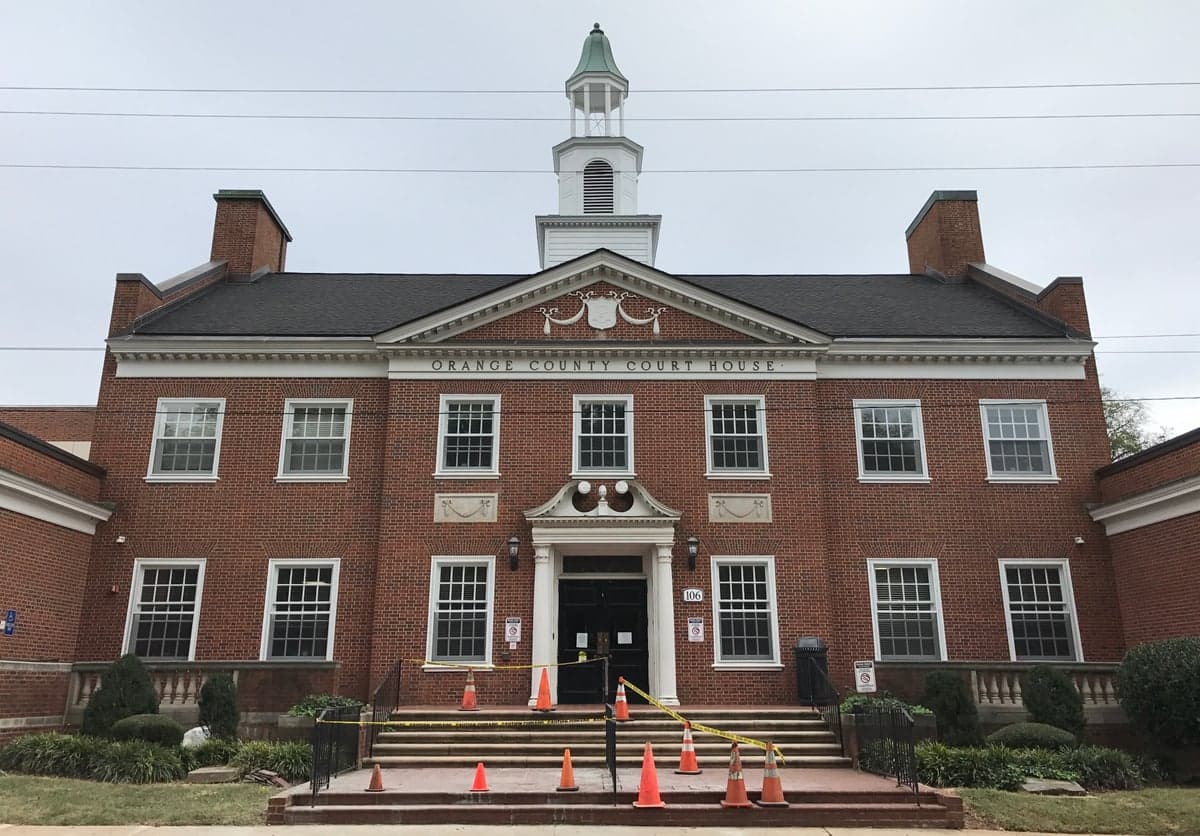
Photo: Wikipedia
Personal Sovereignty in Orange County
Viable for self-reliance. Generally workable, though some barriers may limit total independence.
What does Personal Sovereignty tell us?
Personal Sovereignty measures your capacity for self-reliance and independence with minimal government friction. Higher scores mean fewer barriers between you and the way you want to live... but it assumes you have the space you need and good neighbors.
What does this tell us?
Personal Sovereignty measures your capacity for self-reliance and independence with minimal government friction. Higher scores mean fewer barriers between you and the way you want to live... but it assumes you have the space you need and good neighbors.
State Policy
Energy independence: Importer (15% of energy produced in-state)
Personal Liberty
Homesteading

Personal Liberty Analysis
Orange County, North Carolina, presents a nuanced personal sovereignty environment where state-level protections for gun rights and property rights coexist with a county government that leans more interventionist than its rural neighbors. The county’s autonomy profile is shaped by the competing influences of the progressive college town of Chapel Hill, the historic small-town feel of Hillsborough, and the more rural, unincorporated areas like Caldwell and Efland. For a conservative-leaning individual or family, the key takeaway is that personal freedom is strongest in the county’s outer reaches and weakest within the municipal limits of Chapel Hill and Carrboro, where local ordinances and a higher density of regulation apply.
Tax burden and local regulatory posture: how heavy is the hand of government?
Orange County’s tax burden is among the highest in North Carolina, driven largely by the services demanded by its population. The combined property tax rate for the county and Chapel Hill is approximately 1.04 per $100 of assessed value, significantly above the state median of around 0.72. This funds a well-regarded school system and extensive parks, but it directly reduces disposable income for homeowners. The county also imposes a 0.5% local sales tax on top of the state’s 4.75% rate. Regulatory posture is mixed: the county has a unified development ordinance that imposes stricter stormwater and tree-protection rules than most rural counties, particularly in the Jordan Lake watershed area. However, outside municipal limits, there is no countywide zoning for agricultural uses, meaning a landowner in Efland can keep livestock or operate a small farm without a special permit, whereas a similar property inside Hillsborough’s extra-territorial jurisdiction (ETJ) would face more hurdles. The county’s land-use plan is advisory, not mandatory, for most rural parcels, giving property owners more latitude than in neighboring Durham County.
Self-defense and gun law specifics: what can you legally do to protect yourself?
North Carolina is a shall-issue state for concealed carry permits, and Orange County’s sheriff’s office processes applications without the discretionary denials seen in some more restrictive counties. The state preempts local governments from regulating the possession, sale, or transfer of firearms, so Chapel Hill cannot ban guns in city parks or impose its own waiting periods, despite periodic local efforts to do so. Open carry is legal without a permit for anyone 18 or older who can legally possess a firearm. Stand-your-ground laws apply statewide, meaning there is no duty to retreat before using deadly force in self-defense in any place where the person is lawfully present. However, the cultural climate in Chapel Hill and Carrboro is notably less gun-friendly; public carry is uncommon and may draw unwanted attention from law-abiding citizens. In contrast, in rural areas like White Cross or Buckhorn, firearm ownership is the norm, and shooting ranges are more accepted. The county has no local ammunition tax or magazine capacity restrictions, as those are preempted by state law. For a family moving to the area, the practical difference is that you can legally own and carry firearms anywhere in the county, but the social environment in the urban core may feel less welcoming to visible gun ownership.
Self-reliance and homesteading viability: lot sizes, zoning, and off-grid feasibility
Homesteading viability varies dramatically across Orange County. In the unincorporated areas, minimum lot sizes are typically 1 to 2 acres for a single-family home on a well and septic system, which is feasible for a small homestead. Areas like Caldwell and Efland have a history of agricultural use, and the county’s zoning allows for keeping chickens, goats, and even a few head of cattle without a special use permit, provided the property is at least one acre. Off-grid living is legally possible but practically constrained: the county requires a permitted septic system for any dwelling with plumbing, and the health department enforces strict soil suitability tests. Solar panels are allowed without county-level restrictions, but the local utility, Duke Energy, has net metering caps that limit the financial benefit of exporting power. Rainwater collection is legal and encouraged for non-potable uses. The biggest hurdle for off-gridders is the building code: the county enforces the state’s residential code for all new dwellings, meaning a tiny house on wheels is treated as an RV and cannot be a permanent residence unless it meets foundation and square footage requirements. In Hillsborough’s ETJ, the rules are tighter, with a minimum 3-acre lot for new subdivisions and stricter stormwater management. For a serious homesteader, the northwest corner of the county near the Caswell County line offers the most freedom, with larger parcels and less enforcement pressure.
Personal liberties: parental rights, medical autonomy, speech, and property
Parental rights in Orange County are generally protected under state law, but the local school board has adopted policies that some conservative families find intrusive. The district’s comprehensive sex education curriculum includes content on gender identity and sexual orientation, and parents must opt their children out rather than opt them in. The county’s health department operates a Title X family planning clinic that provides contraceptive services to minors without parental consent, a state-level policy that applies uniformly. Medical autonomy is a mixed bag: North Carolina has not expanded Medicaid under the Affordable Care Act, but Orange County’s public hospital system, UNC Health, is a large employer and generally follows standard medical protocols. There are no local vaccine mandates beyond state requirements for school attendance, and the county does not have a local mask mandate or business closure ordinance on the books as of 2026. Free speech is robustly protected; the county has no local hate speech ordinances that would conflict with the First Amendment, and public comment periods at county commission meetings are open to all. Property rights are the strongest area of personal liberty here: the county’s eminent domain authority is limited to public projects like road widening, and there is no countywide rent control or short-term rental ban outside of Chapel Hill’s city limits. In Mebane (which straddles Orange and Alamance counties), property taxes are lower, and the regulatory climate is more permissive for home-based businesses.
Overall, Orange County offers a split sovereignty landscape: state law provides a solid floor for gun rights, property rights, and tax structure, but the county’s local government adds a layer of regulation and higher taxes that is heavier than in neighboring Alamance or Caswell counties. For a family that values personal freedom and self-reliance, the best strategy is to locate in the unincorporated rural areas—such as Efland, Caldwell, or White Cross—where the regulatory touch is lightest and the homesteading lifestyle is most viable. The urban core of Chapel Hill and Carrboro will feel more restrictive, with higher taxes, more zoning oversight, and a cultural environment less aligned with conservative values. Compared to the rest of North Carolina, Orange County ranks in the top 10% for tax burden but in the bottom 20% for local regulatory interference in rural areas, making it a viable choice for those who prioritize state-level protections and are willing to navigate a higher cost of government in exchange for proximity to a major university and its amenities.

* Values derived from national, state, county, city and local statistics and may differ in a specific area. Last updated: 2026-06-22T20:04:09.000Z
Narrative content on this page is AI-generated and may contain mistakes. Verify any details that matter before acting on them.
ReloMaps may earn a commission from affiliate links at no extra cost to you.

