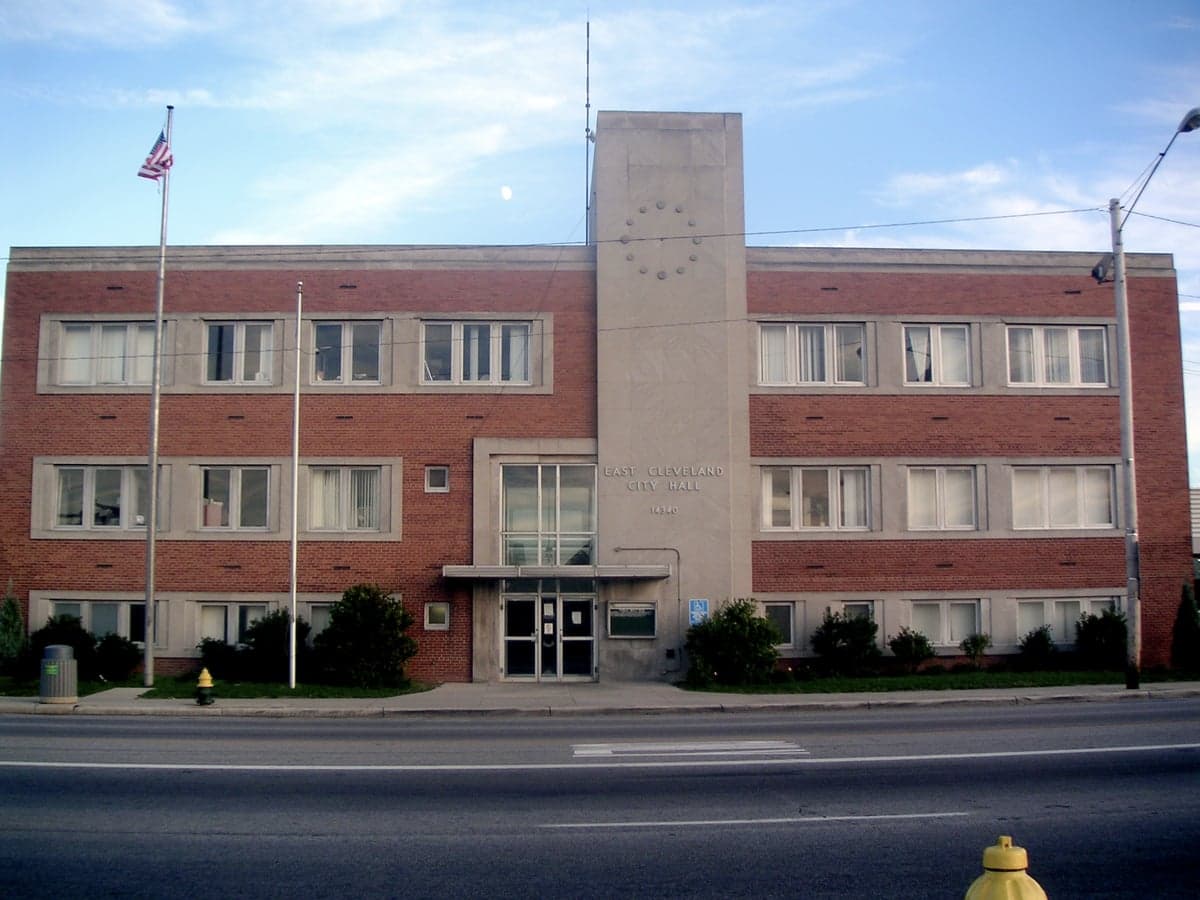
Photo: Wikipedia
Political ClimatePolitical Climate in East Cleveland, OH
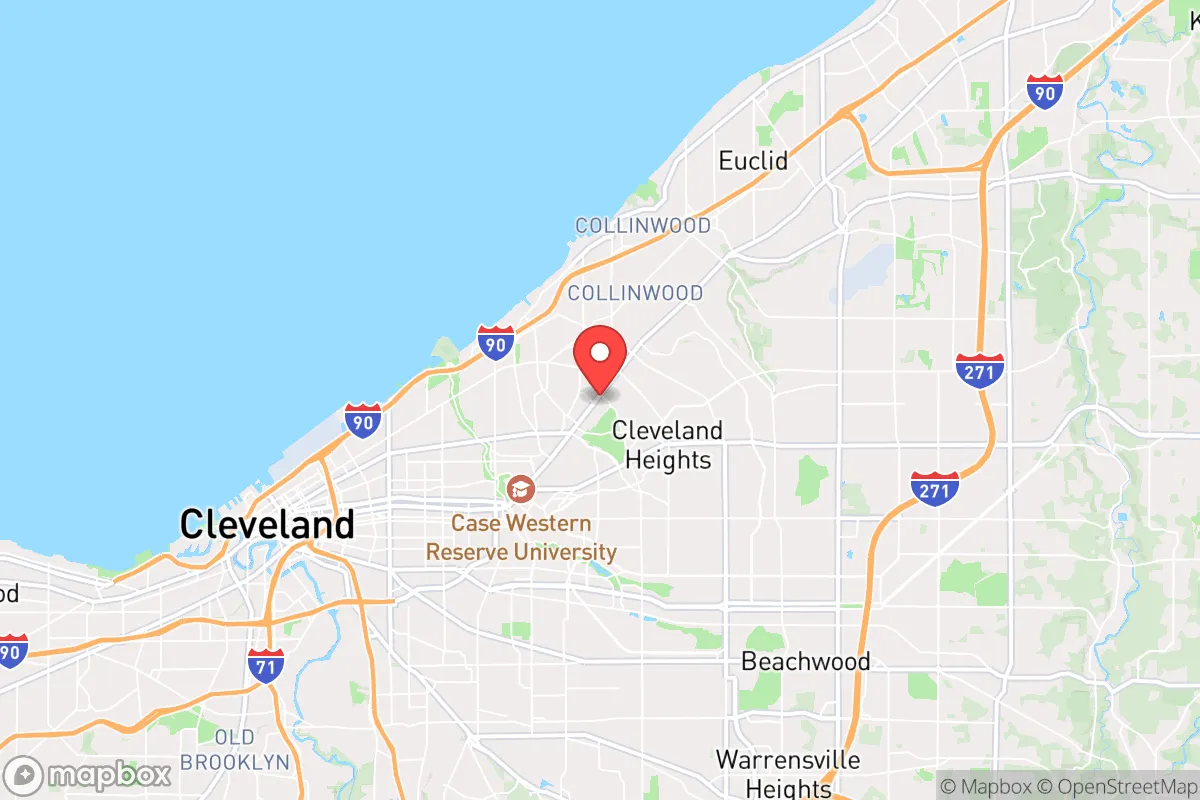
District shown is the primary district for this city’s centroid. Cities may span multiple districts.
Local Political AnalysisPolitical Analysis of East Cleveland, OH
East Cleveland is one of the most reliably Democratic strongholds in all of Ohio, with a Cook Partisan Voting Index (PVI) of D+28. That means the city consistently votes about 28 points more Democratic than the national average, making it a deep-blue island in a state that, as of 2024, carries a PVI of R+5. The trajectory here has been remarkably stable for decades; East Cleveland hasn't voted for a Republican presidential candidate since the 1950s, and local elections are effectively decided in the Democratic primary. The surrounding Cuyahoga County, anchored by Cleveland proper, leans Democratic overall, but as you drive east into suburbs like Shaker Heights or Cleveland Heights, you'll find a more moderate liberal tilt, while heading further east into places like Euclid or Willoughby shifts toward a more mixed or even conservative-leaning electorate.
How it compares
The contrast between East Cleveland and the rest of Ohio is stark. While Ohio as a whole has trended rightward over the past two decades—flipping from a perennial swing state to a solidly Republican-leaning one—East Cleveland has only deepened its Democratic commitment. In the 2024 presidential election, for example, East Cleveland voted over 85% for the Democratic candidate, while Ohio as a whole went Republican by roughly 11 points. This isn't just a city-versus-state divide; it's a microcosm of the urban-rural split that defines Ohio politics. Neighboring Cleveland Heights (PVI D+22) and Shaker Heights (PVI D+18) are also deeply blue, but East Cleveland's PVI is the highest in the region. Meanwhile, just 15 miles south, the city of Parma (PVI R+2) is a classic swing suburb, and 30 miles east in Geauga County, communities like Chardon (PVI R+16) are overwhelmingly Republican. So East Cleveland isn't just blue—it's an outlier even among its liberal neighbors.
What this means for residents
For liberal residents, the political climate is a comfortable one. Local government, school board, and city council races are dominated by Democrats, and progressive policies on housing, policing reform, and social services are generally the norm. You'll find strong community organizing around issues like affordable housing and racial equity, and the city's leadership tends to align with national Democratic priorities. For conservative residents, however, the reality is that they are a distinct minority. It's not hostile—people are neighborly—but you won't find many Republican campaign signs or local GOP clubs. If you're a conservative, you might feel your views are underrepresented in local decision-making, especially on issues like taxes or public safety funding. That said, the city's deep poverty and aging infrastructure mean that practical concerns often transcend party labels; everyone wants better roads, safer streets, and more jobs.
Culturally, East Cleveland stands apart from much of Ohio due to its overwhelmingly Black population (over 90%) and its history as a post-industrial suburb that never fully recovered from the 1970s. This shapes a political culture focused on survival and equity rather than the suburban growth debates you'd hear in places like Dublin or West Chester. Policy-wise, the city has been a testing ground for community land trusts and anti-displacement measures, which are rare in the rest of Ohio. The long-term trajectory? East Cleveland will likely remain a Democratic stronghold, but its influence in statewide politics is limited by its small population (roughly 18,000) and economic challenges. As Ohio continues to redden, East Cleveland will stand as a vivid reminder of the state's deep political fractures—a place where the national Democratic platform is not just preferred, but lived daily.

State Political ClimatePolitical Climate in Ohio
State Political AnalysisPolitical Environment in the State
Ohio is a classic swing state that has shifted decisively rightward over the past decade, now carrying a Cook Partisan Voting Index of R+5. For most of the 2000s and 2010s, Ohio was the ultimate bellwether—voting for the winner in every presidential election from 1964 to 2020—but the 2020 and 2024 cycles saw it move from a pure purple state to a solidly red-leaning one, with Donald Trump winning by 8 points in 2020 and 11 points in 2024. The dominant coalition is a mix of working-class voters in the Rust Belt, rural conservatives across the western and southern counties, and a growing exurban population around Columbus and Cincinnati, while the Democratic base is increasingly concentrated in the urban cores of Cleveland, Columbus, and Cincinnati, plus a few college towns like Athens and Oberlin.
Urban vs. rural divide
The political map of Ohio is a textbook example of the urban-rural split. The three major metros—Cuyahoga County (Cleveland), Franklin County (Columbus), and Hamilton County (Cincinnati)—are Democratic strongholds, with Cleveland and Columbus routinely delivering 65-70% of the vote for Democratic candidates. But the rest of the state is overwhelmingly Republican. The western half of Ohio, from the Indiana border to the Scioto River, is deep red, with counties like Mercer, Shelby, and Darke often voting 75-80% Republican. The Appalachian counties in the southeast, once reliably Democratic, have flipped hard to the GOP over the last two cycles, driven by cultural and economic grievances. A notable exception is Delaware County, just north of Columbus, which was historically a swing suburb but has trended rightward as it fills with conservative-leaning families moving out of the city. Meanwhile, Athens County (home to Ohio University) and Oberlin (in Lorain County) remain liberal outliers, but they don't move the statewide needle.
Policy environment
Ohio's policy environment is broadly conservative, with a few notable exceptions. The state has a flat income tax rate of 3.5% (down from 4.8% in 2020), and the sales tax is 5.75% at the state level, with local add-ons that can push it to 8% in some cities. Property taxes are moderate, averaging about 1.5% of assessed value, but they vary widely by district. The regulatory posture is business-friendly, with a right-to-work law (though not a full right-to-work state) and limited zoning restrictions in rural areas. Education policy is a flashpoint: Ohio has a robust school voucher program (the EdChoice system) that allows families to use public funds for private or religious schools, and it has expanded significantly under recent Republican governors. Healthcare is mixed—Medicaid expansion was adopted under Governor John Kasich in 2013, but the state has not pursued a state-based exchange, and abortion access was effectively banned after six weeks following the 2022 Dobbs decision, though a 2023 ballot initiative enshrined abortion rights in the state constitution. Election laws have tightened: voter ID requirements were strengthened in 2023, absentee ballot drop boxes were limited to one per county, and early voting hours were standardized. Gun laws are permissive: Ohio is a constitutional carry state (permitless carry for adults 21 and older, passed in 2022), with no waiting periods, no magazine capacity limits, and a "stand your ground" law enacted in 2021.
Recent policy direction
The last five years have seen Ohio move decisively in a conservative direction on nearly every front. On gun and self-defense law, the 2022 permitless carry bill (HB 227) and the 2021 "stand your ground" law (SB 175) eliminated the duty to retreat and removed the requirement for a concealed carry permit. On parental and education rights, the state passed a "Parents' Bill of Rights" in 2023 (HB 8) that requires schools to notify parents about curriculum changes and restricts instruction on sexual orientation and gender identity in grades K-3. On speech and privacy, Ohio enacted a social media age-verification law in 2024 (SB 29) requiring parental consent for minors under 16 to create accounts, though it's being challenged in court. On medical and bodily autonomy, the 2023 Issue 1 ballot measure codified abortion access up to fetal viability, overriding the six-week ban, but the state still restricts Medicaid funding for abortion and requires parental consent for minors. On property rights, Ohio has strong eminent domain protections and no statewide rent control, but local zoning battles in suburbs like Dublin and West Chester are heating up over density and affordable housing. On taxation, the flat income tax is scheduled to drop to 3% by 2026, and the state has eliminated the municipal income tax for small businesses in many cities. On voting and ballot access, the 2023 voter ID law (SB 92) requires a photo ID for in-person voting, and absentee ballot applications must be notarized for first-time voters—a change that has drawn criticism from voting rights groups.
Civil unrest & political movements
Ohio has seen its share of political flashpoints. The 2020 protests in Columbus and Cleveland over George Floyd's death were large but largely peaceful, though there were isolated incidents of property damage. The 2023 East Palestine train derailment sparked a populist backlash against both Norfolk Southern and the federal government, with local residents organizing town halls and demanding stricter rail safety regulations—a rare issue that united left and right. Immigration politics are less visible than in border states, but there's been a growing debate over the influx of Haitian and Central American migrants into cities like Springfield and Dayton, with local Republican officials calling for stricter enforcement and Democratic mayors pushing for sanctuary policies. Election integrity controversies have been a persistent theme since 2020, with Republican Secretary of State Frank LaRose conducting a voter roll purge in 2023 that removed over 200,000 inactive registrations, and the state legislature passing the voter ID law over Democratic objections. There's also a small but vocal secession movement in the Appalachian counties, with some residents calling for a "State of Appalachia" that would break away from the rest of Ohio, though it remains fringe. A new resident would notice the prevalence of "Trump 2024" signs in rural areas and "We Believe" signs in suburban yards, but the political temperature is generally lower than in states like Florida or Texas—Ohioans tend to be more reserved in their public displays of partisanship.
Projection
Over the next 5-10 years, Ohio is likely to become more reliably Republican at the statewide level, but with a growing Democratic base in the cities that could flip the state back to purple if national trends shift. The key demographic driver is the continued exodus of young, college-educated voters from rural areas to Columbus and Cincinnati, while the rural population ages and shrinks. In-migration from other states is modest—Ohio gains about 10,000 new residents per year from domestic migration, mostly from Michigan, Indiana, and Pennsylvania—and these newcomers tend to be conservative-leaning families drawn to the low cost of living and business climate. The state's political trajectory will depend on whether the GOP can hold its margins in the suburbs of Columbus and Cincinnati, which are trending slightly more Democratic as they diversify. A new resident moving in now should expect a state that is solidly red in statewide elections, with a conservative policy environment that is unlikely to change dramatically, but with enough urban and suburban diversity to keep things interesting. The biggest wildcard is the 2026 gubernatorial election, which could see a moderate Republican or a Democrat win if the national mood shifts, but the legislature is likely to remain firmly in GOP hands for the foreseeable future.
For a new resident, the bottom line is that Ohio offers a conservative-leaning policy environment with low taxes, permissive gun laws, and strong school choice options, but with the urban amenities of Cleveland, Columbus, and Cincinnati providing cultural and political counterweights. If you're a conservative family, you'll find a welcoming environment in the suburbs of Delaware County or the rural towns of western Ohio. If you're a liberal, you'll feel at home in the city centers or college towns, but you'll need to accept that your vote won't carry much weight in statewide elections. The state is politically stable, with no major flashpoints on the horizon, and the cost of living is low enough that most people can afford to live where they feel most comfortable politically. Just be aware that the political divide is real and visible—you'll see it in the yard signs, the local news coverage, and the conversations at the coffee shop—but Ohioans are generally polite about it, and the state's famous "Ohio nice" culture means you can disagree without being disagreeable.
* Values derived from national, state, county, city and local statistics and may differ in a specific area. Last updated: 2026-06-16T10:00:30.000Z
Narrative content on this page is AI-generated and may contain mistakes. Verify any details that matter before acting on them.
ReloMaps may earn a commission from affiliate links at no extra cost to you.

