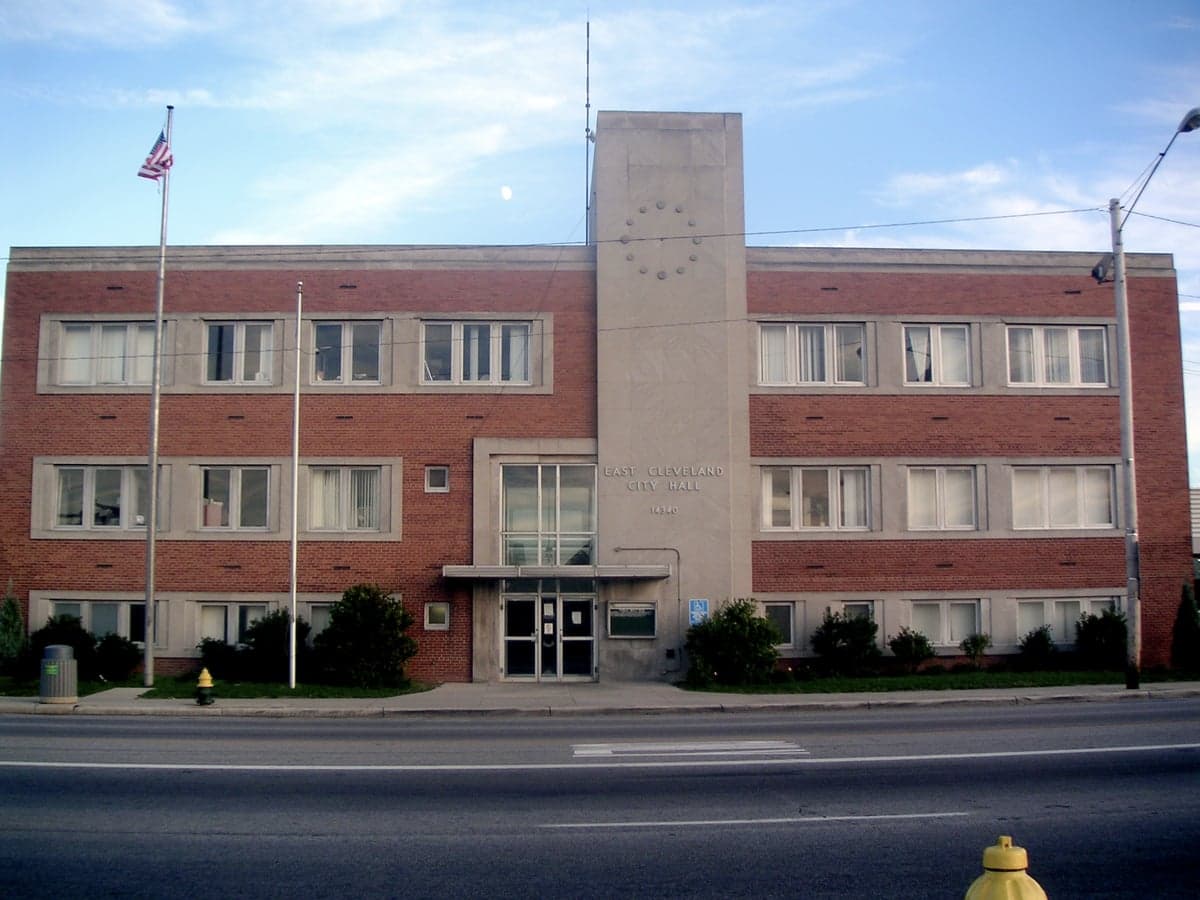
Photo: Wikipedia
Demographics of East Cleveland, OH
Affluence Level in East Cleveland, OH
A low-income area with significant economic hardship. Household wealth and educational attainment are well below national averages.
People of East Cleveland, OH
The people of East Cleveland, Ohio, today form a densely concentrated, predominantly African American community of 13,666 residents, making it one of the most heavily Black cities in Cuyahoga County at 87.7% of the population. The city is notably less diverse than the surrounding region, with a foreign-born share of just 1.5% and small White (7.4%), Hispanic (1.1%), East/Southeast Asian (0.6%), and Indian subcontinent (0.1%) populations. With only 15.8% of adults holding a college degree, East Cleveland’s population is characterized by deep local roots, economic challenges, and a strong sense of place shaped by decades of industrial decline and demographic change.
How the city was settled and grew
East Cleveland’s original population was drawn by its position as a streetcar suburb of Cleveland in the late 19th and early 20th centuries. The city incorporated in 1895, and its early growth was fueled by European immigrants—primarily German, Irish, Italian, and Polish families—who settled in working-class neighborhoods like Shaw Village and Superior–Euclid. These groups built the city’s first housing stock of single-family homes and duplexes, working in nearby factories and rail yards. The arrival of the Cleveland Railway Company’s streetcar lines in the 1890s made East Cleveland a convenient bedroom community for Cleveland’s growing industrial workforce. By 1930, the population had swelled to over 39,000, almost entirely White and native-born or of European descent. The city’s early identity was that of a stable, middle-class suburb, with neighborhoods like Forest Hills and Euclid–Superior serving as anchors for families seeking space away from the city core.
Modern era (post-1965)
The post-1965 period brought dramatic demographic transformation. Following the Hart-Cellar Immigration Act and the broader Great Migration of African Americans from the South, East Cleveland began attracting Black families seeking better housing and jobs in the Cleveland area. By 1970, the Black population had risen to roughly 40%, and by 1990 it exceeded 90%. This shift was concentrated in neighborhoods like Shaw Village and Superior–Euclid, where older housing stock became available as White families moved to outer suburbs. The city’s population peaked at 39,600 in 1960, then fell sharply as deindustrialization and white flight accelerated. The loss of manufacturing jobs at nearby plants—including General Motors’ Fisher Body plant and Ford’s Brook Park facility—hit East Cleveland hard, and the population dropped to 27,217 by 2000. Today’s 13,666 residents represent a 50% decline since 2000 alone. The foreign-born share remains very low at 1.5%, and the small Hispanic (1.1%) and East/Southeast Asian (0.6%) populations are scattered, with no single ethnic enclave forming. The Indian subcontinent population is negligible at 0.1%.
The future
East Cleveland’s population is projected to continue shrinking, with no major reversal expected in the next 10–20 years. The city’s demographic profile is becoming slightly more diverse at the margins: the White share has stabilized around 7–8%, and the Hispanic share, though small, has grown from near zero in 1990. However, the city remains overwhelmingly African American, and the low college attainment rate (15.8%) and high poverty rate (over 30%) limit in-migration of younger, more educated households. New residents are most likely to be Black families priced out of Cleveland proper or inner-ring suburbs like Shaker Heights, settling in the Forest Hills and Euclid–Superior areas where housing is most affordable. The city’s cultural identity remains deeply tied to its African American heritage, with institutions like the East Cleveland Public Library and local churches serving as community anchors. No significant new immigrant or ethnic communities are emerging, and the city’s future is one of slow decline in population but potential stabilization of its core Black population.
For someone moving in now, East Cleveland offers some of the lowest housing costs in Cuyahoga County and proximity to Cleveland’s job centers, but it comes with significant challenges: a shrinking tax base, underfunded schools, and limited retail and services. The city is becoming a quieter, older, and more economically strained version of its former self—a place where deep community ties persist, but where population loss and disinvestment are the dominant trends. New residents should expect a tight-knit, predominantly African American community with few newcomers from outside the region.

* Values derived from national, state, county, city and local statistics and may differ in a specific area. Last updated: 2026-06-16T10:00:30.000Z
Narrative content on this page is AI-generated and may contain mistakes. Verify any details that matter before acting on them.
ReloMaps may earn a commission from affiliate links at no extra cost to you.

