
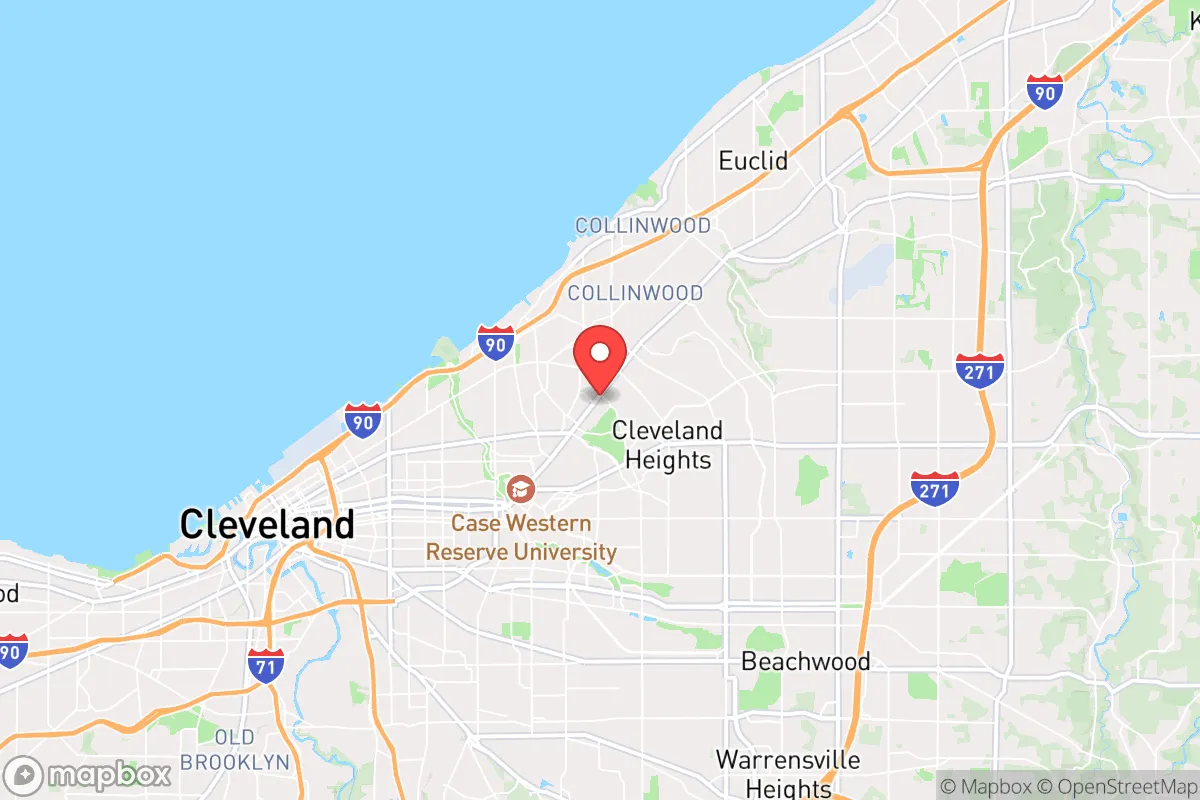
Photo: Wikipedia
Personal Sovereignty in East Cleveland, OH
Viable for self-reliance. Generally workable, though some barriers may limit total independence.
What does Personal Sovereignty tell us?
Personal Sovereignty measures your capacity for self-reliance and independence with minimal government friction. Higher scores mean fewer barriers between you and the way you want to live... but it assumes you have the space you need and good neighbors.
What does this tell us?
Personal Sovereignty measures your capacity for self-reliance and independence with minimal government friction. Higher scores mean fewer barriers between you and the way you want to live... but it assumes you have the space you need and good neighbors.
State Policy
Energy independence: Importer (40% of energy produced in-state)
Personal Liberty
Homesteading

Personal Liberty Analysis
East Cleveland, Ohio, presents a complex and often contradictory environment for personal sovereignty, where the promise of low property costs and a hands-off local government is sharply constrained by the state's regulatory reach and the city's own fiscal and infrastructural challenges. For a single individual or family prioritizing autonomy, the area offers a high degree of personal liberty in certain domains—particularly around property use and self-defense—but demands a realistic reckoning with a heavy state-level tax burden and a local government that, due to limited resources, may be less of an active partner and more of a passive observer in daily life. The net effect is a sovereignty profile that is neither fully libertarian nor heavily paternalistic, but rather a patchwork of high freedom in some areas and significant structural friction in others.
Tax burden and regulatory posture in East Cleveland
Ohio’s state-level tax structure imposes a notable drag on personal autonomy, and East Cleveland residents feel this acutely. The state income tax ranges from 0% to 3.99% on earned income, with a flat 4% corporate income tax that can affect small business owners and independent contractors. Property taxes in East Cleveland are relatively moderate compared to nearby suburbs like Shaker Heights or Cleveland Heights, with effective rates around 2.0% to 2.5% of assessed home value, but the city’s own 2.5% municipal income tax—one of the highest in the state—applies to both residents and non-residents working within city limits. This creates a combined tax burden that can approach 6-7% of gross income for a single earner, significantly reducing disposable income and the financial freedom to invest in self-reliant projects. The regulatory posture at the city level is notably light-touch in practice, largely due to understaffed code enforcement and planning departments. Zoning codes exist on paper but are rarely enforced aggressively, meaning residents often have de facto latitude to modify properties, run small home-based businesses, or keep livestock without formal permits—though this permissiveness comes with the risk of sudden enforcement if a complaint is filed. The state’s regulatory environment is more intrusive, particularly around occupational licensing and environmental rules, but for most individuals, the primary friction point is the tax burden rather than bureaucratic red tape.
Self-defense rights and gun law specifics in East Cleveland
Ohio is a constitutional carry state, and East Cleveland residents enjoy robust self-defense rights under state law. Since June 2022, Ohio law permits any law-abiding adult to carry a concealed handgun without a permit, and open carry is also legal without a license. The state does not require registration of firearms, and there is no waiting period for purchases. However, East Cleveland itself has a history of local ordinances that attempted to restrict firearms—such as a 2015 ban on assault weapons and high-capacity magazines—but these were effectively nullified by state preemption laws (Ohio Revised Code 9.68), which prohibit municipalities from enacting their own gun control measures. As a result, the city’s legal landscape for self-defense is identical to the rest of Ohio. Stand-your-ground laws apply, with no duty to retreat in any place where a person is lawfully present. Castle doctrine protections are strong, covering both homes and vehicles. For a sovereignty-minded individual, the practical concern is less about legal restrictions and more about the high violent crime rate in East Cleveland—which, at roughly 1,500 violent crimes per 100,000 residents (2023 data), is among the highest in Ohio. This creates a situation where the legal right to self-defense is broad, but the necessity of exercising it is elevated, and the local police response times can be slow due to understaffing. Many residents choose to arm themselves not as a political statement but as a practical necessity for daily safety.
Self-reliance and homesteading viability: lot sizes, zoning, and off-grid feasibility
East Cleveland’s urban density—averaging over 5,000 people per square mile—limits traditional homesteading, but the city’s aging housing stock and large lot sizes (many single-family homes sit on quarter-acre or larger parcels) offer surprising potential for self-reliance. Typical residential lots range from 0.15 to 0.35 acres, which is ample for substantial vegetable gardens, small fruit orchards, and even a few chickens or rabbits. City zoning permits backyard chickens (hens only, no roosters) with a permit, and there are no restrictions on beekeeping. Larger livestock like goats or pigs are prohibited within city limits, but the nearby rural areas of Cuyahoga County—within a 15-minute drive—allow such activities. Off-grid feasibility is limited: the city mandates connection to municipal water and sewer, and solar panel installation requires a building permit and must comply with utility interconnection standards. However, the city does not actively enforce energy independence measures, and many residents have installed rain barrels and small solar arrays without issue. The biggest barrier to self-reliance is the condition of the housing stock itself—many homes are older, with outdated electrical systems and poor insulation, requiring significant capital investment to achieve energy independence. For a family willing to invest sweat equity, the low property prices (median home value around $40,000 as of 2025) make it feasible to acquire a property with a large yard and retrofit it for greater self-sufficiency, but the upfront costs of such retrofits can be substantial relative to the home’s value.
Personal liberties: parental rights, medical autonomy, speech, and property
Ohio law provides a generally favorable environment for personal liberties, though with notable caveats. Parental rights are strongly protected under state law: Ohio Revised Code 3319.321 gives parents broad authority over their children’s education, including the right to homeschool without excessive state oversight (annual notification and a brief assessment are required). School choice is robust, with charter schools and voucher programs available, though East Cleveland’s own school district is under state oversight due to chronic academic underperformance. Medical autonomy is more mixed: Ohio has not expanded Medicaid under the Affordable Care Act in a way that restricts private healthcare choices, but the state does impose vaccine mandates for school attendance (with medical and religious exemptions available). The state’s abortion laws are restrictive, with a six-week heartbeat ban in effect, which may be a factor for some families. Free speech protections are strong, with no notable local ordinances restricting expression beyond standard nuisance laws. Property rights are where East Cleveland offers the most tangible autonomy: the city’s low property values and weak enforcement culture mean that residents can often modify their homes and land with minimal interference. Building permits are required for major structural changes, but minor renovations, fencing, and landscaping are rarely challenged. The city’s tax foreclosure rate is high (over 10% of properties are in some stage of foreclosure), which creates opportunities for acquiring property at auction but also signals a stressed municipal system that may not reliably provide services like snow removal or street maintenance—a trade-off that self-reliant individuals may view as acceptable.
Overall, East Cleveland offers a sovereignty profile that is strongest in the domains of self-defense and property use, moderate in parental and speech rights, and weakest in tax burden and off-grid infrastructure. Compared to other Rust Belt cities with similar demographics, East Cleveland’s regulatory environment is notably permissive—largely by neglect rather than design—which can be an advantage for those who prefer to be left alone. However, the high crime rate, poor municipal services, and heavy state-level taxation mean that personal sovereignty here requires active self-reliance, not passive freedom. For a conservative-leaning individual or family who values independence and is willing to accept the risks and responsibilities of a low-service, high-crime urban environment, East Cleveland can be a place of genuine autonomy. For those seeking a more predictable, low-tax, low-crime setting with strong infrastructure, the surrounding suburbs or rural areas of Ohio may offer a more straightforward path to personal sovereignty.

* Values derived from national, state, county, city and local statistics and may differ in a specific area. Last updated: 2026-06-16T10:00:30.000Z
Narrative content on this page is AI-generated and may contain mistakes. Verify any details that matter before acting on them.
ReloMaps may earn a commission from affiliate links at no extra cost to you.

