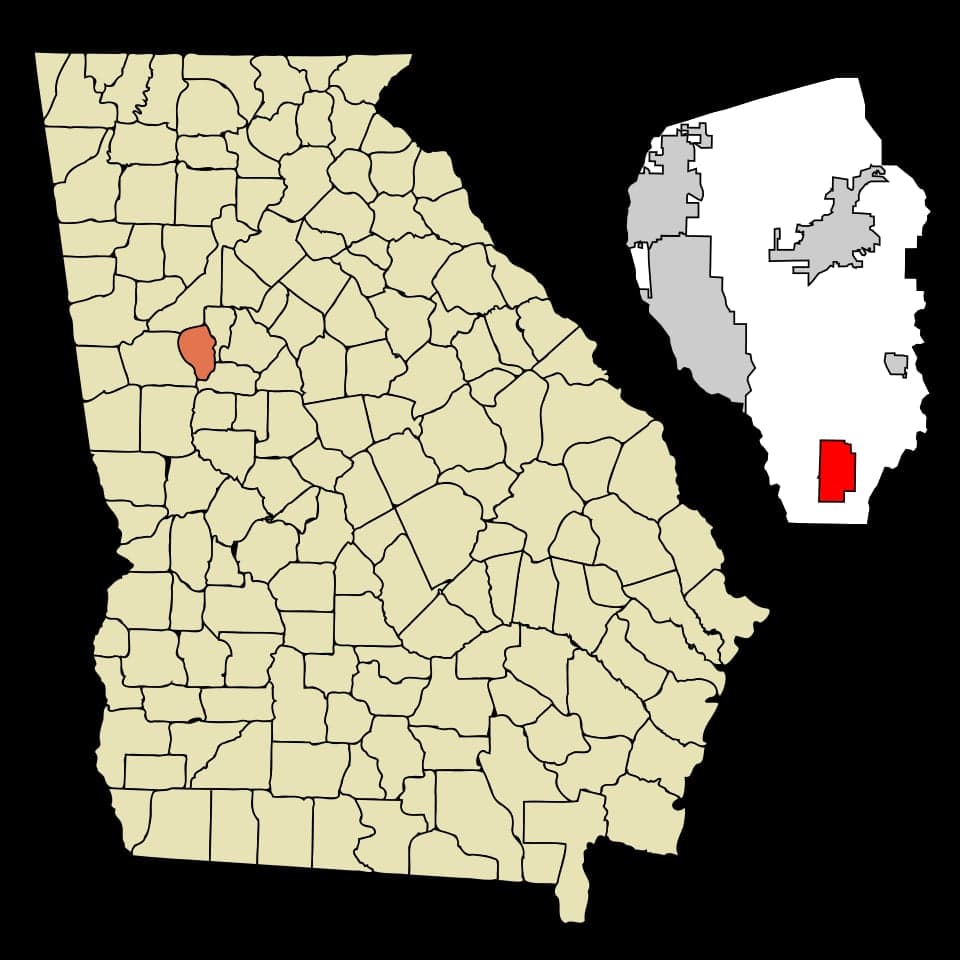
Photo: Wikipedia
Political ClimatePolitical Climate in Brooks, GA
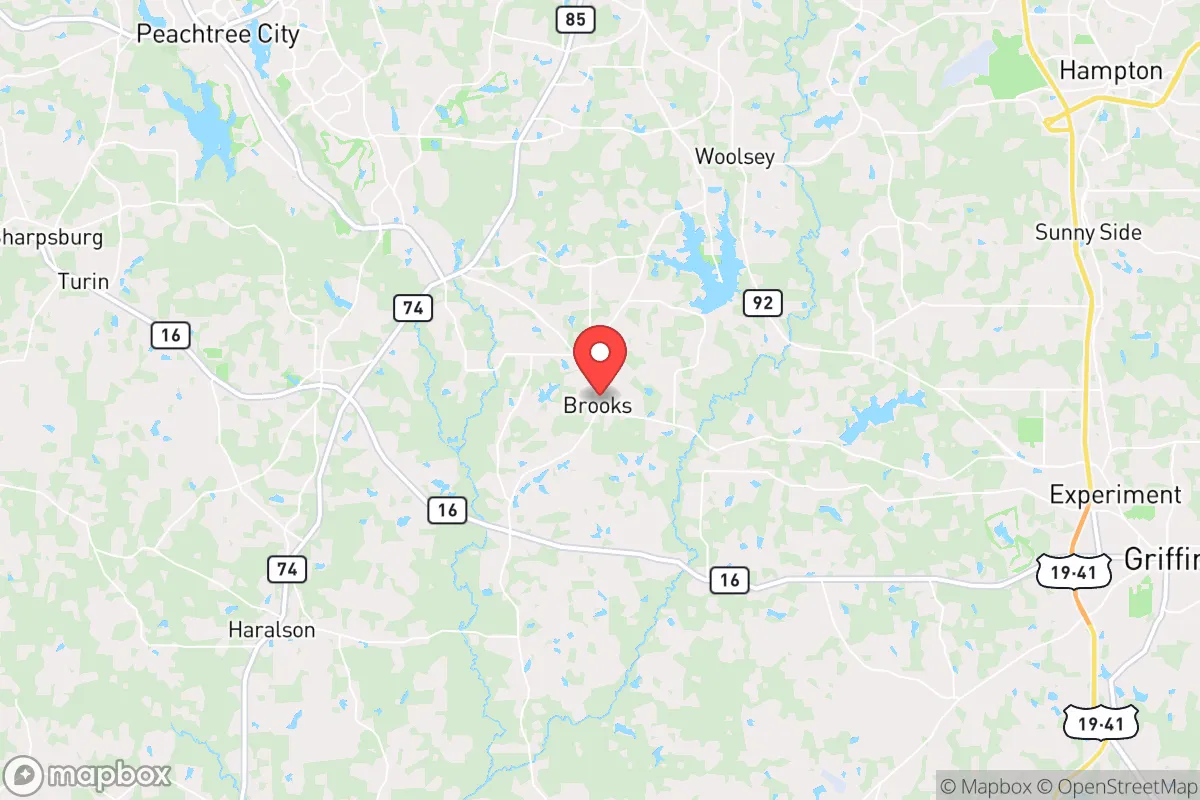
District shown is the primary district for this city’s centroid. Cities may span multiple districts.
Local Political AnalysisPolitical Analysis of Brooks, GA
Brooks, Georgia, is about as reliably Republican as small-town Georgia gets — a Cook PVI of R+15 means this rural Fayette County community votes roughly 15 points more conservative than the national average. That’s a solid red anchor in a state that’s been trending purple over the past decade. If you’d asked me twenty years ago, I’d have said Brooks was just another sleepy whistle-stop where everybody knew your truck and your party registration. Today, the political lean hasn’t budged much, but the surrounding context has: metro Atlanta’s liberal suburbs keep creeping south, and places like Fayetteville and Peachtree City have gotten more competitive. Brooks itself? Still deep red, and likely to stay that way for the foreseeable future.
How it compares
Georgia as a whole is a different animal. The state’s Cook PVI is effectively neutral — it’s a toss-up at the presidential level, with both Biden and Trump winning by razor-thin margins in recent cycles. Brooks sits inside that R+15 bubble, which puts it to the right of even most rural Georgia counties. For context, neighboring Spalding County (Griffin) leans R+12, while Fayette County overall is around R+10. Brooks is the reddest pocket in an already red county. Drive 30 miles north to College Park or East Point, and you’re in solidly Democratic territory. So the contrast isn’t just between Brooks and Georgia — it’s between Brooks and the Atlanta metro’s liberal core. The state’s political center of gravity has shifted toward the I-85 corridor, but Brooks remains a holdout of old-school Southern conservatism.
What this means for residents
For conservative residents, Brooks feels like home — local offices are held by Republicans, the county commission leans right, and you won’t find many yard signs for the other side. Taxes are low, gun laws are permissive, and the local school board tends to emphasize traditional values. For liberal residents, it can be isolating. There’s no active Democratic party presence in Brooks itself; you’d have to drive to Fayetteville or even Atlanta to find like-minded groups. That said, nobody’s hostile — it’s more of a quiet assumption that everyone agrees. The practical effect is that policy debates are minimal: zoning, development, and school funding all happen within a conservative framework. If you’re progressive, you learn to pick your battles or just enjoy the low cost of living and quiet streets.
Culturally, Brooks is distinct from the state’s urban centers in ways that go beyond voting. The local economy still revolves around agriculture and small manufacturing, not tech or film. You’ll see more pickup trucks than Teslas, and the biggest community events are the Brooks Farmers Market and the annual Brooks Day celebration. There’s no real push for the kind of rapid growth that’s reshaping nearby towns like Senoia or Sharpsburg. The policy distinction that matters most day-to-day is land use: Brooks has resisted annexation and high-density housing, keeping its rural character intact. That’s a deliberate choice, and it reflects a political culture that values stability over change. Whether you see that as stubbornness or preservation depends on your perspective, but it’s the reality of life here.

State Political ClimatePolitical Climate in Georgia
State Political AnalysisPolitical Environment in the State
Georgia has transformed from a reliably Republican stronghold into a true battleground over the past two decades. The state voted for a Democratic presidential candidate in 2020 for the first time since 1992, then narrowly returned to Trump in 2024 by about two points, while simultaneously re-electing Republican Governor Brian Kemp by a comfortable margin. This split-ticket reality reflects a state where the Atlanta metro area's explosive growth and diversification have created a powerful Democratic coalition, while rural and exurban Georgia remains deeply conservative. For a relocator, this means living in a state where your local political experience will vary dramatically depending on whether you settle inside the I-285 perimeter or out in the piney woods of south Georgia.
Urban vs. rural divide
The political map of Georgia is a story of two Georgias. The Atlanta metropolitan area — including Fulton, DeKalb, Cobb, and Gwinnett counties — now reliably votes Democratic, with Cobb and Gwinnett flipping blue in the 2016–2020 cycle after decades of Republican lean. Fulton County alone delivered nearly 300,000 more votes for Biden than Trump in 2020, enough to flip the entire state. Other urban centers like Savannah (Chatham County), Augusta (Richmond County), Columbus (Muscogee County), and Athens (Clarke County) also lean Democratic, though with smaller margins. Meanwhile, rural south Georgia — places like Albany, Valdosta, and Waycross — vote heavily Republican, as do the mountain and foothill counties of north Georgia, including Dalton, Gainesville, and Rome. The exurban ring north of Atlanta — Forsyth, Cherokee, and Hall counties — remains a Republican stronghold, with Forsyth County voting nearly 70% for Trump in 2024. The divide is stark: a relocator moving to Buckhead will experience a very different political climate than someone settling in the 400 corridor north of Cumming.
Policy environment
Georgia's state-level policy is shaped by a Republican-controlled General Assembly and governor's office. The tax structure is increasingly friendly to residents and businesses: a flat income tax rate of 5.49% in 2024 is scheduled to drop to 4.99% by 2027, and there is no state estate or inheritance tax. Sales tax varies by county, typically 7–8%. Georgia is a right-to-work state with a business-friendly regulatory posture, and it has not expanded Medicaid under the Affordable Care Act, though it operates a limited waiver program. Education policy includes robust school choice options: the Georgia GOAL Scholarship program provides tax credits for private school scholarships, and charter schools are widely available. Election laws were tightened with SB 202 in 2021, which added voter ID requirements for absentee ballots, limited drop box locations and hours, and restricted third-party ballot collection. Georgia does not have a red flag law, and in 2022 it enacted permitless carry (HB 218), allowing most adults to carry a firearm without a license. Abortion is restricted to roughly six weeks under HB 481, which took effect after the Dobbs decision. The state also has a "stand your ground" self-defense law.
Recent policy direction
Over the past five years, Georgia's legislature has moved decisively in a conservative direction on multiple fronts. On gun rights, HB 218 (2022) eliminated the requirement for a permit to carry a concealed firearm, making Georgia one of about 25 permitless carry states. On election integrity, SB 202 (2021) was passed in response to the 2020 election controversies, imposing new ID requirements for absentee voting and prohibiting mobile voting centers. On education, SB 140 (2022) banned the teaching of "divisive concepts" related to race and gender in public schools, and the state has expanded parental rights in curriculum review. On medical freedom, HB 1105 (2023) prohibited COVID-19 vaccine mandates for government employees and contractors. On property rights, Georgia has not enacted any major new eminent domain or land-use restrictions, but it remains a "title theory" state for mortgages. On privacy, there is no comprehensive data privacy law yet, though a bill has been proposed. The state also passed the Campus Free Speech Act (SB 17, 2023), which prohibits public colleges from restricting speech based on viewpoint and requires universities to adopt free speech policies. For a relocator weighing these issues, Georgia offers a clear conservative tilt on guns, abortion, and education, while remaining relatively moderate on taxes and taxes — not as low as Florida or Texas, but trending downward.
Civil unrest & political movements
Georgia has seen its share of political flashpoints. The 2020 protests in Atlanta following George Floyd's murder were large and occasionally violent, leading to property damage and a heavy police response. The "Stop Cop City" movement — opposing the construction of a public safety training center in Atlanta's South River Forest — has generated sustained protests, including a fatal shooting of an activist by law enforcement in 2023. On immigration, Georgia has strict enforcement laws: HB 87 (2011) requires certain employers to use E-Verify and penalizes harboring undocumented immigrants, and no Georgia city operates as a sanctuary city. Election integrity remains a live issue: after the 2020 election, Georgia conducted a full hand recount of all 5 million ballots, finding no evidence of widespread fraud, but the controversy persists among some Republican activists. Several rural counties have passed Second Amendment sanctuary resolutions, though these are symbolic. Political activism is visible on both sides — you'll see Trump flags in rural areas and "Defend the Atlanta Way" signs in liberal neighborhoods. For a new resident, the level of political engagement is high, but actual civil unrest is mostly confined to Atlanta; outside of that, daily life is quiet.
Projection
Over the next 5–10 years, Georgia is likely to remain a competitive swing state, but the trajectory is toward a slight Democratic lean if current demographic trends hold. The Atlanta metro continues to grow rapidly, attracting young, diverse, and racially diverse populations from other states, especially from California and Florida. Gwinnett County is now majority-minority and Cobb is trending that way. Rural Georgia is losing population. This suggests that while Republicans may still win statewide races in close elections, the legislature may remain in GOP hands due to gerrymandering. In-migration also includes many conservative-leaning retirees and families moving to exurbs like Forsyth and Cherokee, which may offset some urban gains. A relocator moving to Georgia should expect a state where policy will remain conservative
* Values derived from national, state, county, city and local statistics and may differ in a specific area. Last updated: 2026-10-14T23:27:47.000Z
Narrative content on this page is AI-generated and may contain mistakes. Verify any details that matter before acting on them.
ReloMaps may earn a commission from affiliate links at no extra cost to you.

