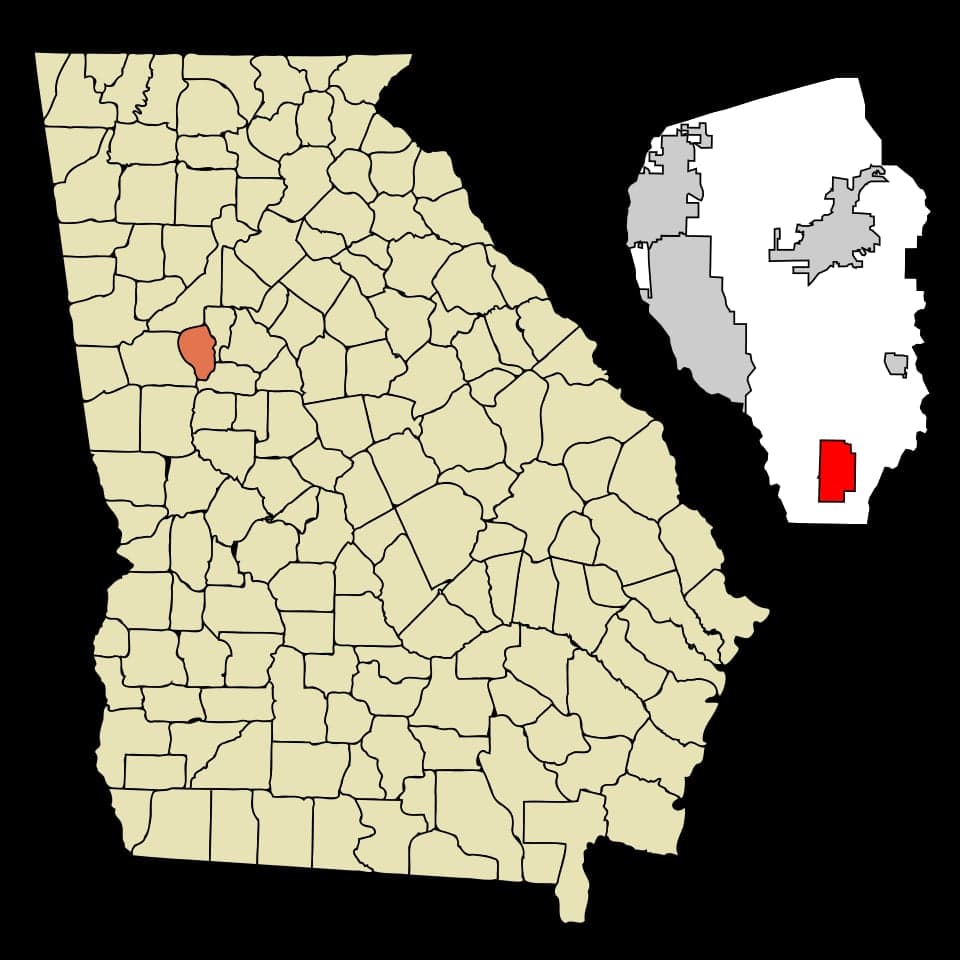
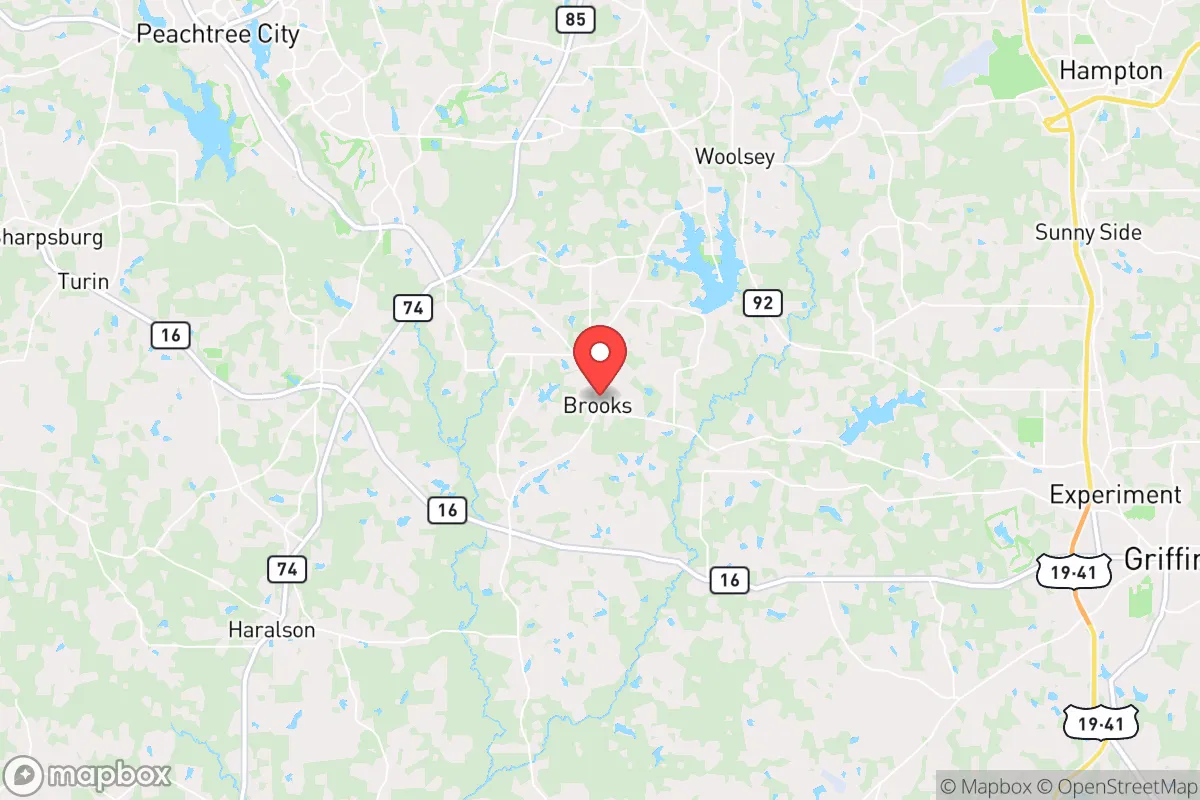
Photo: Wikipedia
Demographics of Brooks, GA
Affluence Level in Brooks, GA
An upper-middle-class area. Household wealth, education levels, and homeownership run ahead of national benchmarks.
People of Brooks, GA
The people of Brooks, Georgia, today form a small, tight-knit community of 693 residents that is overwhelmingly White (97.1%) and entirely native-born, with zero foreign-born residents recorded in recent data. The town retains a distinctly rural character despite being within commuting distance of Atlanta, and its 39.0% college-educated share is notably high for a town its size, reflecting a population that values both quiet country living and professional opportunity. Brooks is the kind of place where families have known each other for generations, and new arrivals are typically drawn by the promise of space, safety, and a slower pace.
How the city was settled and grew
Brooks was founded in the 1850s as a railroad stop along the Macon & Western line, and its earliest settlers were farmers of English and Scots-Irish descent who took advantage of land grants in the fertile Piedmont region. The railroad brought a small commercial core, and by the early 1900s the town had a handful of stores, a cotton gin, and a depot. The original population clustered in what is now the Historic Downtown Brooks district along Main Street, where many of the oldest homes still stand, and in the Railroad District near the depot, where workers and merchants built modest frame houses. A second wave arrived in the 1920s and 1930s, drawn by the expansion of the peach and cotton industries; these families settled in the Brooks Farm area west of downtown, a patchwork of small homesteads that remains largely unchanged today. Through the mid-20th century, Brooks remained a quiet agricultural hamlet, with little industrial development and virtually no in-migration from outside the region.
Modern era (post-1965)
The post-1965 period brought little demographic change in Brooks itself, as the town lacked the jobs or housing stock to attract new groups. The foreign-born population remained at zero, and the Black population, which had never been significant, also fell to zero. Instead, the most notable modern shift has been a slow trickle of domestic in-migration from the Atlanta metro area, particularly after 2000, when families seeking larger lots and lower taxes began buying into subdivisions like Brooks Crossing and Brooks Estates, both built on former farmland east of downtown. These new residents are almost entirely White, with the small Hispanic (0.7%) and East/Southeast Asian (0.4%) shares concentrated in these newer subdivisions rather than in the historic core. The Brooks Ridge neighborhood, developed in the 2010s, attracted a handful of families from elsewhere in Fayette County, but the overall racial composition has remained virtually static. Brooks has not experienced the suburban diversification seen in nearby Peachtree City or Fayetteville; it has stayed resolutely homogeneous by choice and by housing stock.
The future
Brooks’s population is likely to remain small and overwhelmingly White for the next 10–20 years. The town’s zoning limits large-scale development, and most new construction is infill on large lots in areas like Brooks Station, a 2020s subdivision that has added about a dozen homes, all sold to White buyers. The Hispanic and East/Southeast Asian shares may inch upward slowly as Atlanta’s outer suburbs continue to push south, but Brooks lacks the rental housing and service jobs that typically attract first-generation immigrants. The cultural identity is evolving from a fading agricultural past toward a commuter exurb: more residents work in Fayetteville or Atlanta, and the town’s few remaining stores are giving way to home-based businesses. For someone moving in now, Brooks offers a stable, low-crime environment with a known social fabric, but little diversity or demographic dynamism.
In short, Brooks is becoming a quieter, more residential version of its former self—a place where the people are stable, well-educated, and almost entirely native-born White, with only the faintest hints of future diversification. It suits those who want a predictable, predictable community with strong family ties and easy highway access, not those seeking multicultural energy or rapid change.

* Values derived from national, state, county, city and local statistics and may differ in a specific area. Last updated: 2026-10-14T23:27:47.000Z
Narrative content on this page is AI-generated and may contain mistakes. Verify any details that matter before acting on them.
ReloMaps may earn a commission from affiliate links at no extra cost to you.

