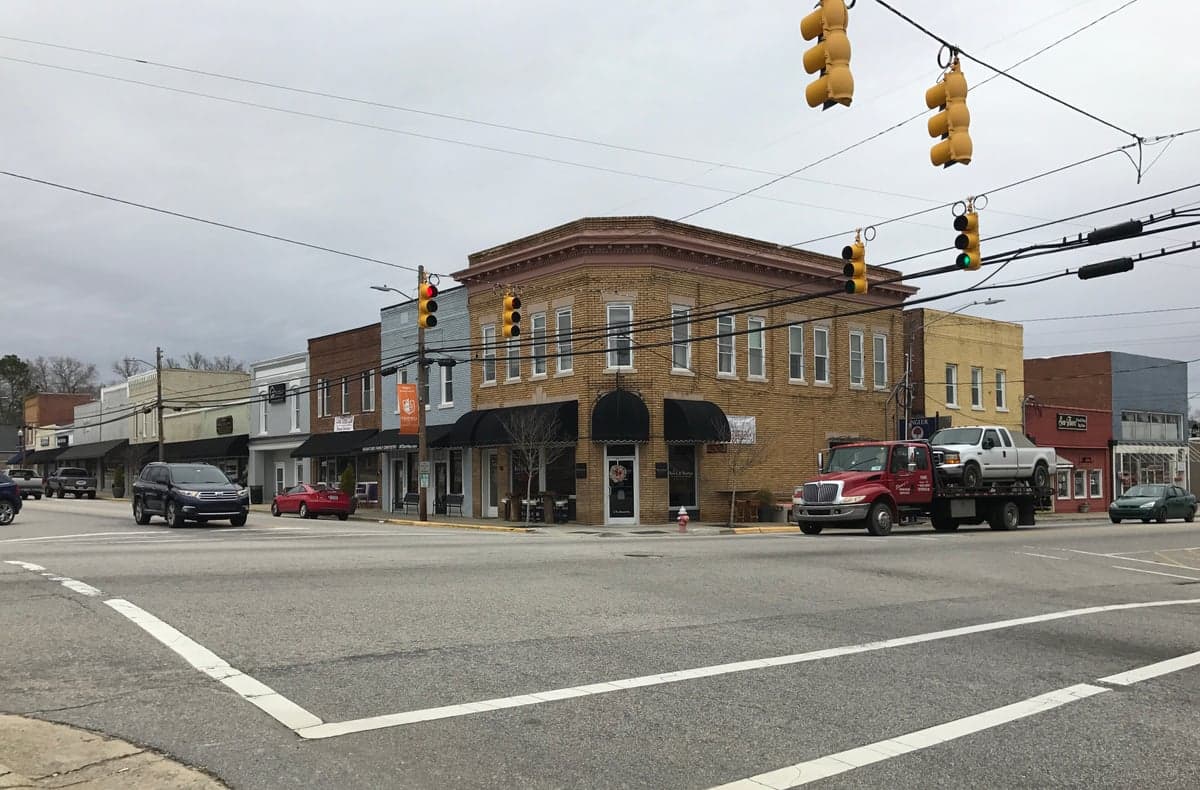
Photo: Wikipedia
Political ClimatePolitical Climate in Angier, NC
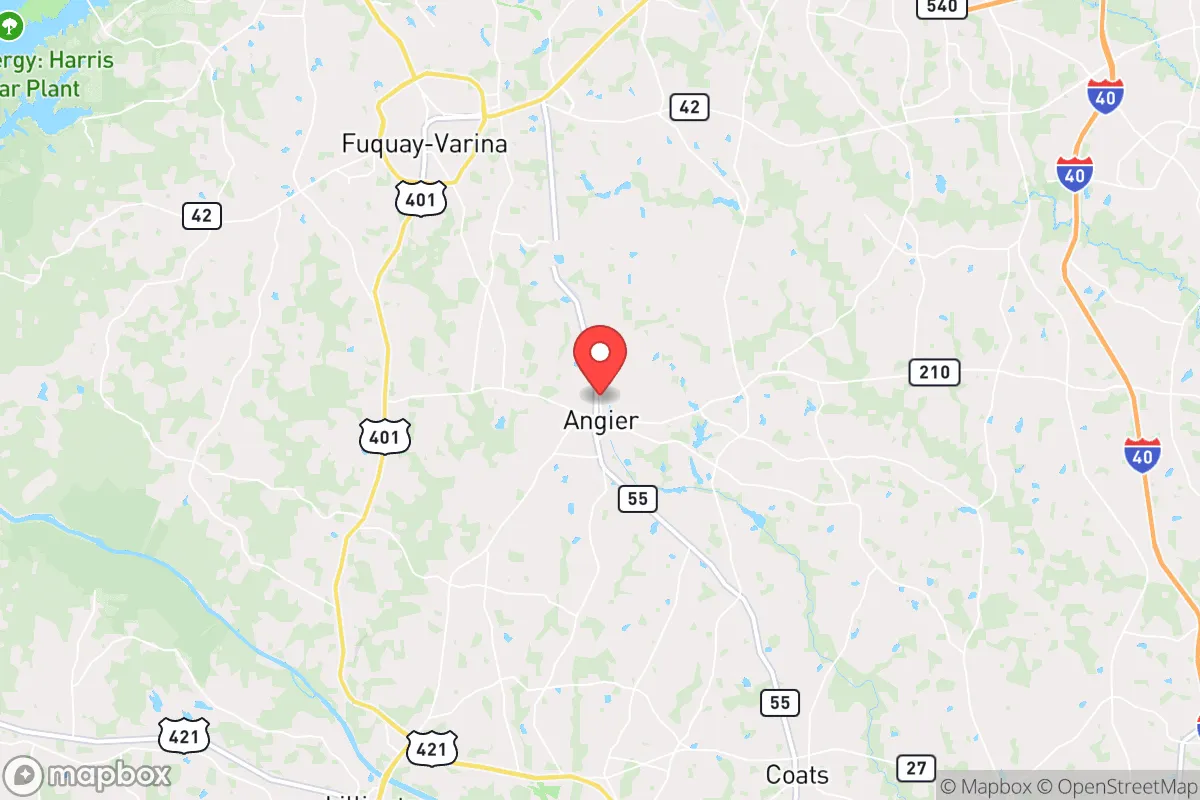
District shown is the primary district for this city’s centroid. Cities may span multiple districts.
Local Political AnalysisPolitical Analysis of Angier, NC
Angier, North Carolina, leans solidly Republican, with a Cook PVI of R+8, making it significantly more conservative than the state as a whole, which sits at R+1. This isn't a new development—the town has long been a reliably red pocket in Harnett County, but the margin has widened in recent cycles as suburban growth from the Raleigh-Durham metro area pushes outward. While the state has become a competitive battleground, Angier's politics have stayed steady, with local elections often decided in the GOP primary and Democratic candidates rarely breaking 40% in countywide races.
How it compares
Angier's R+8 rating places it about seven points to the right of North Carolina's overall R+1 lean. That gap is meaningful: in a state where presidential races are decided by less than two points, Angier votes like a deep-red district. For context, nearby towns like Fuquay-Varina (Wake County) have shifted purple as transplants arrive, while Lillington (Harnett County) remains similarly conservative but with a slightly older, more rural base. The contrast is sharpest heading east toward Smithfield or south toward Dunn, where Democratic support is higher due to larger minority populations and more unionized manufacturing jobs. Angier's trajectory, however, is tied to its growth—new subdivisions are bringing in families from Wake County who often retain their moderate-to-conservative lean, reinforcing the existing tilt rather than diluting it.
What this means for residents
For conservative residents, Angier's political climate means local government is reliably aligned with their values. Tax rates are kept low, zoning is minimal, and the school board and town council rarely face serious ideological challenges. The Harnett County GOP is active but not factionalized, so primaries tend to be about competence rather than purity tests. For liberal residents, the reality is more isolating. There is no organized Democratic presence in town; the nearest active party groups are in Fuquay-Varina or Raleigh. Socially, it's common to assume neighbors share conservative views, so progressive residents often keep their politics private to avoid friction. That said, the growing population has brought some diversity of thought—younger families and remote workers are less uniformly conservative than the longtime farming community, but the shift is slow. On hot-button issues like gun rights or school curriculum, the local consensus is firmly traditional, and public debate rarely challenges that.
Culturally, Angier's politics show up in everyday life. The annual Angier Heritage Day celebrates small-town values with a heavy emphasis on faith and family, and the local chamber of commerce is intertwined with conservative business networks. There's no local equivalent of a progressive bookstore or activist meetup; the nearest Whole Foods or indie coffee shop with a political bulletin board is a 25-minute drive north. Policy-wise, the town has resisted annexation battles and kept its police force small, reflecting a preference for limited government. For newcomers, the political climate is less about overt conflict and more about a quiet, pervasive conservatism that shapes everything from school board decisions to which candidates get lawn signs. If you're moving here, know that your vote will likely not swing an election, but your willingness to engage with neighbors on shared community projects—regardless of party—will define your experience far more than any ballot box outcome.

State Political ClimatePolitical Climate in North Carolina
State Political AnalysisPolitical Environment in the State
North Carolina is the quintessential swing state in 2026, with a Cook PVI of R+1 that barely hints at the internal tension. Over the last 10-20 years, the state has shifted from reliably Republican in presidential races (winning it for Bush in 2004, Romney in 2012) to a true battleground — Trump carried it by only 1.3 points in 2024, down from 3.6 in 2020. The dominant coalition is a rural, conservative base in the Piedmont and Coastal Plain, increasingly checked by explosive growth in the urban Research Triangle and Charlotte metro. This isn't a deep-red state like its neighbor South Carolina; it's a state where control of the legislature and governorship has seesawed, and where the margin in any statewide race is often within a point or two.
Urban vs. rural divide
The political map of North Carolina is a story of three distinct regions. The Research Triangle — Raleigh, Durham, Chapel Hill, and Cary — is the state's liberal engine, powered by universities, tech firms, and a massive influx of out-of-state professionals. Wake County (Raleigh) flipped from red to blue in the 2010s and now votes Democratic by double digits. Mecklenburg County (Charlotte) is similarly blue, driven by banking and a diverse, growing population. These two metros alone account for roughly a third of the state's vote. In contrast, the rural east — places like Pitt County (Greenville), Robeson County, and the coastal counties — vote heavily Republican, with many precincts going 70%+ for Trump. The Piedmont Triad (Greensboro, Winston-Salem, High Point) is a classic battleground within a battleground: Guilford County leans blue, but surrounding rural counties like Randolph and Davidson are deep red. A relocator moving to Charlotte will experience a diverse, moderate-to-liberal city, while someone settling in Hickory or Wilmington will find a much more conservative environment. The mountain counties (Watauga, Buncombe) are a blue island — Asheville is famously liberal — but the rest of the western part of the state is solidly Republican.
Policy environment
North Carolina's policy environment is a mixed bag that reflects its divided politics. The flat state income tax is currently 4.5%, with a scheduled phase-down to 3.99% by 2027 — a clear draw for conservative relocators. The state has a right-to-work law and is generally business-friendly, with low corporate taxes. On education, the state has a robust charter school law and a growing school voucher program (the Opportunity Scholarship Program), which now covers all income levels. However, teacher pay remains below the national average, and the state has been embroiled in a long-running lawsuit (Leandro) over adequate school funding. Healthcare is a flashpoint: the state expanded Medicaid in 2023 under a bipartisan deal, covering roughly 600,000 new enrollees, but the state also has some of the strictest abortion laws in the South — a 12-week ban with limited exceptions, passed in 2023. Election laws are a perennial battleground: the state requires voter ID, has strict absentee ballot rules, and has seen repeated court battles over gerrymandering. The state's gun laws are permissive: permitless carry was enacted in 2023, and the state has a strong preemption law preventing local governments from enacting their own restrictions. For a conservative relocator, the tax and gun environment is a major plus; for a liberal one, the abortion restrictions and voting access debates are significant concerns.
Recent policy direction
The last five years have seen a clear rightward shift on several fronts, driven by a Republican-controlled General Assembly that has been able to override Democratic Governor Roy Cooper's vetoes since 2023. The 12-week abortion ban (SB 20, 2023) was the most high-profile change, replacing a previous 20-week limit. The same year saw the passage of permitless carry (HB 189), allowing any adult who can legally own a firearm to carry it concealed without a permit. On education and parental rights, the state passed the "Parents' Bill of Rights" (HB 755) in 2023, requiring schools to notify parents about instructional materials related to sexuality and gender identity, and prohibiting instruction on gender identity and sexuality in K-4. The state also banned transgender girls from participating in girls' school sports (HB 574, 2023). On voting and ballot access, the legislature tightened absentee ballot rules and enacted a strict voter ID law (SB 824, 2018, fully implemented in 2023). On the taxation front, the income tax rate is being cut annually, and the corporate tax rate is scheduled to phase out entirely by 2030. On property rights, the state has strong eminent domain protections and a right-to-farm law that shields agricultural operations from nuisance lawsuits. For a relocator weighing these, the direction is clear: the state is becoming more conservative on social issues, more permissive on guns, and more tax-friendly, while maintaining a relatively moderate posture on economic regulation.
Civil unrest & political movements
North Carolina has a history of visible political activism on both sides. The Moral Monday protests of 2013, led by the NAACP, drew thousands to the state capitol to protest voting restrictions and social policies. In 2020, the George Floyd protests in Raleigh, Charlotte, and Asheville were large and occasionally violent, with property damage in downtown Raleigh. On the right, the LGBTQ+ and parental rights movement has been highly organized, with groups like "Moms for Liberty" gaining significant influence in local school board races, particularly in suburban counties like Wake and Union. The immigration debate is less heated than in border states, but there have been flashpoints: in 2019, the state passed a law (HB 370) requiring sheriffs to cooperate with ICE detainers, and several counties (including Durham and Orange) have declared themselves "sanctuary" jurisdictions, leading to legal battles. Election integrity remains a live issue: the 2020 and 2024 elections saw intense scrutiny, with Republican-led audits and lawsuits over ballot procedures, though no widespread fraud was ever proven. A new resident in Raleigh will see occasional protests at the Legislative Building; in Charlotte, the political activism is more diffuse; in rural counties, it's quieter but the political divide is felt in daily conversation. The state's secession/nullification rhetoric is minimal — North Carolina was the last state to secede in 1861, and modern talk of secession is fringe.
Projection
Over the next 5-10 years, North Carolina is likely to become more competitive, not less. The in-migration from blue states (New York, New Jersey, California) is concentrated in the urban metros, which will continue to push Wake and Mecklenburg counties further left. However, the rural and exurban areas are also growing, and the Republican legislature has shown a willingness to gerrymander aggressively — the current congressional map (drawn in 2023) gives Republicans a 10-4 advantage in a state that is roughly 50-50. The demographic shift is real: the state's Hispanic population is growing fast, and younger voters are more liberal, but the state also has a large and aging white conservative population. The wildcard is the suburbs: places like Union County (east of Charlotte) and Johnston County (southeast of Raleigh) are growing rapidly and are currently red, but could shift as new residents arrive. The governor's race in 2028 will be a bellwether — if a Republican wins the governorship for the first time since 2017, expect a full conservative policy agenda. If a Democrat holds it, the state will remain a policy stalemate. For a relocator moving in now, expect to see a state that is politically divided but functionally conservative — the legislature will continue to push right on social issues and taxes, while the courts and governor provide a check. The state is unlikely to become a deep-red Texas or a deep-blue Virginia; it will remain a purple state with a conservative tilt.
Bottom line for a new resident: If you're a conservative, you'll find a state that largely aligns with your values on taxes, guns, and parental rights, with a growing economy and low cost of living. If you're a liberal, you'll find vibrant blue cities and a strong activist community, but you'll be living under a state government that is actively working against many of your priorities. The key is location: choose Raleigh or Charlotte for a blue bubble, Wilmington or Hickory for a red one, and Greensboro or Asheville for something in between. The state's politics are a constant negotiation, and that's unlikely to change anytime soon.
* Values derived from national, state, county, city and local statistics and may differ in a specific area. Last updated: 2026-10-09T15:44:37.000Z
Narrative content on this page is AI-generated and may contain mistakes. Verify any details that matter before acting on them.
ReloMaps may earn a commission from affiliate links at no extra cost to you.

