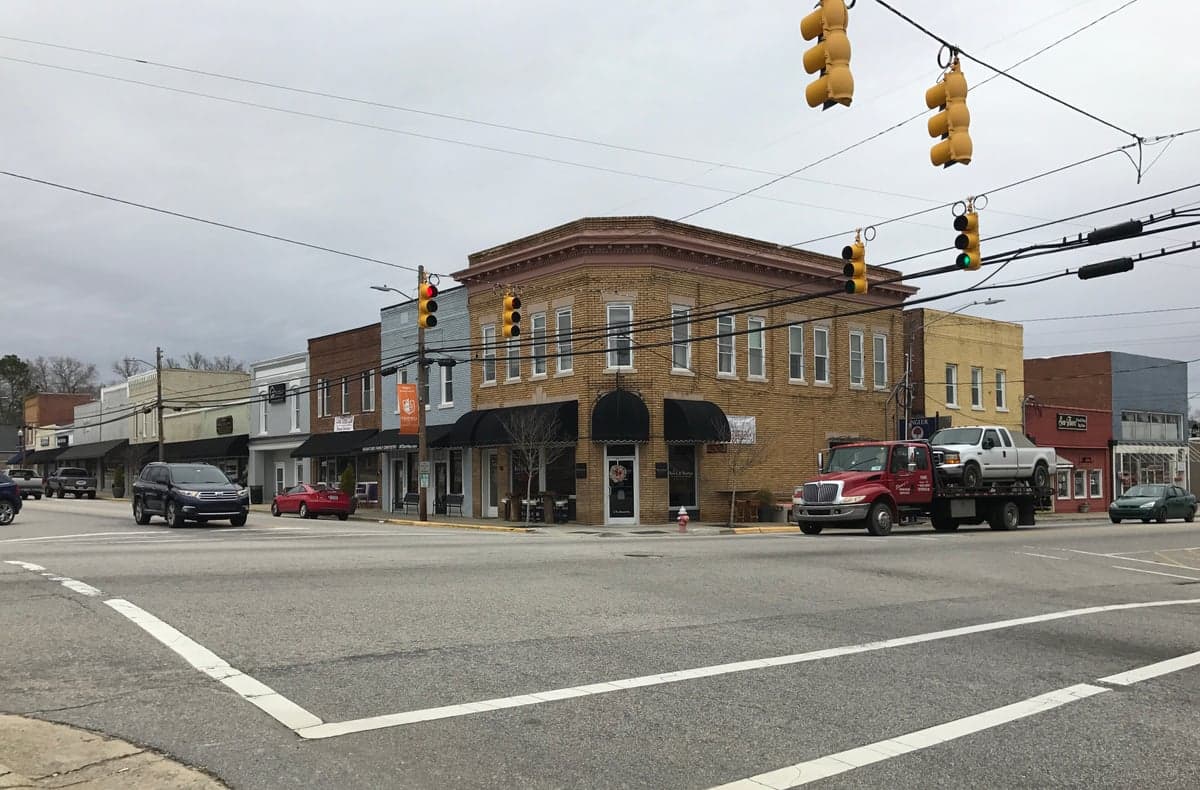
Photo: Wikipedia
Personal Sovereignty in Angier, NC
Viable for self-reliance. Generally workable, though some barriers may limit total independence.
What does Personal Sovereignty tell us?
Personal Sovereignty measures your capacity for self-reliance and independence with minimal government friction. Higher scores mean fewer barriers between you and the way you want to live... but it assumes you have the space you need and good neighbors.
What does this tell us?
Personal Sovereignty measures your capacity for self-reliance and independence with minimal government friction. Higher scores mean fewer barriers between you and the way you want to live... but it assumes you have the space you need and good neighbors.
State Policy
Energy independence: Importer (15% of energy produced in-state)
Personal Liberty
Homesteading

Personal Liberty Analysis
Angier, North Carolina, offers a notably high degree of personal sovereignty, rooted in the state’s broader culture of limited government and individual responsibility. For residents who prioritize autonomy—whether in financial decisions, self-defense, or lifestyle choices—the regulatory environment is generally light-touch, with local ordinances in this Harnett County town rarely adding significant layers of restriction beyond state law. The area’s mix of rural heritage and suburban growth creates a setting where self-reliance is not just tolerated but expected, making it a practical choice for those seeking to minimize external control over their daily lives.
Tax burden and regulatory posture in Angier
North Carolina’s tax structure is among the more favorable in the Southeast for individuals and families focused on financial independence. The state levies a flat personal income tax rate of 4.75% as of 2026, with a standard deduction of $12,750 for single filers and $25,500 for married couples filing jointly. There is no state-level tax on Social Security benefits, and a $2,000 deduction per child under 17 further reduces liability for families. Property taxes in Angier are set by Harnett County at a rate of approximately $0.72 per $100 of assessed value, which is below the state average of roughly $0.80. For a home valued at $300,000, annual property taxes come to about $2,160—a manageable figure compared to many metro areas. Sales tax in Angier is 7%, comprising the state’s 4.75% rate plus local add-ons, but groceries and prescription drugs are exempt. Occupational licensing requirements are moderate; most trades require state certification, but the process is streamlined compared to more heavily regulated states like California or New York. Zoning in Angier is relatively permissive, with the town’s Unified Development Ordinance allowing for home-based businesses, accessory dwelling units, and agricultural uses in many residential zones without excessive red tape. The regulatory posture can be described as “hands-off unless necessary,” with enforcement focused on public safety rather than lifestyle micromanagement.
Self-defense and gun law specifics in North Carolina
North Carolina is a strong Second Amendment state, and Angier residents benefit from some of the most permissive self-defense laws in the region. The state is a “shall-issue” jurisdiction for concealed carry permits, meaning that if you meet the statutory requirements—age 21, completion of a firearms safety course, no disqualifying criminal record—the sheriff’s office must issue the permit. There is no discretionary denial by local officials. Open carry of handguns and long guns is legal without a permit for anyone who can lawfully possess a firearm. The state’s Stand Your Ground law, codified in N.C. Gen. Stat. § 14-51.3, removes any duty to retreat before using deadly force in self-defense when you are lawfully present and reasonably believe force is necessary to prevent death or great bodily harm. Castle Doctrine protections extend to your home, vehicle, and workplace. Angier itself has no local ordinances restricting firearm possession beyond state law; there are no city-level magazine capacity bans or waiting periods. For those who carry, the state recognizes permits from all other states, and North Carolina’s permit is honored in 30+ states through reciprocity. The practical effect for Angier residents is that self-defense decisions remain largely a personal matter, with legal backing for those who choose to arm themselves.
Self-reliance and homesteading viability in Angier
Angier’s location in Harnett County places it in a sweet spot for homesteading and self-reliance. The town’s zoning code allows for agricultural uses on lots as small as one acre in the RA (Residential Agricultural) district, which covers much of the outlying area. Many residential lots in the town proper are a quarter to half an acre, but properties just outside the town limits routinely range from 1 to 5 acres, with some larger tracts available. Raising chickens, goats, and even small livestock is permitted in most unincorporated areas of Harnett County without a special permit, though pigs and cattle may require additional acreage. The county’s soil quality is generally good for gardening, with the Cape Fear River basin providing adequate water access. Off-grid feasibility is moderate: North Carolina has no statewide ban on rainwater collection, and Harnett County does not prohibit it, though the state does require a permit for wells. Solar panel installation is straightforward, with no homeowner association (HOA) restrictions in unincorporated areas—though some subdivisions in Angier do have HOAs that may limit visible panels. The county’s building code follows the state’s adoption of the 2018 International Residential Code, which is standard but not overly burdensome; owner-builders can act as their own general contractor with proper permits. For those seeking to reduce reliance on municipal systems, the area’s combination of affordable land, lenient zoning, and a supportive climate makes Angier a viable location for a self-reliant lifestyle.
Personal liberties: parental rights, medical autonomy, speech, and property
North Carolina law generally respects parental rights in education and healthcare decisions. The state’s Parents’ Bill of Rights, enacted in 2023, requires school districts to notify parents of any changes in a child’s health or well-being, and to obtain parental consent before administering any mental health or medical questionnaire. Parents have the right to opt their children out of sex education and to review all instructional materials. In Angier, the Harnett County School System follows these state mandates, and local school board meetings have been venues for active parental engagement. Medical autonomy is less explicitly protected: North Carolina does not have a broad right-to-try law for terminally ill patients beyond the federal standard, and vaccine mandates for school attendance remain in place for standard childhood immunizations, though religious and medical exemptions are available. The state does not have a specific law protecting alternative medical treatments, but enforcement is generally lax for non-invasive therapies. Free speech protections are robust, with no state-level hate speech laws that would criminalize unpopular opinions; the First Amendment is the primary guardrail. Property rights are strong, with North Carolina’s right-to-farm law protecting agricultural operations from nuisance lawsuits if they have been in operation for at least one year. Eminent domain is limited to public use projects, and the state requires just compensation. For Angier residents, these legal frameworks mean that personal choices—from how you raise your children to what medical treatments you pursue—are largely left to individual discretion, with government intervention reserved for clear public safety concerns.
Overall, Angier ranks as a high-sovereignty location within North Carolina, comparable to other rural-suburban towns in the Sandhills region. The combination of low taxes, permissive gun laws, homesteading-friendly zoning, and strong parental rights creates an environment where personal freedom is the default. While not as libertarian as some Western states like Idaho or Montana, Angier offers a practical balance of autonomy and community infrastructure that appeals to conservative-leaning individuals and families. For those who value making their own decisions about finances, self-defense, and lifestyle without constant government oversight, Angier represents a solid choice in the Southeast.

* Values derived from national, state, county, city and local statistics and may differ in a specific area. Last updated: 2026-10-09T15:44:37.000Z
Narrative content on this page is AI-generated and may contain mistakes. Verify any details that matter before acting on them.
ReloMaps may earn a commission from affiliate links at no extra cost to you.

