Photo: Wikipedia
Demographics of Angier, NC
Affluence Level in Angier, NC
A below-average socioeconomic profile. Incomes, home values, and educational attainment trail the U.S., with higher poverty and unemployment.
People of Angier, NC
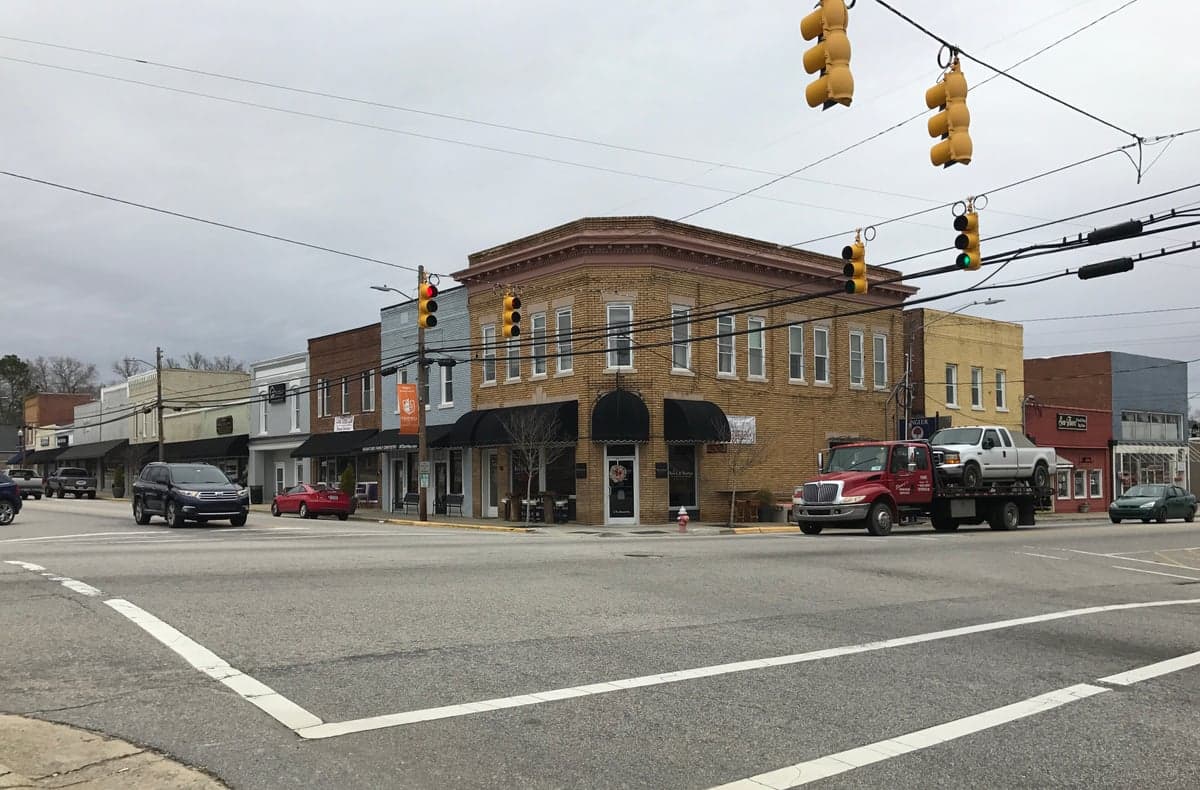
The people of Angier, North Carolina today form a compact, family-oriented community of 5,746 residents, characterized by a notable Hispanic plurality alongside a substantial White and Black population. The town’s identity is rooted in its railroad and agricultural past, but its modern character is increasingly shaped by suburban growth spilling outward from the Raleigh-Durham metro area. With a foreign-born share of 6.9% and a college-educated rate of 26.9%, Angier is a working-to-middle-class town where ethnic diversity is a visible, everyday reality, particularly in its newer subdivisions and along its historic Main Street corridor.
How the city was settled and grew
Angier’s human history begins not with colonial settlement but with the arrival of the railroad in the late 19th century. Incorporated in 1903, the town was named for a railroad official and grew as a shipping point for cotton and tobacco. The earliest residents were largely White farmers and merchants of English and Scots-Irish descent, who built homes along what is now Depot Street and West McIver Street, the historic core. A small but established Black community developed in the Angier Heights area, centered around churches and the local school, drawn by post-Reconstruction land ownership opportunities and work in the tobacco warehouses. Through the mid-20th century, the population remained small—under 1,000—and overwhelmingly White, with the Black community comprising roughly 15-20% of residents, concentrated in the same historic neighborhoods.
Modern era (post-1965)
The post-1965 period brought two major demographic shifts. First, the expansion of nearby Fort Bragg (now Fort Liberty) and the growth of Research Triangle Park drew new residents to Harnett County, including a small number of Asian and Indian families, though these groups remain tiny (East/Southeast Asian at 0.7%, Indian at 0.0%). Second, and far more consequential, was the arrival of Hispanic immigrants—primarily from Mexico and Central America—beginning in the 1980s and accelerating through the 2000s. These families were drawn by agricultural work in the surrounding fields and later by construction and service jobs in the expanding Raleigh suburbs. They settled initially in rental housing along North Raleigh Street and in the South Angier area near the railroad tracks, and later in newer subdivisions like Angier Crossing and Hickory Ridge. Today, Hispanics make up 28.2% of the population, a share that has more than doubled since 2000. The White population, now 52.5%, has declined proportionally but remains the largest single group, with many long-time families still living in the historic Depot Street and West McIver Street neighborhoods. The Black population, at 15.1%, has remained relatively stable, with many families still rooted in Angier Heights and newer subdivisions like Pine Forest.
The future
The population of Angier is heading toward greater diversity and continued growth, driven by its position on the outer edge of the Raleigh-Durham commuting zone. The Hispanic share is likely to continue rising, as families already in the area have children and as new arrivals are drawn by affordable housing compared to Wake County. The White share will probably continue a slow decline, though White families moving from higher-cost areas will keep the number of White residents steady or slightly growing. The Black share is expected to remain stable or increase modestly, as some Black families from Raleigh seek lower property taxes and larger lots. New development is concentrating in subdivisions like Angier Crossing and Hickory Ridge, which are attracting a mix of White, Hispanic, and Black homebuyers, while the historic core remains more ethnically segmented. The town’s cultural identity is evolving from a quiet, predominantly White railroad town into a more diverse, family-oriented suburb—a shift that is visible in the growing number of Hispanic-owned businesses on North Raleigh Street and the increasing bilingual presence in local schools.
For someone moving in now, Angier offers a lower-cost, family-focused alternative to the Raleigh suburbs, with a population that is becoming more diverse and younger. The town is not a melting pot in the classic sense—neighborhoods still show some ethnic clustering—but the overall trend is toward integration, particularly in newer housing developments. The bottom line: Angier is a place where a working-to-middle-class family, regardless of background, can find an affordable home in a community that is still small enough to know its neighbors but growing fast enough to offer new opportunities.

* Values derived from national, state, county, city and local statistics and may differ in a specific area. Last updated: 2026-10-09T15:44:37.000Z
Narrative content on this page is AI-generated and may contain mistakes. Verify any details that matter before acting on them.
ReloMaps may earn a commission from affiliate links at no extra cost to you.

