Photo: Wikipedia
Political ClimatePolitical Climate in Americus, GA
District shown is the primary district for this city’s centroid. Cities may span multiple districts.
Local Political AnalysisPolitical Analysis of Americus, GA
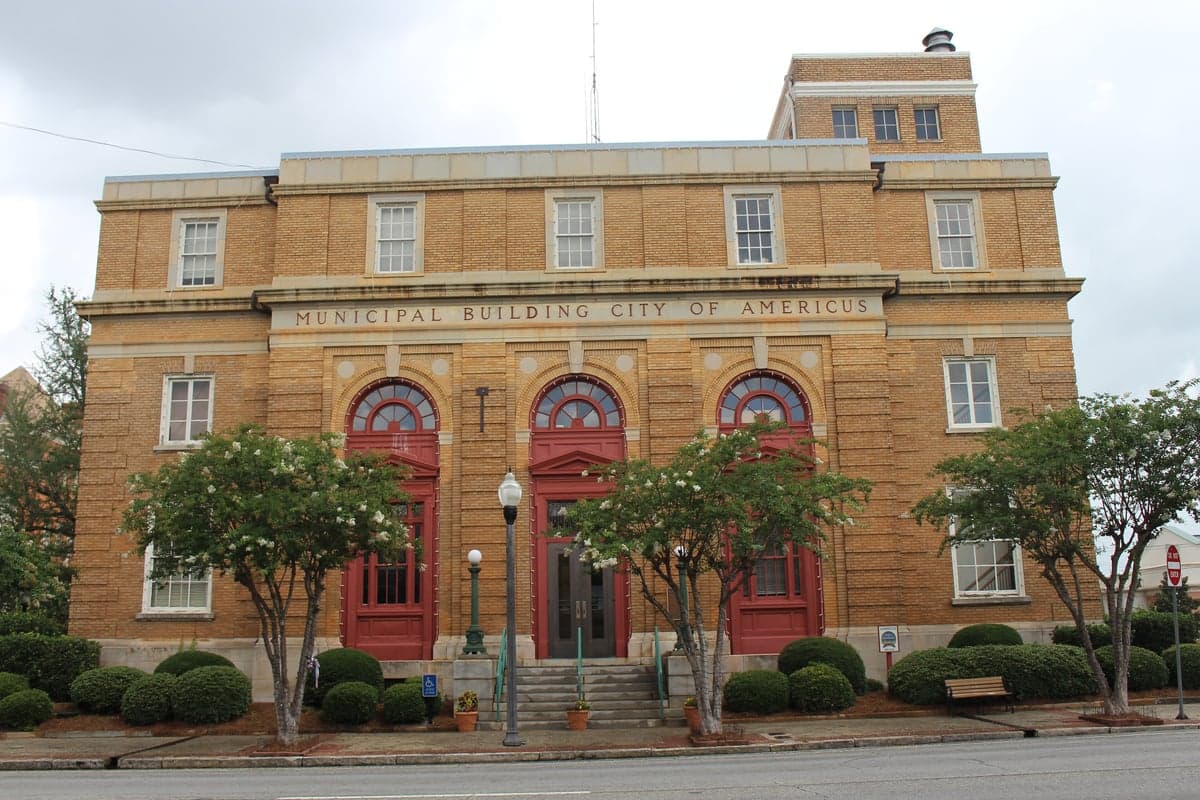
Americus, Georgia, sits in a bit of a political pocket. While the surrounding region of southwest Georgia has trended heavily Republican over the past couple decades, Americus itself has held onto a reliably Democratic lean, reflected in its Cook Partisan Voting Index (PVI) of D+4. That means the city is about four points more Democratic than the national average, which is a stark contrast to the deep-red rural counties that ring it. If you’ve lived here a while, you’ve seen this play out in local elections and even in how folks talk about state politics. The city’s character—shaped by its historically Black colleges, a strong civic engagement tradition, and a more diverse economy than the surrounding farm towns—keeps it from swinging with the rest of the region.
How it compares
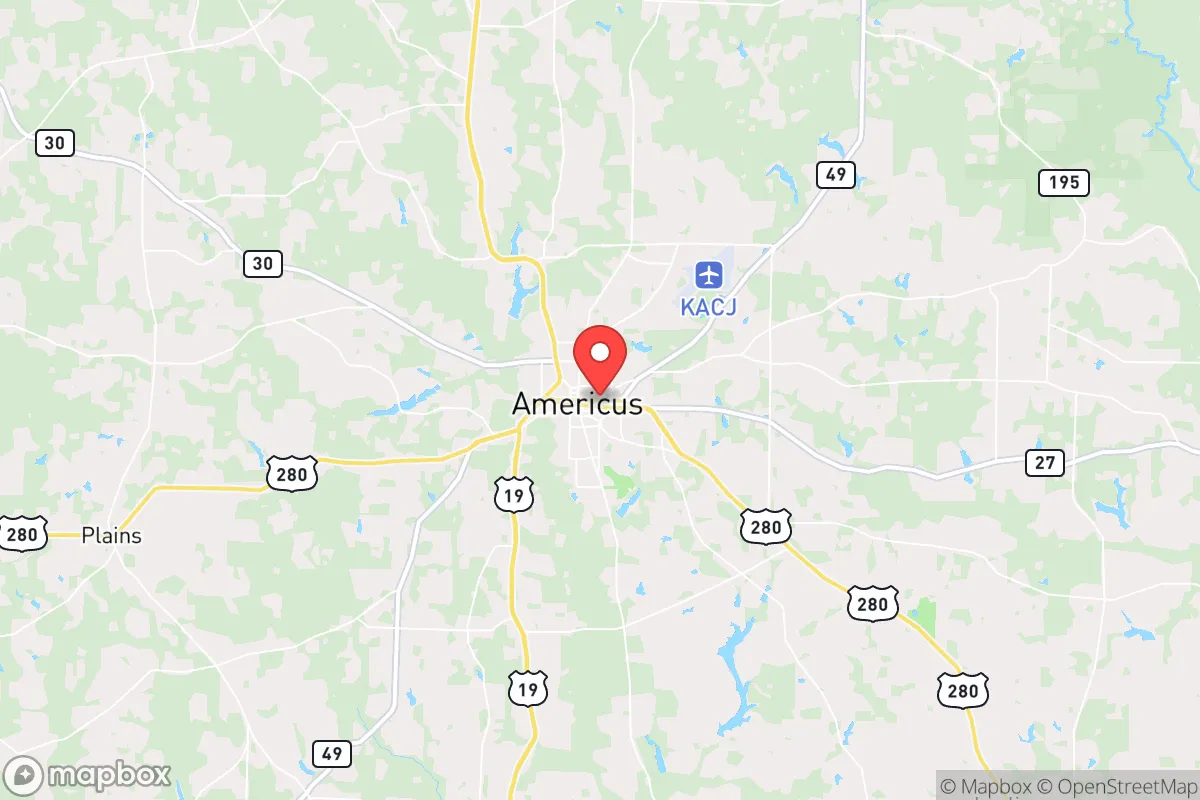
To understand Americus, you have to look at its neighbors. Drive 20 miles east to Cordele or 30 miles west to Albany, and you’ll find communities that vote more consistently Republican, though Albany still has a Democratic lean in its city limits. The real contrast is with the rural precincts just outside Americus—places like Sumter County’s unincorporated areas, which often vote 60-70% Republican. Statewide, Georgia has become a true battleground, flipping blue for Biden in 2020 and then swinging back toward Trump in 2024, but that statewide PVI is basically neutral. Americus, by contrast, is a solidly blue dot in a red sea. The city’s Democratic lean isn’t new—it’s been a reliable base for local Democrats for decades, even as the state legislature and governor’s office have shifted right. What’s changed is the intensity: national polarization has made that local divide feel sharper, especially during election seasons when yard signs in town lean heavily Democratic while the surrounding countryside is plastered with Republican ones.
What this means for residents
For a conservative living in Americus, the practical reality is that you’re in the minority locally, but you’re part of the majority in the county and state. You’ll likely find your views reflected in the sheriff’s office, the county commission, and state legislative seats. For a liberal resident, the city itself feels like a safe space—most of your neighbors share your political outlook, and local city council races tend to be decided in Democratic primaries. But when you drive five minutes out of town, the political landscape flips. That split means both sides learn to coexist in daily life—church, the Piggly Wiggly, Friday night football—because you have to. The biggest practical impact is on policy: Americus’s city government tends to focus on downtown revitalization, affordable housing, and public services, while the county and state push more conservative priorities like tax cuts and limited regulation. That tension can slow down big projects, but it also means nothing gets done without some compromise.
Cultural and policy distinctions
One thing that sets Americus apart is the influence of Georgia Southwestern State University and the historic Koinonia Farm, which was a civil rights-era intentional community. That legacy gives the town a progressive undercurrent you don’t see in nearby Plains or Ellaville. You’ll find more support for environmental initiatives and social justice causes here than in the surrounding counties. On the flip side, gun rights and religious conservatism are still the norm—this isn’t Atlanta. The local Democratic party is more moderate than its national counterpart, often focusing on bread-and-butter issues like infrastructure and education rather than cultural flashpoints. For a newcomer, the key takeaway is that Americus is a place where you can be openly liberal without feeling isolated, but you’ll also have conservative neighbors who are your friends, not your enemies. The political climate here is less about shouting matches and more about knowing who to call when you need something done.

State Political ClimatePolitical Climate in Georgia
State Political AnalysisPolitical Environment in the State
Georgia has transformed from a reliably Republican stronghold into the nation’s most competitive swing state over the past two decades, with a partisan lean that now sits within a razor-thin margin. The state’s 16 electoral votes flipped to Joe Biden in 2020 by just 11,779 votes, and both Senate seats went to Democrats in the 2021 runoffs, marking a seismic shift from the 2008 cycle when Barack Obama lost the state by 5 points. Today, the coalition is split roughly 49-49 between the two major parties, driven by explosive growth in the Atlanta metro area, a diversifying electorate, and suburban women breaking toward Democrats, while deep-red rural counties and the exurban fringe have only hardened their Republican margins.
Urban vs. rural divide
The political map of Georgia is a study in stark contrasts. Metro Atlanta, home to roughly 60% of the state’s population, is the engine of Democratic gains — Fulton and DeKalb counties routinely deliver 75-85% Democratic margins, while Gwinnett, Cobb, and Henry counties have flipped from reliably red to blue-leaning since 2016. Outside the I-285 perimeter, the story flips: rural south Georgia counties like Brooks, Irwin, and Tift vote 70-80% Republican, and the exurban ring — places like Forsyth County (north of Atlanta) and Cherokee County — remain deeply conservative, often voting 65-70% GOP. The divide is also visible in smaller metros: Savannah (Chatham County) leans Democratic, while Columbus (Muscogee County) is a true toss-up, and Augusta (Richmond County) trends blue but is surrounded by deep-red rural counties. The result is a state where statewide races are decided by turnout in the Atlanta suburbs, not the rural strongholds.
Policy environment
Georgia’s policy landscape reflects its divided government: a Republican-controlled legislature and governor’s office, but with a Democratic governor from 2015-2019 (Nathan Deal) and now Republican Brian Kemp, who has governed as a pragmatic conservative. The state has a flat income tax rate of 5.49% (phasing down to 4.99% by 2029), a relatively low corporate tax rate, and no estate or inheritance tax. Property taxes are moderate, with a statewide average effective rate around 0.87%, though they vary significantly by county — Fulton County’s rates are higher than rural areas. Education policy is a flashpoint: Georgia has a robust school choice program (the Georgia Promise Scholarship Act, passed in 2024, offers $6,500 for private school tuition), but public school funding remains a perennial issue, with teacher pay raises passed in 2023 and 2024. Healthcare is a major gap — Georgia is one of 10 states that has not expanded Medicaid under the ACA, leaving roughly 300,000 low-income adults in a coverage gap. Election laws have been contentious: the 2021 SB 202 (the Election Integrity Act) added voter ID requirements for absentee ballots, limited drop boxes, and restricted third-party ballot collection, drawing both praise from conservatives and criticism from voting rights groups.
Recent policy direction
The last three years have seen a flurry of legislation that signals where Georgia is heading. On gun rights, the state remains permissive: permitless carry (HB 218) was signed into law in 2022, allowing concealed carry without a license, and Georgia has strong Stand Your Ground and castle doctrine laws. Parental rights in education got a boost with the 2022 “Parents’ Bill of Rights” (HB 1178), which requires schools to notify parents of curriculum changes and allows them to opt children out of certain materials. On speech and privacy, Georgia passed a data privacy law (the Georgia Data Privacy Act) in 2023, but it’s weaker than California’s — no private right of action. Medical and bodily autonomy is sharply divided: Georgia’s 2019 “Heartbeat Bill” (HB 481) bans abortion after six weeks, with limited exceptions, and was upheld by the state Supreme Court in 2023. Property rights remain strong, with no statewide rent control and relatively low property taxes, though conservation easements are popular in rural areas. On voting, the 2024 session saw no major new restrictions, but the state’s new independent redistricting commission (created in 2023) is drawing maps that could shift a few congressional seats toward competitiveness.
Civil unrest & political movements
Georgia has been a focal point for political activism on both sides. The 2020 election cycle saw massive protests in Atlanta after George Floyd’s murder, with the city becoming a hub for the racial justice movement — the “Cop City” controversy (the planned Atlanta Public Safety Training Center) has sparked ongoing protests and legal battles, with activists calling it a symbol of police militarization. On the right, the “Stop the Steal” movement was particularly active in Georgia, with Trump allies challenging the 2020 results and leading to the Fulton County grand jury investigation into election interference. Immigration politics are heated but less visible than in border states: Georgia has a 2011 law (HB 87) that allows police to check immigration status during traffic stops, but enforcement is uneven. There is no sanctuary city policy in Georgia — in fact, a 2024 law (SB 180) requires local law enforcement to cooperate with ICE detainers. Election integrity remains a live issue: the 2024 presidential election saw no major controversies in Georgia, but the state’s new voting machines (touchscreen with paper backup) have been tested in multiple cycles. A new resident would notice political yard signs and bumper stickers are common, especially in the Atlanta suburbs, but the state avoids the open-carry political rallies seen in some Western states.
Projection
Over the next 5-10 years, Georgia is likely to remain a toss-up state, but the demographic trends favor Democrats slowly. The Atlanta metro is adding 100,000+ new residents annually, many from blue states and abroad, and the state’s growing Asian American and Hispanic populations (now 5% and 11% of the electorate, respectively) lean Democratic. However, the exurban and rural counties are not shrinking — they’re holding steady, and the GOP’s structural advantages in the legislature (through gerrymandered maps) will persist. The wild card is the 2026 gubernatorial race: if a Democrat wins, expect a push for Medicaid expansion and voting rights changes; if a Republican holds the seat, the current policy trajectory — lower taxes, school choice expansion, and continued abortion restrictions — will continue. A relocator moving in now should expect a state where statewide elections are decided by 1-2 points, where the political culture is polarized but not violent, and where the Atlanta suburbs will determine the state’s future direction.
For a new resident, the bottom line is that Georgia offers a genuinely competitive political environment where your vote matters — but the experience varies dramatically by where you live. If you’re a conservative, you’ll find a state government that largely reflects your values on taxes, guns, and education, but you’ll be living in a state where the governor’s mansion could flip in any election. If you’re a liberal, you’ll find a vibrant activist community in Atlanta and Savannah, but you’ll face a state legislature that is likely to remain Republican-controlled for the foreseeable future. The practical takeaway: choose your county carefully, because the political reality in Forsyth County is completely different from Fulton County, and both are within a 30-minute drive of each other.
* Values derived from national, state, county, city and local statistics and may differ in a specific area. Last updated: 2026-10-29T21:15:33.000Z
Narrative content on this page is AI-generated and may contain mistakes. Verify any details that matter before acting on them.
ReloMaps may earn a commission from affiliate links at no extra cost to you.

