Photo: Wikipedia
Demographics of Americus, GA
Affluence Level in Americus, GA
A below-average socioeconomic profile. Incomes, home values, and educational attainment trail the U.S., with higher poverty and unemployment.
People of Americus, GA
The people of Americus, Georgia, today form a predominantly Black (60.8%) and historically rooted community of roughly 15,910 residents, characterized by a strong sense of place and a slower pace of life. The city’s identity is deeply tied to its agricultural and railroad heritage, with a notably low foreign-born population of just 1.1% and a small but growing Hispanic community at 2.9%. With a college attainment rate of 21.5%, Americus is a working-class city where family ties and local institutions—from churches to Georgia Southwestern State University—anchor daily life. The population is older and more stable than the national average, reflecting decades of out-migration by younger adults seeking opportunity elsewhere.
How the city was settled and grew
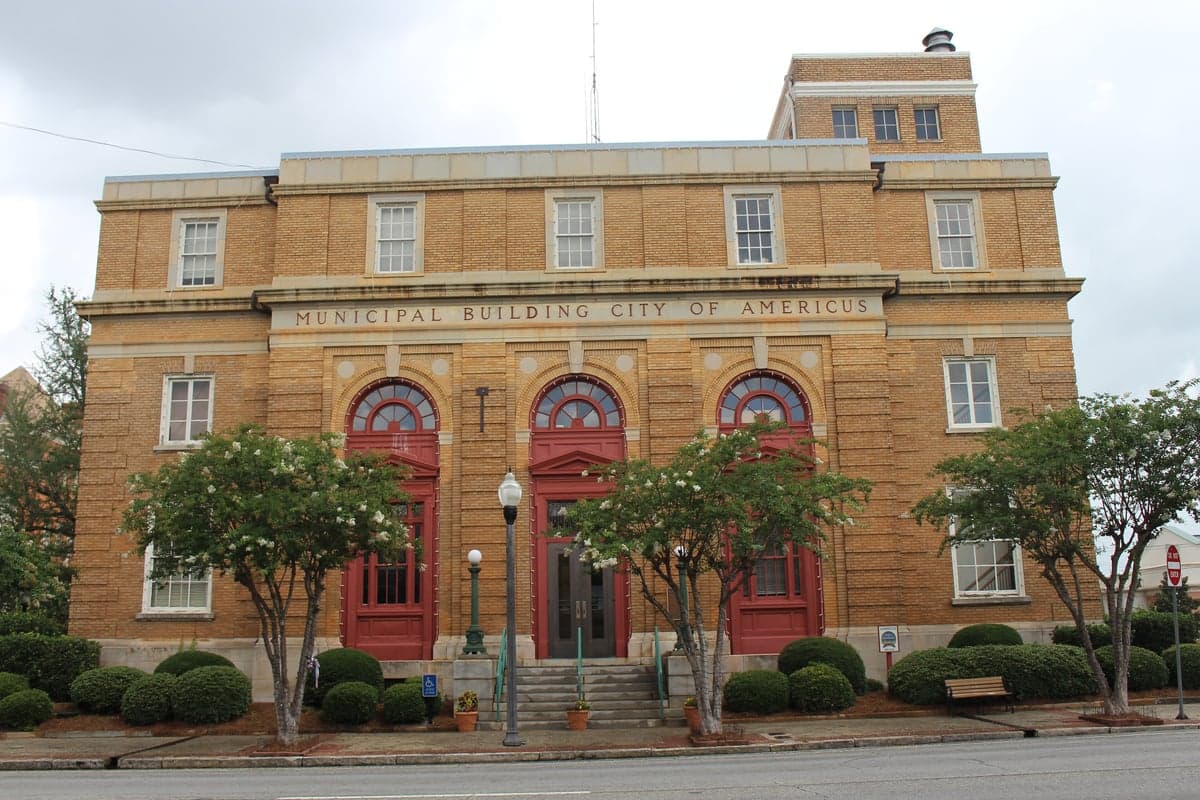
Americus was founded in 1832 as the seat of Sumter County, carved from Creek Indian lands ceded in the 1820s. The original white settlers were planters from the coastal Carolinas and Virginia, drawn by the fertile black soil ideal for cotton. They established large plantations worked by enslaved Black laborers, who by 1860 made up a majority of the county’s population. After the Civil War, freedmen and their families concentrated in East Americus, a historically Black neighborhood that grew along the railroad tracks and remains the city’s most prominent African American district. The arrival of the Savannah, Americus & Montgomery Railway in the 1850s turned the town into a regional cotton-shipping hub, attracting a wave of white merchants and tradesmen who settled in the Downtown Historic District, building the brick storefronts and Victorian homes that still define the city center. By 1900, Americus had a population of about 7,000, with a rigidly segregated social order: white families lived west of Lee Street, while Black families were concentrated east of it, a pattern that persisted for decades.
Modern era (post-1965)
The post-1965 era brought significant demographic change, driven by the Civil Rights Movement and the mechanization of agriculture. The 1970s and 1980s saw a steady out-migration of white families to suburban subdivisions like Oakland Plantation and Lakeview, while Black families began moving into previously white areas near Georgia Southwestern State University and along U.S. Highway 19. The city’s white population share dropped from roughly 45% in 1970 to 30.3% today, while the Black share rose to 60.8%. The Hispanic population, though still small at 2.9%, has grown since the 1990s, with families settling in the Westview area and near the industrial parks on the city’s southern edge, drawn by work in poultry processing and construction. The Asian population (East/Southeast Asian) remains tiny at 1.2%, concentrated among faculty and staff at Georgia Southwestern and the nearby Jimmy Carter National Historical Park. The Indian-subcontinent population is negligible at 0.1%. The foreign-born share of 1.1% is among the lowest in Georgia, reflecting Americus’s limited draw for international migration.
The future
The population of Americus is projected to remain flat or decline slightly over the next decade, as the city continues to lose younger adults to larger metros like Atlanta (roughly 150 miles north) and Columbus. The Black majority is expected to hold steady, while the white share may edge lower as older white residents age in place. The Hispanic share is likely to grow slowly, reaching perhaps 4-5% by 2035, as families settle in the Southside industrial corridor. The city’s cultural identity is becoming more outwardly focused, driven by the presence of Habitat for Humanity International (founded here in 1976) and the Carter Center’s rural initiatives, which bring a small but steady stream of progressive-minded newcomers. However, the overall character remains deeply Southern and church-centered, with limited diversity beyond the Black-white binary. For someone moving in now, Americus offers a tight-knit, affordable community where racial lines are still felt but are less rigid than a generation ago, and where the future hinges on retaining young families and attracting light industry to stem population loss.
Americus is becoming a quieter, older, and more stable version of its 20th-century self—a place where the past is never far from the surface, and where new arrivals will find a community that values continuity over change. For families seeking a low-cost, low-crime environment with strong church and school ties, it offers a viable alternative to the sprawl of Georgia’s larger cities, provided they are comfortable with a predominantly Black and politically conservative social landscape.

* Values derived from national, state, county, city and local statistics and may differ in a specific area. Last updated: 2026-10-29T21:15:33.000Z
Narrative content on this page is AI-generated and may contain mistakes. Verify any details that matter before acting on them.
ReloMaps may earn a commission from affiliate links at no extra cost to you.

