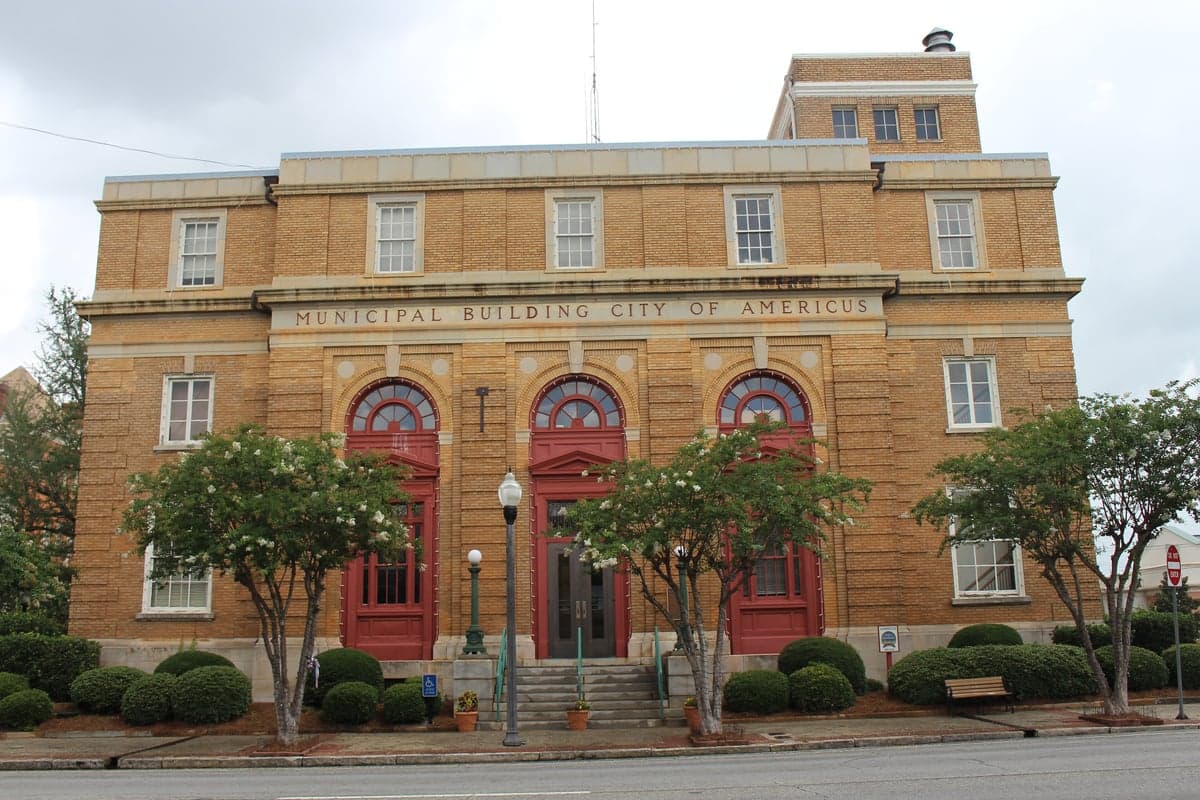
Photo: Wikipedia
Personal Sovereignty in Americus, GA
Viable for self-reliance. Generally workable, though some barriers may limit total independence.
What does Personal Sovereignty tell us?
Personal Sovereignty measures your capacity for self-reliance and independence with minimal government friction. Higher scores mean fewer barriers between you and the way you want to live... but it assumes you have the space you need and good neighbors.
What does this tell us?
Personal Sovereignty measures your capacity for self-reliance and independence with minimal government friction. Higher scores mean fewer barriers between you and the way you want to live... but it assumes you have the space you need and good neighbors.
State Policy
Energy independence: Importer (12% of energy produced in-state)
Personal Liberty
Homesteading

Personal Liberty Analysis
Americus, Georgia, offers a personal sovereignty environment shaped by a combination of low state-level tax burdens, permissive self-defense laws, and a rural-to-suburban landscape that supports self-reliance, though local zoning and municipal ordinances introduce some constraints that residents should weigh carefully. For the freedom-minded individual or family, the city sits in a state that consistently ranks among the most business- and liberty-friendly in the nation, but the specific dynamics of Sumter County and the city limits create a nuanced picture where state-level permissiveness meets local administrative realities. The overall autonomy environment here is strong relative to the national average, but not as unregulated as more remote rural counties in South Georgia or the Appalachian foothills.
Tax burden and regulatory posture in Sumter County
Georgia’s state-level tax structure is a clear advantage for sovereignty-minded residents. The state imposes a flat income tax rate of 5.49% (as of 2025, with a scheduled reduction to 4.99% by 2029), and there is no state-level tax on Social Security benefits or retirement income from most sources. Property taxes in Sumter County are moderate: the millage rate for the county is approximately 12.5 mills, and the city of Americus adds its own levy, bringing the combined effective rate to roughly 1.2% to 1.5% of assessed value, depending on the specific property location. This is below the national average but higher than some neighboring rural counties like Schley or Marion, where millage rates can be 2-3 mills lower. The regulatory posture at the state level is light-touch: Georgia is a right-to-work state, has no state-level minimum wage above the federal $7.25, and imposes relatively few occupational licensing requirements compared to states like California or New York. However, Americus itself enforces standard municipal codes—building permits are required for structural changes, and the city has a rental inspection program for multi-unit properties. For a single-family homeowner not operating a business, the regulatory burden is low; for someone wanting to run a home-based enterprise, the city requires a business license (typically $50-$150 annually) and may restrict certain commercial activities in residential zones. Overall, the tax and regulatory environment here is favorable for personal sovereignty, but not as hands-off as unincorporated areas of the county.
Self-defense and gun law specifics in Georgia
Georgia is a strong Second Amendment state, and Americus residents benefit from some of the most permissive firearm laws in the Southeast. The state has permitless carry (constitutional carry) for anyone 21 or older who is legally allowed to possess a firearm—no license, training, or permit is required to carry a concealed handgun in public. Open carry is also legal without a permit for those 18 and older, though local ordinances in Americus may restrict carrying in certain government buildings or public parks (check city code for specific signage). There is no state-level magazine capacity restriction, no assault weapon ban, and no waiting period for firearm purchases. The state’s Stand Your Ground law is in full effect: there is no duty to retreat before using deadly force in self-defense if you are lawfully present and reasonably believe force is necessary to prevent death, great bodily harm, or a forcible felony. Castle Doctrine protections also apply to vehicles and occupied structures. For those who want a permit for reciprocity purposes, Georgia issues a Weapons Carry License (WCL) through the county probate court—Sumter County’s process is straightforward, typically requiring a $30 fee, a background check, and a 30-60 day processing time. The local sheriff’s office is generally supportive of gun rights, and there are no known local ordinances that significantly undermine state preemption laws. For a self-defense-focused resident, Americus offers a legal environment that maximizes personal autonomy with minimal bureaucratic friction.
Self-reliance and homesteading viability: lot sizes, zoning, and off-grid feasibility
Americus and its surrounding unincorporated areas present a mixed picture for homesteading and off-grid living. Within the city limits, standard residential lots range from 0.25 to 0.5 acres in older neighborhoods, with newer subdivisions offering lots up to 1 acre. The city zoning code allows for backyard chickens (hens only, no roosters) on lots of at least 10,000 square feet, and beekeeping is permitted with registration. However, keeping larger livestock like goats or pigs is prohibited within city limits, and the city enforces a noise ordinance that could affect roosters or frequent barking. For those seeking more land, the unincorporated areas of Sumter County—particularly along Highway 49 south toward Leslie or east toward Cobb—offer parcels from 2 to 20 acres at prices ranging from $3,000 to $8,000 per acre. County zoning is minimal: no building permits are required for agricultural structures under 1,000 square feet, and there are no county-level restrictions on livestock, poultry, or gardening. Off-grid feasibility is moderate: Georgia has no state law prohibiting rainwater collection, and Sumter County does not restrict it. Solar panels are allowed without special permits in unincorporated areas, though the city of Americus requires an electrical permit for grid-tied systems. Septic systems are permitted for properties with at least 1 acre and suitable soil percolation, which is common in the county. The main constraint is water: the Floridan Aquifer provides reliable groundwater at depths of 100-300 feet, but drilling a well costs $5,000-$12,000. For a family wanting to grow food, keep animals, and reduce utility dependence, the unincorporated areas around Americus offer strong viability, while the city itself is more restrictive but still permissive compared to metro Atlanta suburbs.
Personal liberties: parental rights, medical autonomy, speech, and property
Georgia law provides a generally strong framework for personal liberties, though some areas require attention. Parental rights are explicitly protected under state law: Georgia Code § 20-2-786 requires school districts to notify parents of any changes to a student’s services or monitoring related to mental, emotional, or physical health, and parents have the right to opt their children out of sex education or any curriculum they find objectionable. Sumter County Schools generally follow state guidelines, and the local school board has not adopted any controversial policies that override parental authority. Medical autonomy is more mixed: Georgia has no state-level vaccine mandate for adults, and COVID-19 mandates were prohibited by state law in 2023. However, the state does require certain childhood vaccinations for school attendance (with medical and religious exemptions available). Telehealth and direct-primary-care arrangements are legal and growing in the area. Freedom of speech is fully protected under the First Amendment and Georgia’s state constitution, with no notable local ordinances restricting public expression. Property rights are strong: Georgia is a “Dillon’s Rule” state, meaning local governments only have powers explicitly granted by the state, which limits municipal overreach. Eminent domain for private development is restricted by state law. One notable liberty concern: Sumter County has a relatively high property crime rate (roughly 30-40% above the national average), which means that exercising property rights also requires proactive self-defense measures—reinforcing the importance of the gun laws discussed above. For a family prioritizing personal autonomy in education, health decisions, and property use, Americus offers a legal environment that respects individual choice, with the caveat that local crime rates make vigilance necessary.
Overall, Americus provides a personal sovereignty environment that is strong for the South but not extreme—it offers low taxes, permissive gun laws, and viable homesteading options in the county, while the city itself introduces moderate zoning and municipal oversight. Compared to more libertarian-leaning areas like rural North Idaho or the Texas Hill Country, Americus has a slightly heavier local regulatory touch and higher property crime, but it significantly outperforms most of the Northeast, West Coast, or major metro areas in terms of autonomy. For a conservative-leaning individual or family who wants a balance of freedom, affordability, and access to services (with a regional hospital, a university, and a historic downtown), Americus is a solid choice—just be prepared to live outside the city limits if your definition of sovereignty includes keeping goats or drilling your own well.

* Values derived from national, state, county, city and local statistics and may differ in a specific area. Last updated: 2026-10-29T21:15:33.000Z
Narrative content on this page is AI-generated and may contain mistakes. Verify any details that matter before acting on them.
ReloMaps may earn a commission from affiliate links at no extra cost to you.

