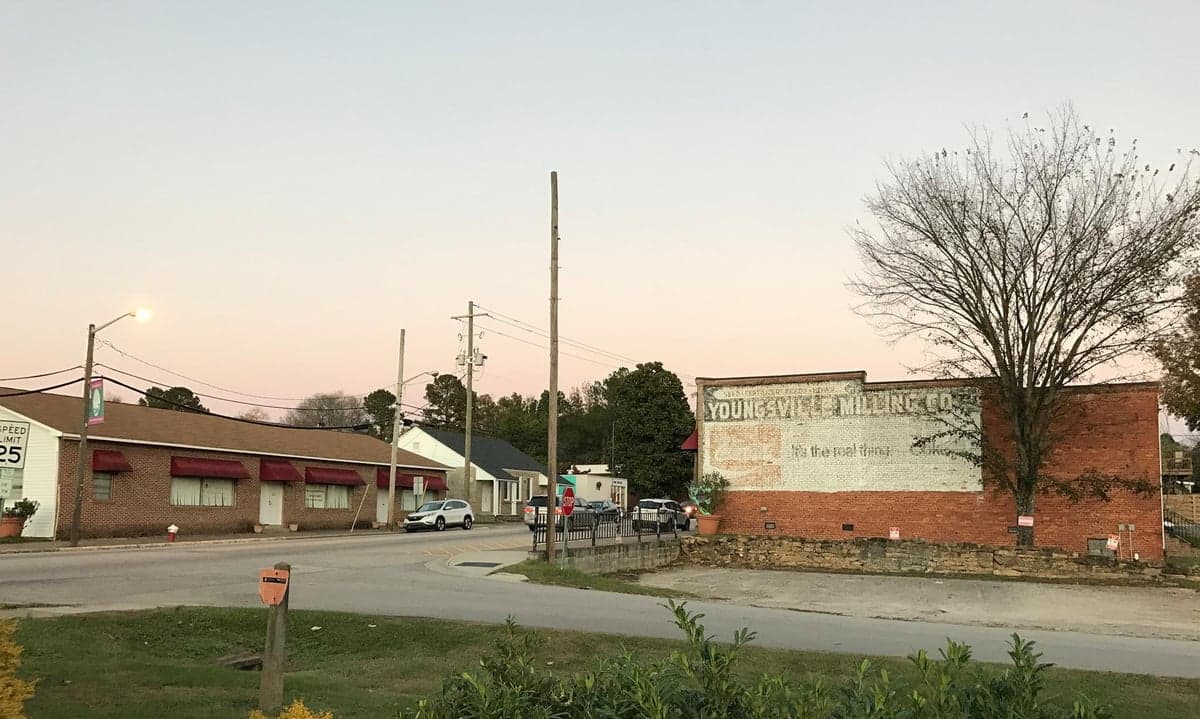
Photo: Wikipedia
Political ClimatePolitical Climate in Youngsville, NC
District shown is the primary district for this city’s centroid. Cities may span multiple districts.
Inherited from parent county — no local data available.
* Lean and PVI are calculated from the surrounding county’s 2020 and 2024 presidential results, Cook-style — a finer measure here than its congressional district (NC-13).
Political rankings in North Carolina
- Most Conservative Cities in North Carolina
- Most Liberal Cities in North Carolina
- Best Liberal-Leaning Towns in the South
- Best Liberal-Leaning Towns in Appalachia
- Safest Liberal-Leaning Towns in the South
- Safest Conservative-Leaning Towns in the South
- Safest Conservative-Leaning Towns on the East Coast
- Affordable Small Towns for Conservatives
- Most Conservative Counties in North Carolina
- Most Liberal Counties in North Carolina
Local Political AnalysisPolitical Analysis of Youngsville, NC
Youngsville, North Carolina, leans solidly Republican, with a Cook Partisan Voting Index (PVI) of R+8, making it significantly more conservative than the state as a whole, which sits at R+1. This isn't a recent shift; the town and surrounding Franklin County have long been a GOP stronghold, though the margin has tightened slightly as the Raleigh-Durham metro area's growth pushes outward. If you've been around here a while, you remember when it was a straight-up red pocket, but now you're starting to see more purple around the edges, especially as folks from Wake Forest and even Raleigh proper move north for cheaper land and a quieter pace.
How it compares
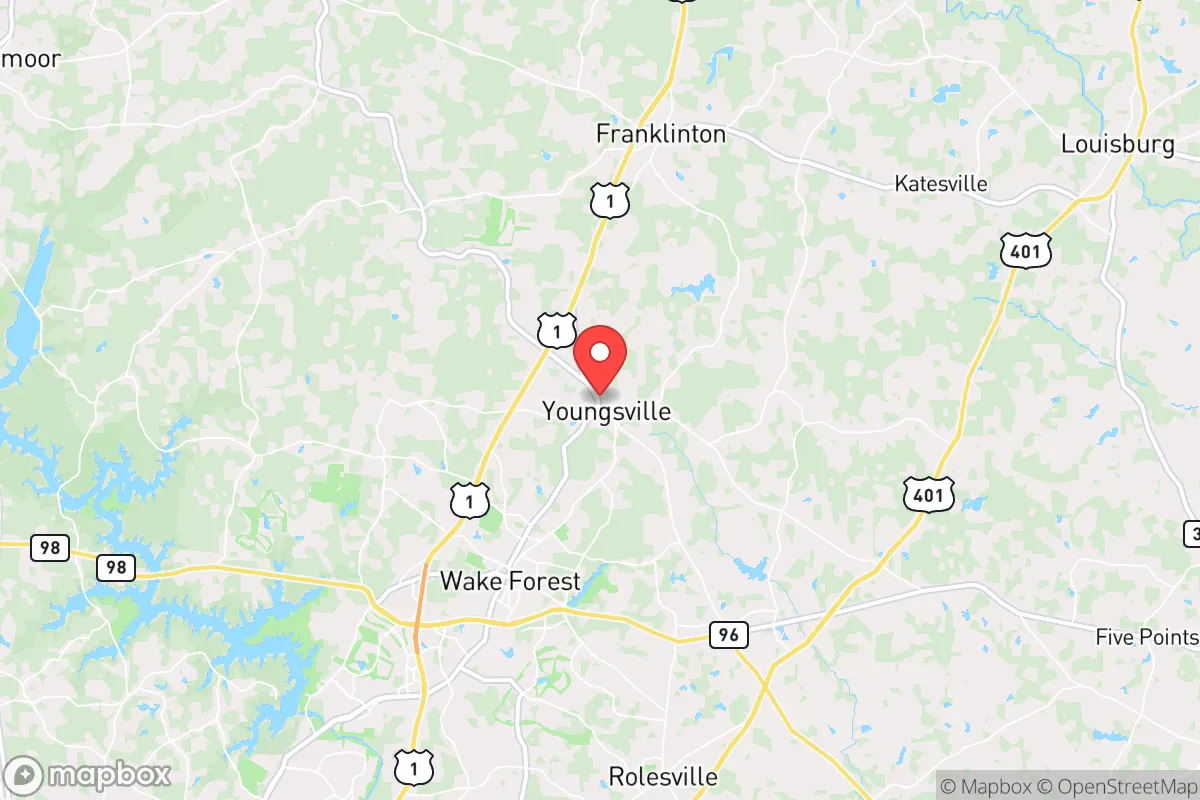
Compared to North Carolina's overall R+1 lean, Youngsville is a full seven points more conservative. That gap is meaningful. Drive ten miles south into Wake County, and you hit the town of Wake Forest, which is more of a toss-up—its PVI is roughly R+2, reflecting a mix of transplants, tech workers, and longtime locals. Go another fifteen miles into Raleigh proper, and you're in D+15 territory. So Youngsville sits in a kind of political buffer zone: conservative enough to feel familiar to rural North Carolinians, but close enough to the Triangle that you'll see Harris-Walz yard signs mixed in with Trump flags during election season. The surrounding Franklin County voted about 62% for Trump in 2020, while the state overall was a 50-49 split. That's a real difference in everyday conversation—people here are less likely to assume you share their political views than they might have been a decade ago.
What this means for residents
For conservative residents, Youngsville offers a reliably red local government and school board, which means lower taxes and fewer zoning restrictions compared to Wake County. You'll find a strong network of churches, gun-friendly policies, and a general sense that your values are the default. For liberal residents, it's a different experience. You're not going to be ostracized, but you'll be in the minority. Local elections often go uncontested by Democrats, and progressive policy pushes—like affordable housing mandates or diversity initiatives—tend to stall. That said, the influx of new residents from the Triangle is slowly shifting the Overton window. A few years ago, you'd never see a "Black Lives Matter" sign on a Youngsville lawn; now you might spot one or two. The practical effect is that liberals here learn to pick their battles and find community in nearby Wake Forest or Raleigh, while conservatives enjoy a political environment that largely mirrors their preferences without much friction.
Culturally, Youngsville still feels like a small Southern town where the high school football game is the biggest event of the week, and the local diner knows your order. But the policy distinctions are real: the town has no city income tax, property taxes are about half of what you'd pay in Raleigh, and the local government is skeptical of state-mandated growth plans. You won't find a bus system or a bike lane network here, and the planning board tends to approve subdivisions with large lots rather than dense apartments. That's changing slowly—a new 200-home development just broke ground off Highway 96—but the political DNA remains deeply rooted in individual property rights and limited government. For anyone moving here, the key takeaway is simple: if you want a place where your vote for a conservative candidate almost always wins, you'll feel at home. If you're looking for a politically diverse community where your liberal views are the norm, you'll want to keep driving south into Wake County.

State Political ClimatePolitical Climate in North Carolina
State Political AnalysisPolitical Environment in the State
North Carolina has been the quintessential swing state for the past two decades, but the pendulum has swung decisively right in recent cycles. With a Cook PVI of R+1, the state is a lean-Republican battleground, but that label hides a deeply polarized reality. The dominant coalition is a mix of rural and suburban conservatives, while the Democratic base is increasingly concentrated in a handful of fast-growing urban centers. Over the last 10-20 years, the state has shifted from a purple toss-up to a state where Republicans control the legislature and most statewide offices, even as Democrats have won the governorship and occasional Senate races. The trajectory is one of slow, steady reddening in the legislature, driven by rural turnout and suburban shifts, even as the urban core grows bluer.
Urban vs. rural divide
The political map of North Carolina is a story of three distinct regions. The Research Triangle — Raleigh, Durham, Chapel Hill, and Cary — is the state's Democratic stronghold, powered by universities, tech workers, and a diverse population. Wake County (Raleigh) voted for Biden by 25 points in 2020, a sharp contrast to the rural counties that surround it. Mecklenburg County (Charlotte) is similarly blue, driven by banking and a growing Hispanic and African American population. On the other side, the rural east and west — places like Robeson County in the east and the mountain counties around Asheville — are deeply Republican. The real battlegrounds are the suburban exurbs: Union County (south of Charlotte) and Johnston County (east of Raleigh) have flipped from purple to solid red in the last decade, while Cabarrus County (Concord) has moved from lean-Republican to reliably red. The Fayetteville area, home to Fort Liberty (formerly Fort Bragg), leans conservative but is influenced by a transient military population. The divide isn't just urban vs. rural — it's also about growth: fast-growing suburban counties like Wake and Mecklenburg are blue, while slower-growing rural counties are red, creating a map that looks like a checkerboard of blue islands in a red sea.
Policy environment
North Carolina's policy environment is a mix of conservative governance and pragmatic moderation. The state has a flat income tax rate of 4.75% (down from 5.25% in 2023), with a scheduled phase-down to 3.99% by 2027. The corporate tax rate is 2.5%, one of the lowest in the country. Sales tax is 4.75% state-wide, with local add-ons pushing it to 7-7.5% in most areas. The state is a right-to-work state, and union membership is low (around 3% private sector). Education policy is a flashpoint: the state has a robust school choice system, including Opportunity Scholarships (vouchers) that were expanded in 2024 to cover all families regardless of income. Public school funding is a perennial court battle — the Leandro case has been ongoing since 1994, with the state Supreme Court ordering billions in additional funding, but the legislature has resisted. Healthcare is a mixed bag: the state expanded Medicaid in December 2023 under a bipartisan deal, adding 600,000 people to the rolls, but the state also has some of the strictest abortion laws in the South — a 12-week ban (with exceptions for rape, incest, and fetal anomalies) passed in 2023. Election laws are conservative: voter ID is required (implemented in 2023 after years of litigation), early voting is generous (17 days), and same-day registration is available during early voting. The state has a Republican-controlled legislature that has consistently overridden Democratic Governor Roy Cooper's vetoes, giving the GOP effective control over most policy levers.
Recent policy direction
The last three years have seen a sharp rightward shift in state policy. In 2023, the Republican supermajority passed HB 808, which eliminated the pistol purchase permit system (a Jim Crow-era law) and allowed permitless concealed carry — North Carolina is now a constitutional carry state. The same session saw SB 20, the 12-week abortion ban, which also included a ban on most abortions after 12 weeks and required in-person counseling. On education, the legislature passed HB 618 in 2024, expanding the Opportunity Scholarship program to universal eligibility, effectively creating a near-voucher system for all K-12 students. On parental rights, the state passed the Parents' Bill of Rights (SB 49) in 2023, requiring schools to notify parents about curriculum changes and medical services. On speech and privacy, the state has not passed a broad social media age-verification law (unlike Florida or Texas), but it did pass a data privacy law (HB 982) in 2023 that gives consumers the right to opt out of data sales. On property rights, the state has strong eminent domain protections — the 2006 Kelo decision prompted a state constitutional amendment limiting eminent domain to public use. On voting, the 2023 SB 747 made it harder for third-party groups to collect absentee ballots and shortened the absentee ballot request window. The overall direction is toward lower taxes, expanded gun rights, school choice, and tighter abortion restrictions — a clear conservative agenda that has been enacted despite a Democratic governor.
Civil unrest & political movements
North Carolina has seen its share of political flashpoints. The Moral Monday protests of 2013-2014 were a defining moment — thousands of activists, led by the NAACP's Rev. William Barber, were arrested at the General Assembly protesting voter ID, education cuts, and the refusal to expand Medicaid. That movement gave rise to a progressive infrastructure that still exists, but it's less visible today. On the right, the NC GOP has been energized by the state's reddening, with groups like the John Locke Foundation (a free-market think tank) and Carolina Journal shaping policy. Immigration politics are relatively muted compared to border states — North Carolina has no sanctuary cities, and the state passed a law in 2015 (HB 318) requiring sheriffs to cooperate with ICE detainers, though some urban counties (Wake, Mecklenburg) have resisted. The election integrity debate has been intense: the 2020 election saw Trump lose the state by 1.3 points, and the GOP-led legislature conducted multiple audits, finding no widespread fraud, but the issue remains a rallying cry for the base. There have been no serious secession or nullification movements. A visible flashpoint for new residents is the Confederate monument debate — the 2015 law (HB 22) protecting monuments was partially repealed in 2020, but the issue still flares up in places like Chapel Hill and Wilmington. Overall, the state is politically engaged but not chaotic — protests are common in Raleigh and Charlotte, but they rarely disrupt daily life for most residents.
Projection
Over the next 5-10 years, North Carolina is likely to become more Republican at the state level, even as the presidential race remains competitive. The key driver is in-migration: the state is growing by about 100,000 people per year, and while many newcomers are from blue states (New York, California), they tend to settle in the suburbs of Charlotte and Raleigh — areas that are already red or trending red. The rural exodus is slowing, but rural counties are aging and becoming more Republican. The Hispanic population is growing fast (now about 10% of the state) and is politically mixed — many are conservative on social issues but lean Democratic on economics. The African American population (22%) remains reliably Democratic but is concentrated in urban areas. The wild card is Gen Z: they are more liberal than previous generations, but they are also less likely to vote. The legislature is likely to remain Republican through at least 2030 due to gerrymandering (the 2023 maps are heavily skewed toward the GOP). The governorship could flip back to Republican in 2024 (Josh Stein, the Democratic AG, is running, but the GOP has a strong bench). A new resident moving in now should expect a state that is conservative on taxes, guns, and education, with a growing economy and a polarized but stable political environment. The blue cities will get bluer, the red counties will get redder, and the suburbs will be the battleground — but the overall direction is rightward.
For a new resident, the bottom line is this: North Carolina offers a low-tax, business-friendly environment with strong gun rights and school choice, but it also has a 12-week abortion ban and a polarized political scene. If you're conservative, you'll find a state government that largely shares your values. If you're liberal, you'll find vibrant blue cities and a robust activist community, but you'll be living under a Republican legislature that is unlikely to change course soon. The state is growing fast, and the politics are stable — you won't see the chaos of a state like Florida or Texas, but you also won't see the progressive policies of a California or New York. It's a Southern state with a moderate-to-conservative tilt, and that's likely to remain the case for the foreseeable future.
* Values derived from national, state, county, city and local statistics and may differ in a specific area. Last updated: 2026-11-13T11:05:16.000Z
Narrative content on this page is AI-generated and may contain mistakes. Verify any details that matter before acting on them.
ReloMaps may earn a commission from affiliate links at no extra cost to you.

