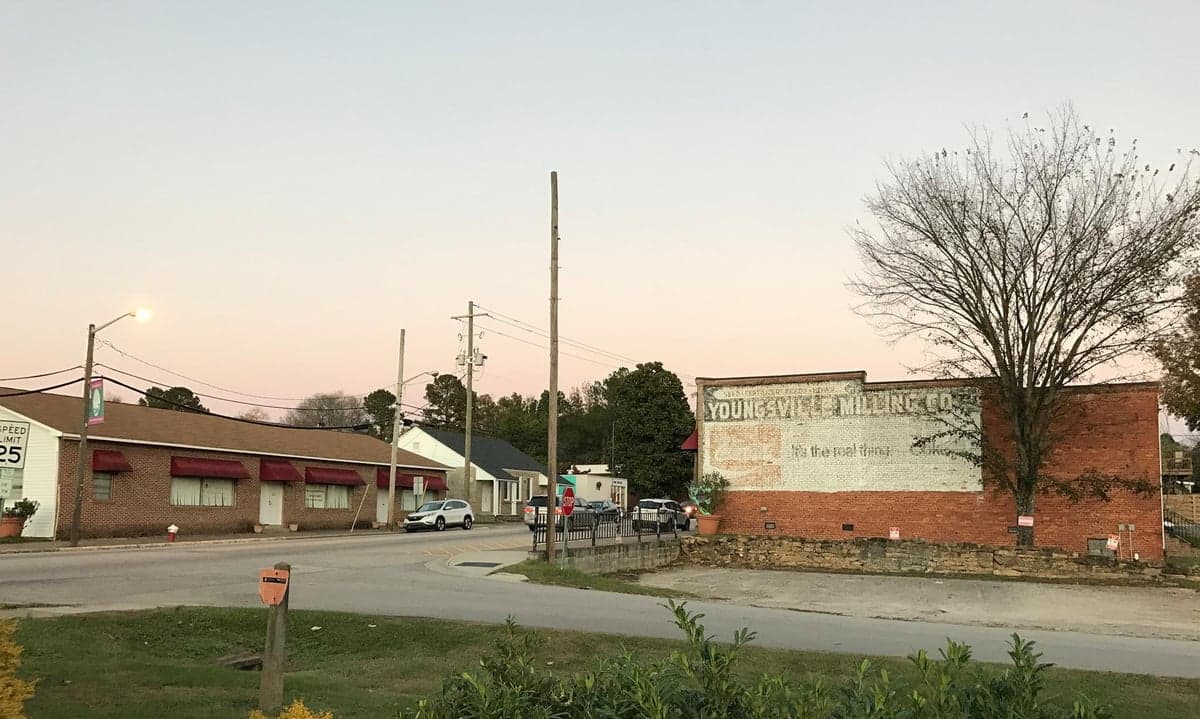
Photo: Wikipedia
Personal Sovereignty in Youngsville, NC
Viable for self-reliance. Generally workable, though some barriers may limit total independence.
What does Personal Sovereignty tell us?
Personal Sovereignty measures your capacity for self-reliance and independence with minimal government friction. Higher scores mean fewer barriers between you and the way you want to live... but it assumes you have the space you need and good neighbors.
What does this tell us?
Personal Sovereignty measures your capacity for self-reliance and independence with minimal government friction. Higher scores mean fewer barriers between you and the way you want to live... but it assumes you have the space you need and good neighbors.
State Policy
Energy independence: Importer (24% of energy produced in-state)
Personal Liberty
Homesteading

Personal Liberty Analysis
Youngsville, North Carolina, offers a notably high degree of personal sovereignty, largely shaped by North Carolina’s status as a Dillon’s Rule state with strong preemption laws that limit local government overreach. While the town itself is small and growing, its regulatory posture is light-touch, and residents enjoy broad autonomy in areas like taxation, self-defense, property use, and family decision-making. For individuals and families prioritizing independence over convenience, Youngsville presents a compelling balance of rural freedom with access to the economic opportunities of the Raleigh-Durham metro area.
Tax burden and regulatory posture in Youngsville
North Carolina’s flat income tax rate of 4.75% (as of 2025) and a state sales tax of 4.75% (with local options bringing it to 7.25% in Franklin County) keep the overall tax burden moderate. Youngsville itself does not levy a municipal property tax; residents pay only Franklin County property taxes, which are assessed at a rate of approximately $0.67 per $100 of valuation. This is significantly lower than neighboring Wake County’s rate of around $0.72, and far below rates in Durham or Orange counties. The regulatory environment is similarly restrained. North Carolina’s state preemption laws prevent local governments from enacting their own minimum wage, paid leave, or rent control ordinances, and also bar counties from regulating agriculture or forestry operations on parcels of 10 acres or more. This means Youngsville’s town council cannot impose burdensome local mandates on businesses or landowners, preserving a predictable, low-friction environment for entrepreneurs and property owners. The state’s right-to-work law further reinforces labor market freedom, and there is no state-level capital gains tax on the sale of a primary residence, which benefits homeowners and investors alike.
Self-defense and gun law specifics in North Carolina
North Carolina is a shall-issue state for concealed carry permits, meaning that if a resident meets objective criteria (age 21, no disqualifying criminal record, completion of a firearms safety course), the sheriff must issue the permit. There is no discretionary denial. Open carry of handguns and long guns is legal without a permit for anyone who can legally possess a firearm. The state also has a strong Stand Your Ground law, codified in N.C. Gen. Stat. § 14-51.3, which eliminates any duty to retreat before using deadly force in self-defense when lawfully present. Castle Doctrine protections extend to occupied vehicles and workplaces. Importantly, North Carolina preempts all local firearm ordinances, so Youngsville cannot ban guns in parks, impose waiting periods, or require additional registration. The only notable restriction is that concealed carry is prohibited in establishments that serve alcohol for on-premises consumption (unless the permit holder is not consuming), and on certain state property like courthouses and schools. For a reader prioritizing self-defense autonomy, Youngsville offers a legal framework that is among the most permissive in the Southeast, with no local barriers to ownership or carry.
Self-reliance and homesteading viability in Youngsville
Youngsville’s zoning code is generally favorable to self-reliance. Residential lots in the town’s extraterritorial jurisdiction (ETJ) and surrounding unincorporated Franklin County can be as small as 0.5 acres in subdivisions, but many rural parcels range from 1 to 10 acres, with some larger tracts available. The county’s zoning ordinance explicitly permits keeping of chickens, goats, and other small livestock on parcels of 1 acre or more, and larger animals like horses or cattle are allowed on 3 acres or more. There is no county-wide ban on beekeeping, and the town’s code does not prohibit front-yard vegetable gardens. Off-grid feasibility is moderate: North Carolina has no state law requiring connection to municipal water or sewer, but Franklin County does enforce septic system permits through the health department. Solar panels are permitted by right, and there is no state-level prohibition on rainwater collection (though the state encourages but does not require a permit for systems over 100 gallons). The main regulatory hurdle is building permits, which are required for any structure over 200 square feet, but inspections are straightforward and fees are low compared to Wake County. For a family wanting to grow food, keep animals, and reduce reliance on external utilities, Youngsville’s regulatory environment is permissive enough to make that feasible without constant government interaction.
Personal liberties in Youngsville: parental rights, medical autonomy, speech, and property
North Carolina’s legal climate strongly supports parental rights in education and medical decisions. The state’s Parents’ Bill of Rights (enacted in 2023) requires school districts to notify parents of any changes in a child’s mental, emotional, or physical health, and prohibits instruction on gender identity and sexual orientation in K-4 classrooms. Parents have the right to opt their children out of any sex education or health curriculum. Medical autonomy is similarly robust: North Carolina does not have a state-level vaccine mandate for adults, and while COVID-19-era mandates have expired, the state’s emergency powers law was reformed in 2021 to limit the governor’s ability to issue sweeping public health orders without legislative approval. There is no state income tax on retirement income (including Social Security, pensions, and 401(k) withdrawals), which enhances financial autonomy for older residents. Free speech protections are strong, with no state-level hate speech laws that could chill expression, and the state’s public records law is among the most open in the country. Property rights are reinforced by North Carolina’s lack of a statewide zoning code; local governments have authority, but the state’s Land Use Planning Act requires that zoning be consistent with a comprehensive plan, limiting arbitrary downzoning. Eminent domain is restricted to public uses (not economic development), and the state’s Agricultural and Forestry Activities Protection Act shields farms from nuisance lawsuits if they were established before nearby residential development. For a reader who values the ability to speak freely, raise children without government interference, and control their own medical choices, Youngsville sits within a state that consistently ranks in the top 10 for personal freedom according to the Cato Institute’s Freedom in the 50 States index.
Overall, Youngsville offers a sovereignty profile that is well above the national average, especially for a town within commuting distance of a major metro area. The combination of low property taxes, state preemption of local overreach, permissive gun laws, and strong protections for parental and property rights creates an environment where individuals and families can live largely unbothered by government. While it lacks the extreme libertarian ethos of a place like Grafton, New Hampshire, or the total absence of zoning found in some Texas counties, Youngsville provides a practical, middle-ground autonomy that is rare in the urbanizing Southeast. For a conservative-leaning individual or family seeking a balance of freedom, affordability, and access to jobs, it is a strong contender.

* Values derived from national, state, county, city and local statistics and may differ in a specific area. Last updated: 2026-11-13T11:05:16.000Z
Narrative content on this page is AI-generated and may contain mistakes. Verify any details that matter before acting on them.
ReloMaps may earn a commission from affiliate links at no extra cost to you.

