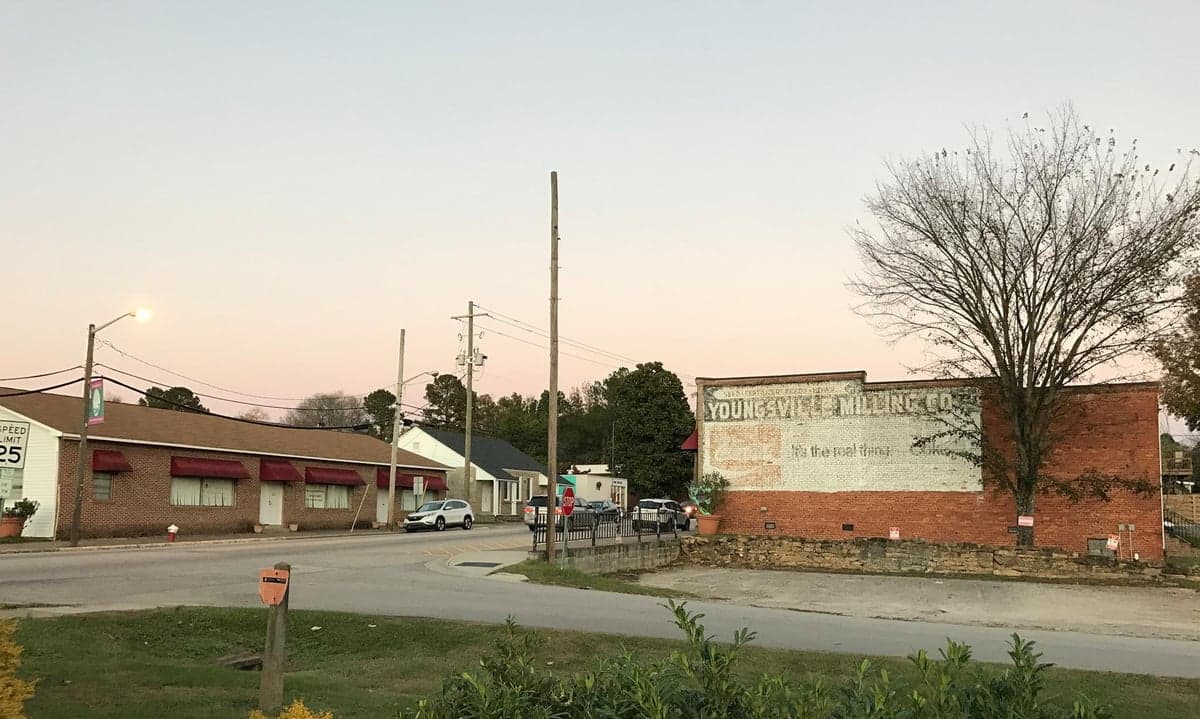
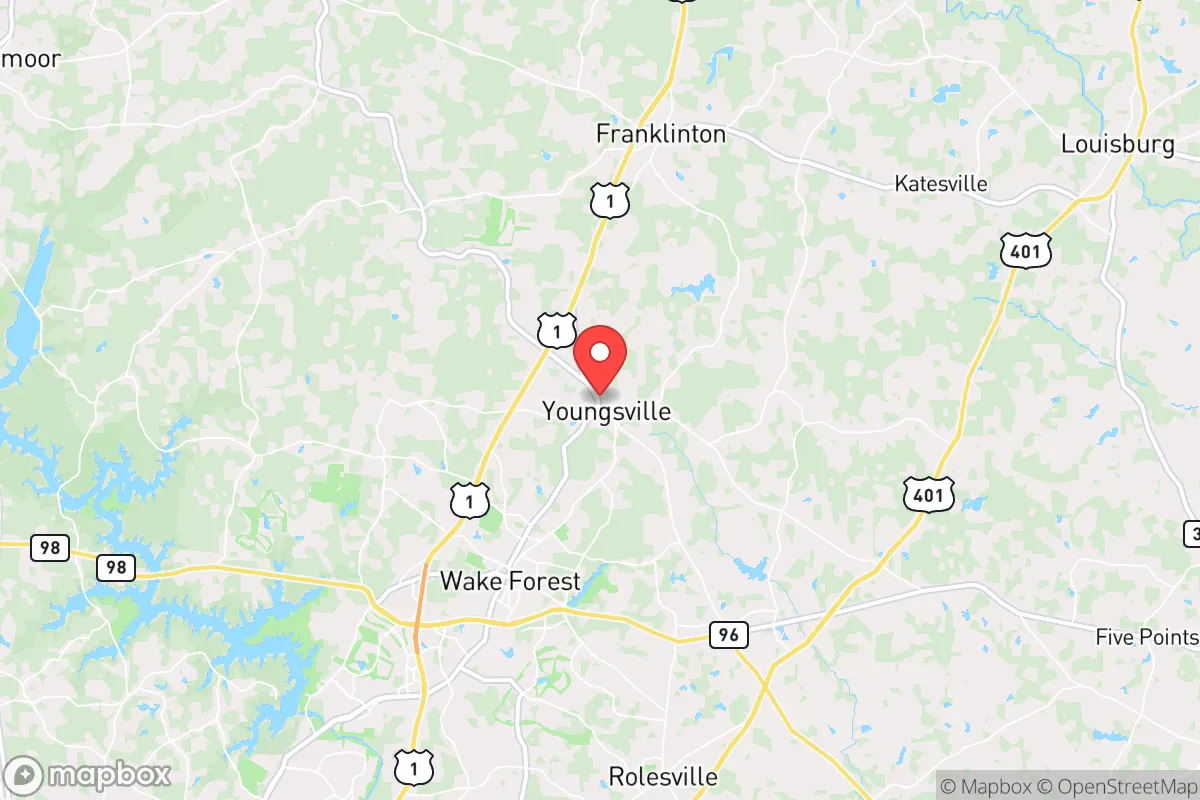
Photo: Wikipedia
Demographics of Youngsville, NC
Affluence Level in Youngsville, NC
A middle-class area roughly in line with national averages across income, home values, education, and employment.
People of Youngsville, NC
The people of Youngsville, North Carolina today form a small, family-oriented community of roughly 2,581 residents, characterized by a predominantly White (61.3%) and Black (28.9%) population with a modest Hispanic presence (7.2%). The city maintains a distinctly suburban, low-density feel, with a higher-than-average college attainment rate of 38.7% and a very low foreign-born share of just 0.9%. Youngsville’s identity is rooted in its historic role as a railroad and tobacco town, now evolving into a quieter, more affordable alternative to the booming Raleigh-Durham metro area, attracting families seeking space and a slower pace.
How the city was settled and grew
Youngsville’s population history begins in the mid-19th century, when the area was part of a land grant region in northern Wake County. The town was officially incorporated in 1875, named after the Young family, who were early landowners and instrumental in bringing the Raleigh and Gaston Railroad through the area. The railroad drew a small, predominantly White farming population, who built the first homes along what is now Main Street and the surrounding Historic District, centered around the intersection of Main and Cross Streets. These early settlers were largely of English and Scots-Irish descent, working small tobacco and cotton farms. A significant Black population also arrived during Reconstruction, many as freedmen who became sharecroppers and tenant farmers on the same lands. They established their own community in the Depot Street area, near the railroad tracks, where a handful of original homes and a historic church remain. By the early 20th century, the town’s economy shifted toward tobacco warehousing and cotton ginning, drawing a few additional families but keeping the population small—under 500 residents through the 1930s. The post-World War II era saw modest growth as returning veterans and their families settled in the West Youngsville area, a cluster of modest ranch homes built on former farmland west of Main Street.
Modern era (post-1965)
The 1965 Hart-Cellar Act had minimal direct impact on Youngsville, as the town’s foreign-born population remains negligible at 0.9%. Instead, the modern era has been defined by domestic in-migration from the broader Raleigh-Durham metro area. Beginning in the 1990s, as Wake County’s population boomed, families seeking lower home prices and larger lots began moving north into Youngsville. This wave was overwhelmingly White and middle-class, settling in new subdivisions like Woods of Youngsville and Hunters Run, both built on former farmland east of the historic core. The Black population, which had historically concentrated in the Depot Street area, began dispersing into these newer subdivisions as well, though the historic neighborhood remains a cultural anchor. The Hispanic population, now 7.2%, began arriving in the 2000s, primarily as construction and service workers drawn by the housing boom. They have concentrated in the South Youngsville area, near the intersection of US-1 and NC-96, where a few small apartment complexes and mobile home parks offer affordable rentals. The Asian population (East/Southeast Asian) remains tiny at 0.6%, with no Indian subcontinent presence recorded, reflecting the town’s limited draw for immigrant professionals compared to nearby Cary or Morrisville.
The future
Youngsville’s population is trending toward slow, steady growth, driven by continued spillover from the Raleigh-Durham metro. The town’s 2020-2024 growth rate of roughly 8% per year is expected to continue, with most new development occurring in the North Youngsville corridor along NC-96, where several large subdivisions are planned. The population is likely to become slightly more diverse, as the Hispanic share grows from its current 7.2% and the Black share remains stable near 30%. However, the foreign-born share is expected to stay low, as Youngsville lacks the job base and rental housing stock that attract international migrants. The White share will likely decline gradually, from 61.3% toward the mid-50% range, as more minority families move in from Wake County. The cultural identity is shifting from a historic farming community to a commuter suburb, with more residents working in Raleigh or Durham and returning home for the quieter lifestyle. This means the town’s social fabric is becoming less tight-knit and more oriented around schools and youth sports, rather than the old church-and-family networks.
For someone moving in now, Youngsville offers a stable, predominantly American-born community with a strong family focus, low crime, and good schools—but little ethnic or cultural diversity. The town is becoming a bedroom suburb for the Triangle, not a destination in its own right, so newcomers should expect a quiet, car-dependent lifestyle with limited dining or entertainment options. The population is growing, but slowly, and the character remains distinctly small-town and conservative-leaning, with a growing number of young families replacing the aging farming population.

* Values derived from national, state, county, city and local statistics and may differ in a specific area. Last updated: 2026-11-13T11:05:16.000Z
Narrative content on this page is AI-generated and may contain mistakes. Verify any details that matter before acting on them.
ReloMaps may earn a commission from affiliate links at no extra cost to you.

