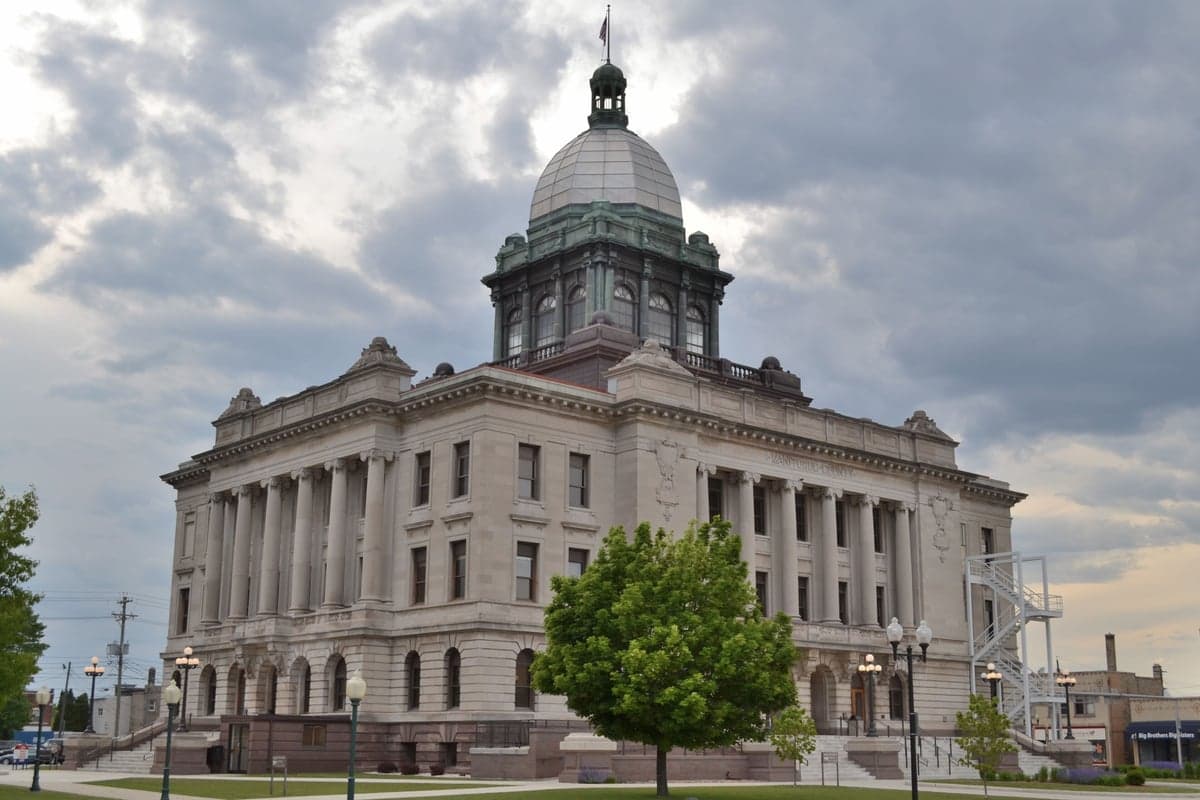
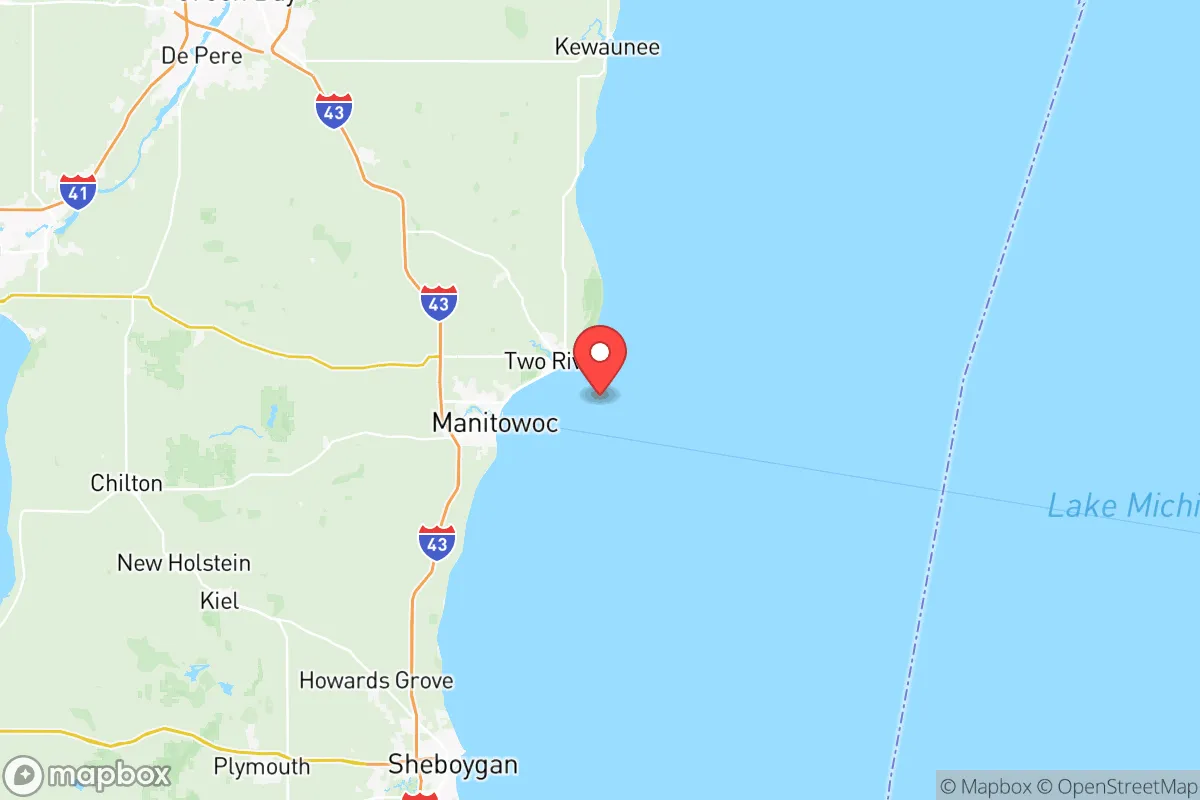
Photo: Wikipedia
Political ClimatePolitical Climate in Manitowoc County
Showing district-level results — no local-only data available.
Local Political AnalysisPolitical Analysis of Manitowoc County
Manitowoc County leans reliably Republican with a Cook PVI of R+8, making it about eight points more conservative than the nation as a whole. That's a significant shift from the 1990s and early 2000s, when the county was a genuine bellwether—voting for the winner in every presidential election from 1980 through 2012. Since 2016, the county has moved rightward faster than the state, and in 2024 it backed Donald Trump by roughly 58% to 40%, a margin that tracks closely with its PVI rating. The surrounding state of Wisconsin, by contrast, has a Cook PVI of EVEN, meaning it's a pure toss-up nationally. So while Wisconsin as a whole is the ultimate swing state, Manitowoc County is now a solidly red part of that swing state.
How it compares
The gap between Manitowoc County and Wisconsin's statewide average is stark and growing. In 2012, Mitt Romney carried the county by about 7 points while losing Wisconsin by 7—a 14-point gap. By 2024, that gap had widened to roughly 18 points, as the county moved right while the state stayed near even. The political geography inside the county tells the story. The city of Manitowoc itself, home to about 33,000 people, is the only real blue-leaning area—it voted for Biden in 2020 and Harris in 2024, though by single-digit margins. Two Rivers, the county's second-largest city, is a classic swing precinct that has trended red in recent cycles. The rural townships—Newton, Meeme, Liberty, and Rockland—are deeply Republican, routinely delivering 65-70% of their votes to GOP candidates. The village of Cleveland and the town of Manitowoc Rapids are also reliably red. So the county's R+8 rating is a composite of one moderately blue city, one swing town, and a sea of red countryside.
What this means for residents
For conservative residents, the county's lean means their values are well-represented at the local level—county board, sheriff, and most municipal offices are held by Republicans. They can expect their property tax levies to stay relatively low and their gun rights to be protected by county ordinances that align with state preemption laws. For liberal residents, the picture is more mixed. They'll find a comfortable political home in the city of Manitowoc, where Democratic candidates consistently win and where local activism around issues like Great Lakes water quality and labor rights has a long history. But they'll also face the reality that their votes are effectively canceled in countywide races and that state legislative districts drawn from the county lean heavily red. The practical effect is that most political energy in the county flows through the Republican Party, and local policy debates tend to center on economic development, agriculture, and manufacturing rather than the cultural flashpoints that dominate state and national politics.
Culturally, Manitowoc County is more pragmatic than ideological. The area's deep roots in dairy farming, shipbuilding, and manufacturing mean that kitchen-table economics—jobs, taxes, and the cost of living—usually trump national culture-war issues. The county's large German and Polish Catholic heritage also tempers some of the more evangelical strains of conservatism found elsewhere in Wisconsin. You'll see pro-life sentiment in rural areas, but also strong support for the local labor unions that still represent workers at companies like Nemak and the Manitowoc Company. The biggest policy distinction from the state as a whole is on environmental regulation: the county's economy depends on Lake Michigan and the Manitowoc River, so even conservative officials tend to support clean-water initiatives and oppose mining projects that threaten the watershed. It's a place where a Republican county board member and a Democratic fisherman can agree on keeping the lake clean, even if they'd never vote for the same presidential candidate.

State Political ClimatePolitical Climate in Wisconsin
State Political AnalysisPolitical Environment in the State
Wisconsin is the ultimate swing state, with a Cook PVI of EVEN that perfectly captures its knife-edge political balance. Over the past 20 years, the state has lurched from reliably blue in presidential races (voting for Democrats from 1988 to 2012) to a dead-even battleground that flipped for Trump in 2016 by less than 23,000 votes, then flipped back to Biden in 2020 by about 20,000 votes. The dominant coalitions are a shrinking but still potent union-and-education Democratic base in the southeast and Dane County, squared off against a growing, energized conservative coalition in the Milwaukee suburbs, the Fox Valley, and the rural western and northern reaches. No state better illustrates the national realignment along educational and geographic lines.
Urban vs. rural divide
The political map of Wisconsin is a story of two metros and everything else. Milwaukee County is the Democratic anchor, delivering margins of 60-70% for Democratic candidates, powered by the city's Black and Latino voters and the near-suburbs like Shorewood and Whitefish Bay. Dane County, home to Madison and the University of Wisconsin, is the state's other Democratic stronghold, and it has been growing faster and bluer — Biden won it by over 70 points in 2020. The real action is in the WOW counties — Waukesha, Ozaukee, and Washington — the affluent, heavily white Milwaukee suburbs that were once reliably Republican but have shifted rightward even as the national suburbs trended left. Waukesha County gave Trump 63% in 2020, up from 59% for Romney in 2012. The Fox Valley, anchored by Appleton and Green Bay, is a classic swing region where working-class voters have moved sharply toward Republicans. The rural Driftless Region in the southwest and the Northwoods remain deeply conservative, while the Eau Claire and La Crosse areas are competitive, college-town influenced swing zones.
Policy environment
Wisconsin's policy environment reflects its divided government. The state has a flat income tax of 4.4% (down from 7.65% in 2011) and a 5% state sales tax, with local sales taxes adding up to 0.5-1%. Property taxes are above the national median but have been constrained by state-imposed levy limits since 2005. The state is a "right-to-work" state (passed in 2015) and a "constitutional carry" state for firearms (permitless carry enacted in 2011, with preemption laws preventing local gun ordinances). On education, Wisconsin has a robust school choice program — the Milwaukee Parental Choice Program, dating to 1990, is the oldest in the nation, and the state expanded vouchers statewide in 2013. The University of Wisconsin system has seen significant budget cuts and a shift toward more conservative governance, including the elimination of tenure protections in state law in 2015 (partially restored later). On election law, Wisconsin requires voter ID at the polls (enacted in 2011), has no-excuse absentee voting, and uses drop boxes (subject to ongoing litigation after the 2020 election). The state has a Republican-controlled legislature that has consistently overridden Democratic Governor Tony Evers' vetoes on issues like abortion and election administration.
Recent policy direction
The last five years have seen Wisconsin lurch between its conservative legislature and a Democratic governor. In 2023, the state Supreme Court flipped to a 4-3 liberal majority after the election of Janet Protasiewicz, who campaigned explicitly on abortion rights and legislative redistricting. That court promptly struck down the Republican-drawn legislative maps as unconstitutional in December 2023, ordering new maps for 2024 that are expected to produce a more competitive legislature. On guns, Wisconsin remains a permissive state: no waiting period, no universal background checks, and no "red flag" law, though the legislature has not passed the permitless carry expansion that some neighboring states have. On abortion, a 1849 law banning the procedure was thrown into chaos after Dobbs; a Dane County judge ruled it does not apply to consensual abortions, and the state Supreme Court is expected to rule on the issue in 2024. On education, the legislature passed a $1 billion increase in K-12 funding in 2023, tied to a modest expansion of the school choice program. On voting, the legislature has passed bills to restrict drop boxes and limit absentee voting, but Governor Evers has vetoed them; the issue remains in the courts. On medical freedom, Wisconsin never had a mask mandate or vaccine passport requirement, and the legislature passed a bill in 2021 banning vaccine passports, which Evers allowed to become law without his signature.
Civil unrest & political movements
Wisconsin has been a flashpoint for political unrest. The 2011 Act 10 protests against Governor Scott Walker's union restrictions drew over 100,000 people to the Capitol in Madison and occupied the building for weeks — the largest state capitol protests since the Vietnam era. The 2020 Kenosha unrest, following the shooting of Jacob Blake, saw two nights of rioting, arson, and the killing of two protesters by Kyle Rittenhouse, who was acquitted on self-defense grounds in 2021. That trial became a national flashpoint for gun rights and self-defense law. The 2020 election aftermath saw intense controversy: Trump won Wisconsin by a narrow margin in 2016 but lost in 2020, leading to a partial recount, a state Supreme Court case, and ongoing claims of election irregularities that have fueled a grassroots election integrity movement among conservatives. The "People's Maps" movement, backed by liberal groups, successfully pushed for the new legislative maps. Immigration politics are less heated than in border states, but the debate over sanctuary policies flared in 2019 when Dane County Sheriff Dave Mahoney declared the jail would not honor ICE detainers; the legislature passed a bill to require compliance, which Evers vetoed. The state has no sanctuary cities in the formal sense, but Milwaukee and Madison have "welcoming city" policies limiting local police cooperation with federal immigration enforcement.
Projection
Over the next 5-10 years, Wisconsin is likely to remain a toss-up state, but the demographic currents are shifting. The new legislative maps, effective for 2024, will likely produce a more competitive state Assembly and Senate, ending the Republican supermajorities that have allowed veto overrides. The state Supreme Court's liberal majority will likely rule on abortion, redistricting, and election law in ways that tilt the playing field slightly toward Democrats. However, the in-migration pattern is not clearly partisan: the fastest-growing counties are the conservative WOW suburbs and the liberal Dane County, while rural counties are shrinking. The University of Wisconsin system's continued struggles with enrollment and funding could weaken the Madison-area Democratic machine over time. The Fox Valley and Green Bay area remain the true swing territory — whoever wins those working-class, culturally conservative but economically populist voters will carry the state. A new resident moving in now should expect a state where every election is close, where the legislature and governor are perpetually at war, and where the policy environment can swing dramatically depending on which party holds the trifecta. The state's political identity is fundamentally contested, and that is unlikely to change.
For a new resident, the bottom line is that Wisconsin offers a genuinely competitive political environment where your vote matters at every level. Conservatives will find a state with low taxes, strong gun rights, school choice, and a legislature that has fought to restrict abortion and limit election access — but they will also face a Democratic governor and a liberal state Supreme Court that can block those priorities. Liberals will find a state with a strong union tradition, a vibrant progressive hub in Madison, and a court system that is now protecting abortion rights and fair maps — but they will live under a legislature that has enacted some of the most conservative policies in the Midwest. The practical takeaway: if you want to live in a place where your political engagement can actually change the direction of a state, Wisconsin is one of the few places left where that is true. Just be prepared for the fight to be constant.
* Values derived from national, state, county, city and local statistics and may differ in a specific area. Last updated: 2026-06-28T22:58:46.000Z
Narrative content on this page is AI-generated and may contain mistakes. Verify any details that matter before acting on them.
ReloMaps may earn a commission from affiliate links at no extra cost to you.

