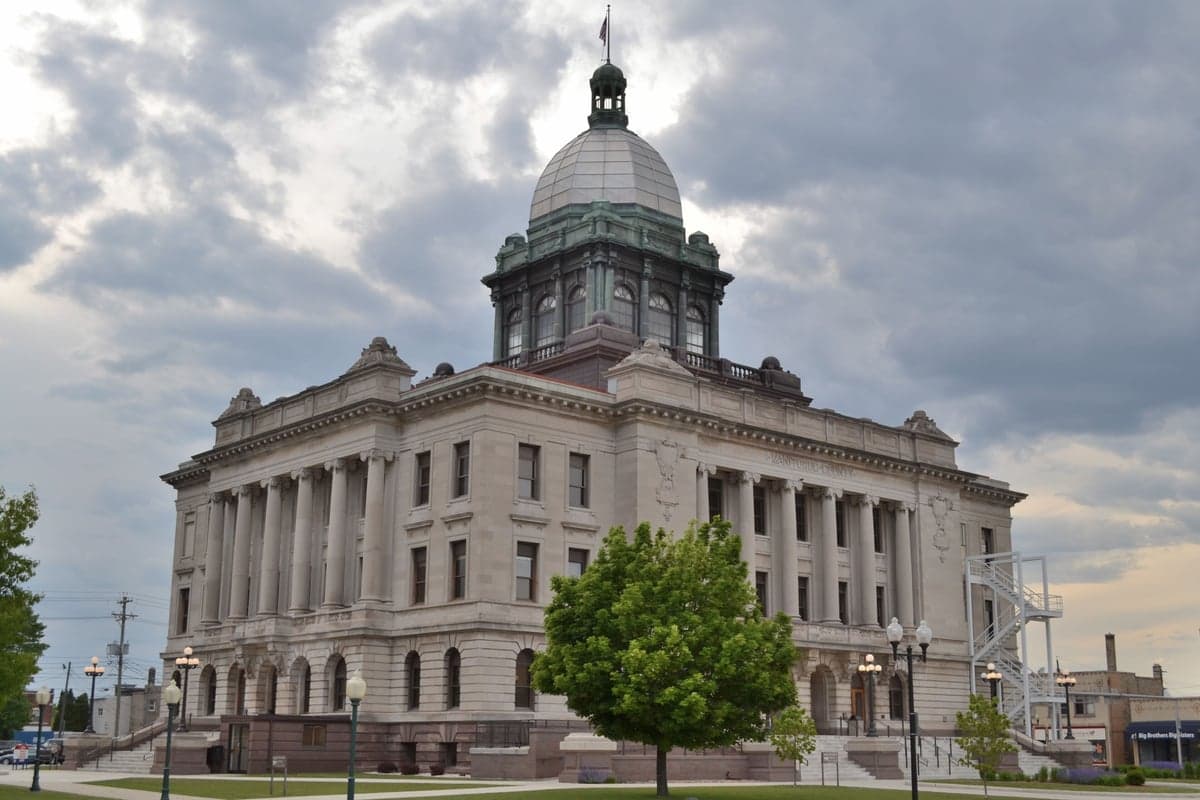
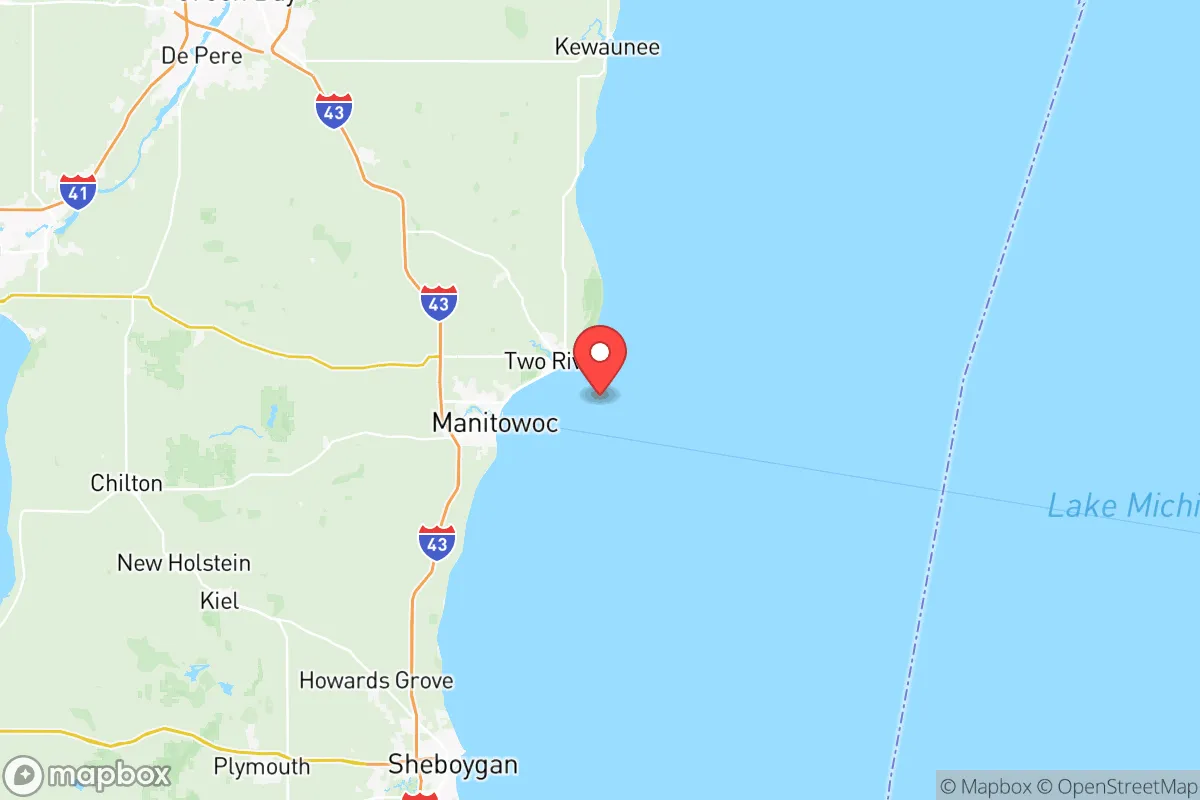
Photo: Wikipedia
Demographics of Manitowoc County
Affluence Level in Manitowoc County
A middle-class area roughly in line with national averages across income, home values, education, and employment.
People of Manitowoc County
Manitowoc County, Wisconsin, is home to 81,314 residents, a population defined by its deep German and Polish Catholic roots, a strong manufacturing and maritime heritage, and a notably low foreign-born share of just 1.8%. The county remains overwhelmingly white at 88.1%, with a growing but still modest Hispanic population of 5.2% and small East/Southeast Asian (2.3%) and Black (0.8%) communities. Its identity is shaped by the legacy of Lake Michigan shipbuilding, dairy farming, and a conservative, family-oriented civic culture that prizes self-reliance and local tradition.
Settlement & growth (pre-1960)
Before European settlement, the area was home to the Menominee and later the Potawatomi and Ho-Chunk nations, who used the Lake Michigan shoreline and the Manitowoc River for fishing, trade, and seasonal camps. French fur traders and missionaries passed through the region in the 17th and 18th centuries, but no permanent European settlement took hold until the 1830s, when the U.S. government forcibly removed Native tribes through treaties and land cessions, opening the area for Yankee and European settlers.
The first permanent American settlers arrived in the 1830s and 1840s, primarily Yankees from New York and New England who established the county seat of Manitowoc (1836) and the village of Two Rivers (1848). These early arrivals built the region's first sawmills, gristmills, and small shipyards, recognizing the natural harbor at the mouth of the Manitowoc River as a strategic asset for Lake Michigan commerce. By 1850, the county's population had reached roughly 8,000, with Yankees dominating the commercial and political elite.
The defining wave of immigration came between 1848 and 1890, when tens of thousands of German-speaking immigrants from Prussia, Pomerania, and Bavaria poured into the county. They were drawn by cheap farmland, the promise of religious freedom (many were Catholic or Lutheran), and chain migration from established German communities. They settled across the entire county, but concentrated heavily in the rural townships of Newton, Meeme, Liberty, and Franklin, as well as in the city of Manitowoc itself, where they worked in shipbuilding, tanneries, and breweries. By 1900, Germans and their descendants made up roughly 60% of the county's population, and German-language newspapers, churches, and social clubs flourished.
A second major European wave arrived between 1870 and 1910: Polish immigrants, primarily from the Prussian partition of Poland, who were recruited to work in the county's expanding manufacturing sector and on dairy farms. They established a strong presence in Manitowoc's south side and in the village of Valders, where St. Mary's Catholic Church became the spiritual and social anchor. By 1920, Poles constituted roughly 15-20% of the county's population, and their descendants remain a visible cultural force today, with Polish festivals, church suppers, and family names like "Wojcik" and "Kowalski" common throughout the county.
Smaller but notable groups included Irish immigrants (who worked on the railroads and in the shipyards, settling in Manitowoc and Two Rivers), Bohemians (Czechs who farmed in the Kellnersville area), and a handful of Scandinavian families who settled in Mishicot and Francis Creek. The county's population peaked at roughly 50,000 by 1910, then continued growing slowly through the mid-20th century as the shipbuilding industry boomed during World War II, when the Manitowoc Shipbuilding Company produced submarines for the U.S. Navy, drawing workers from across the Midwest.
Modern era (post-1965)
The 1965 Hart-Cellar Act had a minimal direct impact on Manitowoc County, as the region did not attract the large-scale immigration seen in major metropolitan areas. The foreign-born population today stands at just 1.8%, far below the national average of roughly 14%. The county's demographic story since 1965 is primarily one of domestic outmigration and aging in place, rather than new immigrant arrivals.
Manufacturing consolidation and the decline of the Great Lakes shipping industry led to steady population loss from the 1970s through the 2010s. The county's population peaked at roughly 86,000 in 1970 and has since declined to 81,314, with the city of Manitowoc losing about 10% of its population since 1980. Young adults have left for college and jobs in Green Bay, Milwaukee, and the Twin Cities, contributing to a median age (roughly 44) that is several years above the national average.
The most notable demographic shift since 1965 has been the growth of the Hispanic population, which rose from less than 1% in 1990 to 5.2% today. This growth is driven primarily by Mexican and Central American immigrants who came to work in the county's food processing plants (especially at the Lakeside Foods and Sartori Cheese facilities) and on dairy farms. They have concentrated in Manitowoc's north side and in the village of Reedsville, where a small but growing Spanish-speaking community has established churches, tiendas, and soccer leagues.
The East/Southeast Asian community (2.3%) is largely composed of Hmong families who resettled in the county after the Vietnam War, with a smaller number of Filipino and Korean immigrants who came as healthcare workers. The Hmong community is concentrated in Manitowoc and Two Rivers, where they have established a mutual assistance association and a Hmong New Year celebration. The Indian subcontinent population (0.2%) and Black population (0.8%) remain very small, with most Black residents being multi-generational American families rather than recent immigrants.
Suburbanization within the county has been modest compared to national trends. The unincorporated areas around Valders, Whitlaw, and Clarks Mills have seen some new home construction, but the county lacks the explosive exurban growth seen in Waukesha or Washington counties. Most residents still live in the three main population centers: Manitowoc (roughly 33,000), Two Rivers (roughly 11,000), and Kiel (roughly 3,800, partially in Calumet County).
The future
Manitowoc County's population is projected to continue a slow decline over the next 10-20 years, driven by an aging population (roughly 20% of residents are over 65) and the outmigration of young adults. The county's birth rate has fallen below replacement level, and net domestic migration has been negative for most of the past two decades. The Hispanic population is expected to grow to roughly 8-10% by 2040, driven by continued labor demand in food processing and agriculture, but the county will remain overwhelmingly white and culturally German-Polish.
The county is becoming slightly more diverse, but at a pace far slower than the state of Wisconsin as a whole or the nation. The East/Southeast Asian and Black populations are likely to remain small, as the county lacks the job diversity and urban amenities that attract larger immigrant communities. The Indian subcontinent population is negligible and unlikely to grow significantly without a major employer recruiting tech or medical professionals.
Culturally, the county is wrestling with the tension between its traditional manufacturing and agricultural identity and the need to attract new residents. Local economic development efforts are focused on tourism (the Lake Michigan shoreline, the Wisconsin Maritime Museum, and the annual Kites Over Lake Michigan festival) and niche manufacturing (metal fabrication, food processing, and plastics). The county's political leanings remain reliably Republican, with Donald Trump winning roughly 60% of the vote in 2024, reflecting the conservative Catholic and Lutheran values that have defined the region since the 19th century.
For someone moving in now, Manitowoc County offers a stable, safe, and affordable community with strong schools in the Manitowoc and Two Rivers districts, low crime rates, and a deep sense of local identity. The trade-off is limited job growth, a shrinking population, and a cultural environment that is less diverse and less dynamic than larger Midwestern cities. It is a place where the past is still very much present, and where newcomers who respect that heritage will find a welcoming, if insular, community.

* Values derived from national, state, county, city and local statistics and may differ in a specific area. Last updated: 2026-06-28T22:58:46.000Z
Narrative content on this page is AI-generated and may contain mistakes. Verify any details that matter before acting on them.
ReloMaps may earn a commission from affiliate links at no extra cost to you.

