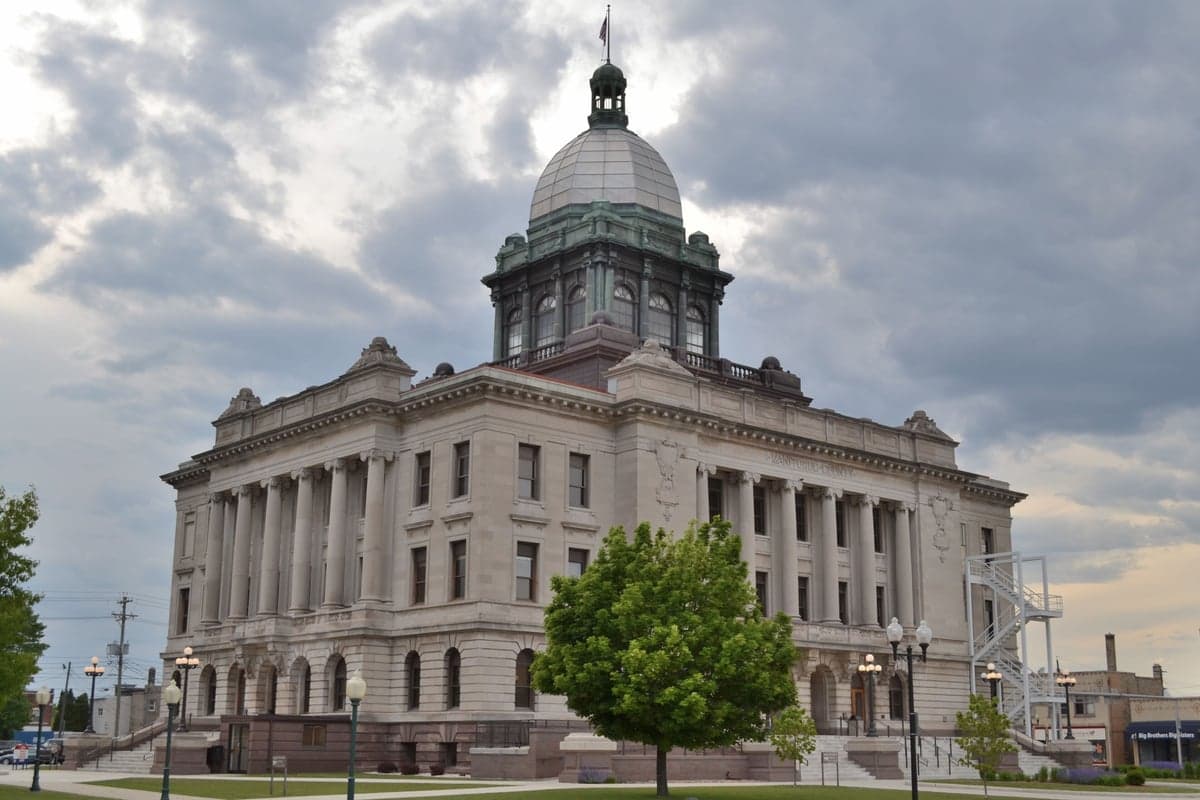
Photo: Wikipedia
Personal Sovereignty in Manitowoc County
Moderate friction. Expect trade-offs in some aspect of personal liberty and independence.
What does Personal Sovereignty tell us?
Personal Sovereignty measures your capacity for self-reliance and independence with minimal government friction. Higher scores mean fewer barriers between you and the way you want to live... but it assumes you have the space you need and good neighbors.
What does this tell us?
Personal Sovereignty measures your capacity for self-reliance and independence with minimal government friction. Higher scores mean fewer barriers between you and the way you want to live... but it assumes you have the space you need and good neighbors.
State Policy
Energy independence: Importer (15% of energy produced in-state)
Personal Liberty
Homesteading

Personal Liberty Analysis
Manitowoc County, Wisconsin, offers a notably high degree of personal sovereignty compared to many urban and coastal regions, particularly for those who value self-reliance and limited government interference. The county’s regulatory environment is generally light-touch, with local officials in towns like Two Rivers and Valders tending toward pragmatic, low-burden approaches. While Wisconsin’s state-level framework sets baseline rules, the county’s rural character and conservative-leaning local governance create a climate where individual autonomy—from tax decisions to self-defense choices—is broadly respected.
Tax burden and regulatory posture in Manitowoc County
Wisconsin’s state income tax is progressive (3.5% to 7.65%), but Manitowoc County’s property tax rates are moderate relative to the state average. The county’s total property tax rate (including school and municipal levies) typically falls around $18–$20 per $1,000 of assessed value, which is competitive with neighboring counties like Sheboygan and Calumet. Sales tax is a flat 5.5% statewide, with no additional county-level surcharge. Regulatory posture is business-friendly in unincorporated areas and smaller towns like Reedsville and Kiel, where zoning boards rarely impose burdensome conditions on home-based businesses or small-scale agricultural operations. The city of Manitowoc itself has more formal permitting processes, but even there, the permitting timeline for residential additions or minor commercial renovations is typically under 30 days. The county’s overall regulatory climate is best described as pragmatic and predictable, with local officials generally deferring to property owners unless public safety is clearly at risk.
Self-defense and gun law specifics in the county
Wisconsin is a “shall-issue” state for concealed carry permits, and Manitowoc County’s sheriff’s office processes applications efficiently, with approval times averaging 2–3 weeks. The county has no local ordinances restricting firearm possession beyond state law, meaning open carry is legal without a permit, and concealed carry requires a permit (issued to any adult who passes a background check and completes a training course). Stand-your-ground protections apply statewide, with no duty to retreat in any place where a person is lawfully present. Gun culture is strong in rural areas like Cooperstown and Francis Creek, where hunting and sport shooting are common. The county has no local ammunition or magazine restrictions, and private firearm sales between individuals are not subject to state-level background checks. For those prioritizing self-defense rights, Manitowoc County’s legal environment is among the most permissive in the Midwest, with local law enforcement generally supportive of responsible gun ownership.
Self-reliance and homesteading viability across the area
Homesteading and off-grid living are feasible in Manitowoc County, particularly in its unincorporated townships. Minimum lot sizes in agricultural zones are typically 35 acres in towns like Gibraltar and Maple Grove, though smaller parcels (1–5 acres) are common in rural residential zones. Zoning codes generally allow accessory dwelling units, workshops, and small-scale livestock (chickens, goats) without special permits. Off-grid systems—solar panels, rainwater collection, composting toilets—are legal but require standard building permits; the county health department does inspect private wells and septic systems, but the process is straightforward. Two Rivers and Manitowoc city limits have stricter codes (e.g., requiring grid connection for new construction), but towns like Newton and St. Nazianz are far more permissive. The county’s agricultural heritage means local officials are accustomed to self-sufficient lifestyles, and code enforcement is complaint-driven rather than proactive. For those seeking to reduce reliance on municipal utilities, the county’s rural areas offer genuine off-grid potential with minimal bureaucratic friction.
Personal liberties in daily life: parental rights, medical autonomy, speech, and property
Parental rights are strongly protected in Manitowoc County. School boards in districts like Valders and Reedsville have consistently resisted state-level curriculum mandates, and local policies allow parents to opt children out of specific lessons or activities without penalty. Medical autonomy is generally respected, though Wisconsin’s vaccine mandates for school attendance apply statewide; exemptions (medical, religious, philosophical) are available and routinely granted. Free speech is robust, with no local ordinances restricting political signage or public assembly. Property rights are well-guarded: the county’s zoning code explicitly states that “no regulation shall be construed to prohibit the use of property for any lawful purpose,” and eminent domain is rarely used outside of major infrastructure projects. Kiel and Two Rivers have active citizens’ groups that monitor local government actions, ensuring transparency. The overall environment is one where individual decision-making is trusted over bureaucratic oversight, particularly in family and health matters.
Compared to many parts of the Upper Midwest, Manitowoc County stands out for its balanced approach to personal sovereignty. It avoids the extremes of both heavy-handed urban regulation and the near-absence of governance found in some remote rural counties. For a relocation-minded individual or family who values self-reliance, gun rights, and minimal tax burden, the county offers a practical, livable middle ground—especially in its smaller towns and unincorporated areas. The key trade-off is that while the regulatory climate is light, it is not absent; those seeking absolute freedom from any oversight may find more permissive environments in parts of the Mountain West or Alaska. But for most people prioritizing personal autonomy within a functional community, Manitowoc County delivers a high degree of freedom with low administrative hassle.

* Values derived from national, state, county, city and local statistics and may differ in a specific area. Last updated: 2026-06-28T22:58:46.000Z
Narrative content on this page is AI-generated and may contain mistakes. Verify any details that matter before acting on them.
ReloMaps may earn a commission from affiliate links at no extra cost to you.

