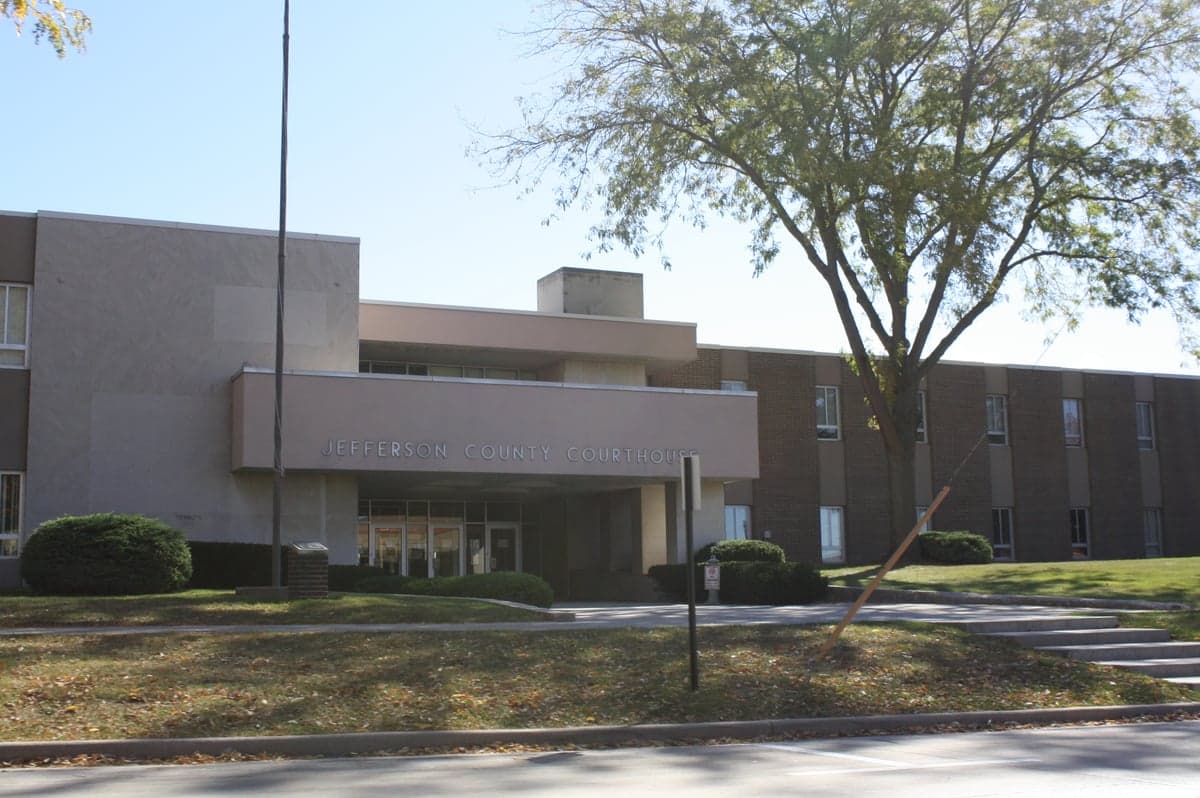
Photo: Wikipedia
Political ClimatePolitical Climate in Jefferson County
Showing district-level results — no local-only data available.
Local Political AnalysisPolitical Analysis of Jefferson County
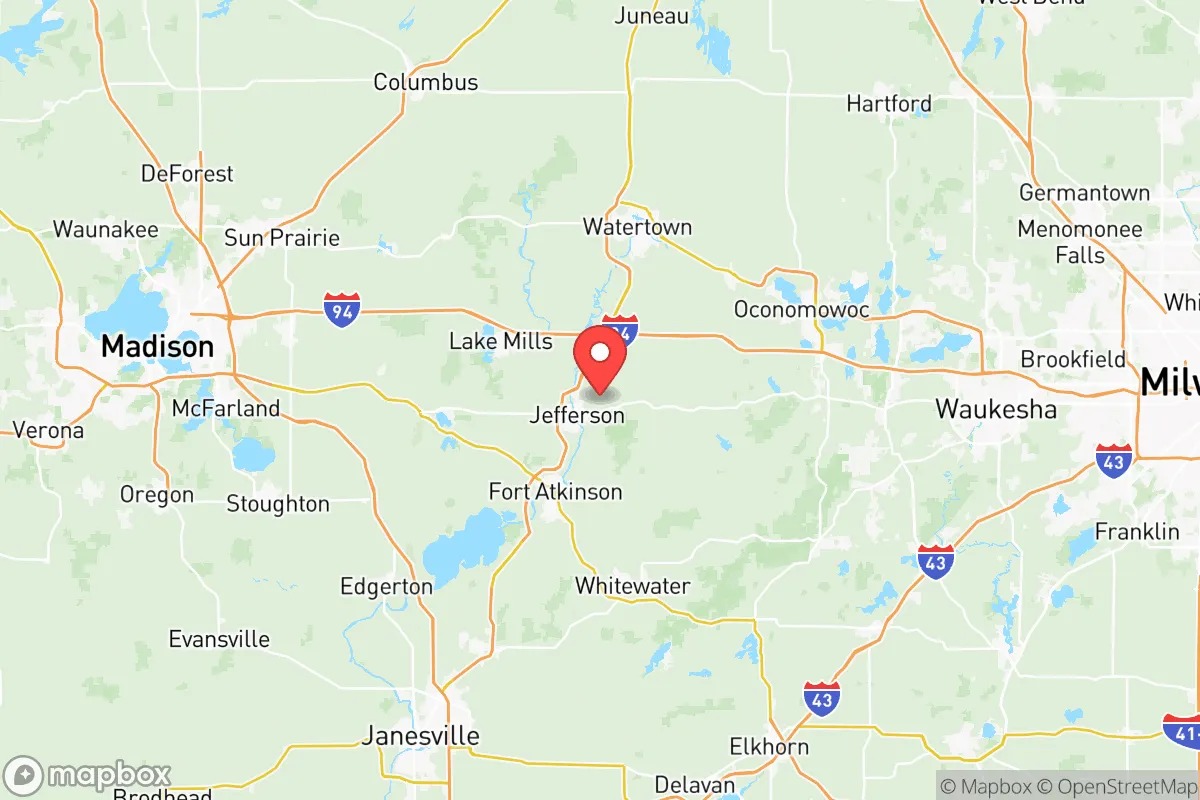
Jefferson County, Wisconsin, is a reliably Republican stronghold with a Cook Partisan Voting Index (PVI) of R+11, meaning it votes about 11 points more Republican than the national average. This stands in stark contrast to the state of Wisconsin as a whole, which has a Cook PVI of EVEN, reflecting its perennial battleground status. The county has trended rightward over the past decade, driven largely by the rural and exurban precincts outside of Watertown and Jefferson, though the city of Whitewater provides a consistent Democratic counterweight.
How it compares
The R+11 rating places Jefferson County among the more conservative counties in southeastern Wisconsin, but it's not as deep red as neighboring Dodge County (R+16) or Washington County (R+20). The real story is the internal divide. The city of Whitewater, home to the University of Wisconsin-Whitewater, is the county's blue anchor—its precincts regularly vote 15-20 points more Democratic than the county average. Conversely, towns like Ixonia and Hebron are reliably deep red, often delivering 65-70% of their votes for Republican candidates. The swing precincts are in the more suburban parts of Jefferson and Watertown, where ticket-splitting still occurs, especially in state legislative races. In 2024, while the county went for Trump by a comfortable margin, these swing areas saw closer races, reflecting the statewide volatility. The county's trajectory is clear: as the rural population ages and the exurban growth from Milwaukee County pushes further west, the Republican lean has solidified, even as Whitewater's student population keeps the Democratic base alive.
What this means for residents
For conservative residents, Jefferson County feels like a place where their values are reflected in local governance. School board meetings, county board decisions, and zoning debates tend to align with a limited-government, property-rights perspective. The county's Republican lean means that local offices—sheriff, county executive, circuit court judges—are almost always held by conservatives, creating a consistent policy environment. For liberal residents, the reality is more nuanced. While they are a clear minority countywide, they hold real power in Whitewater, where city council and school board races are often competitive. A liberal resident in rural Ixonia might feel politically isolated, but one in Whitewater can find a vibrant, engaged community. The practical effect of the R+11 lean is that statewide Democratic candidates rarely invest heavily in the county, meaning local Democratic organizers often feel they are fighting an uphill battle. However, the county's proximity to Madison (about 30 minutes from Jefferson) means that many liberal residents commute to work in a deeply blue city, giving them a daily dose of the state's political divide.
Culturally, Jefferson County is a place where the "live and let live" ethos of rural Wisconsin meets the more activist conservatism of the exurbs. You'll see Trump flags on pickup trucks in the farm country around Lake Mills and Fort Atkinson, but also "Coexist" bumper stickers on Subarus in Whitewater. The county's policy distinctions are subtle but real: it has a strong tradition of local control, meaning that the city of Whitewater can pass its own non-discrimination ordinances or climate resolutions, while the county board might resist state-level mandates on land use or public health. The biggest cultural flashpoint in recent years has been school curriculum and library materials, with conservative groups in the rural towns pushing for more oversight, while Whitewater's school board has defended its current policies. For anyone moving here, the key takeaway is that your experience of Jefferson County's politics will depend almost entirely on which of its towns you call home.

State Political ClimatePolitical Climate in Wisconsin
State Political AnalysisPolitical Environment in the State
Wisconsin is the quintessential swing state, with a Cook PVI of EVEN that perfectly captures its knife-edge balance between Democrats and Republicans. Over the past 20 years, the state has shifted from a reliably blue-leaning battleground (voting for Democrats in every presidential election from 1988 to 2012) to a true toss-up, decided by margins of less than 1% in both 2016 and 2020. The dominant coalitions are a classic Rust Belt split: a Democratic stronghold in the urban crescent of Milwaukee and Madison, versus a deeply Republican rural and exurban base that has grown more conservative with each cycle. The trajectory is one of increasing polarization, with the two sides hardening and the middle shrinking, making every election a national referendum.
Urban vs. rural divide
The political map of Wisconsin is a story of two worlds. Milwaukee County and Dane County (home to Madison) together cast roughly 30% of the state's vote and deliver massive Democratic margins — Milwaukee County went +40 for Biden in 2020, Dane County +75. The suburbs of Milwaukee, however, tell a more nuanced story. Waukesha County remains one of the most reliably Republican suburban counties in the nation, voting +30 for Trump in 2020, while neighboring Ozaukee and Washington counties are similarly deep red. But the inner-ring suburbs like Shorewood and Whitefish Bay have been trending blue, flipping from Republican to Democratic over the past decade. The rural northwoods and western driftless area are overwhelmingly Republican, with counties like Marathon (Wausau) and Brown (Green Bay) becoming more conservative as union influence fades. The Fox Valley region, anchored by Appleton and Oshkosh, is a classic swing area that has leaned right in recent cycles, driven by manufacturing and agricultural voters who feel left behind by the coastal economy.
Policy environment
Wisconsin's policy environment reflects its divided government. The state has a flat income tax of 4.4% (with a top rate of 7.65% on high earners, though a 2023 law is phasing in a flat 3.5% rate by 2026), and a sales tax of 5% (local options push it to 5.5% in Milwaukee). Property taxes are relatively high, ranking around 15th nationally, but are offset by the state's strong homestead credit for low-income homeowners. The regulatory posture is generally business-friendly, with a right-to-work law passed in 2015 and a tort reform system that caps noneconomic damages. Education policy is a battleground: the state has a robust school choice program (the nation's oldest, dating to 1990) and a voucher system that allows students in Milwaukee, Racine, and the statewide program to attend private schools at public expense. Healthcare is mixed — Wisconsin expanded Medicaid under the Affordable Care Act in 2014, but the state does not have its own insurance exchange, relying on the federal marketplace. Election laws are moderately restrictive: voters must show photo ID, absentee ballots require a witness signature, and drop boxes were effectively banned by the state Supreme Court in 2022.
Recent policy direction
The last five years have seen a sharp rightward shift on several fronts, even as the state remains evenly divided. Gun and self-defense law moved significantly: in 2023, Wisconsin became a permitless carry state, allowing concealed carry without a license, and the state already had a Castle Doctrine law. Parental and education rights have been a flashpoint: the 2021-2023 legislative session passed a ban on transgender athletes in girls' sports and a law requiring schools to notify parents of any mental health or sexual health services provided to students. Speech and privacy saw a major win for conservatives with the 2023 Act 12, which prohibits public universities from requiring diversity statements in hiring and limits the use of race in admissions. Medical and bodily autonomy is the most volatile issue: the 1849 abortion ban was effectively reinstated after Dobbs, but a 2023 Dane County judge ruled it does not apply to consensual abortions, leaving the law in limbo pending a state Supreme Court decision. Property rights are generally strong, with no statewide rent control and limited eminent domain abuse. Taxation is trending downward: the 2023 budget cut income taxes by $2 billion and accelerated the flat tax phase-in. Voting and ballot access tightened: the 2022 election law (Act 169) limited early voting to two weeks, banned private grants for election administration, and required absentee ballots to be returned in person or by mail only.
Civil unrest & political movements
Wisconsin has been a national epicenter of political conflict. The 2020 Kenosha unrest following the Jacob Blake shooting saw two nights of riots, arson, and the killing of two protesters by Kyle Rittenhouse, whose acquittal in 2021 became a flashpoint for both sides. The 2020 election integrity controversy was intense: Trump's legal team challenged the results in multiple counties, and the state's Republican-controlled legislature launched a $2.3 million investigation led by former Supreme Court Justice Michael Gableman, which found no evidence of widespread fraud but fueled ongoing distrust. Immigration politics are less visible than in border states, but the 2023 legislative session passed a bill requiring local law enforcement to cooperate with ICE, though it was vetoed by Governor Evers. Sanctuary policies are limited to a few cities like Madison, which has a "Welcoming City" ordinance. Secession or nullification rhetoric is minimal, though some rural counties have passed symbolic resolutions declaring themselves "Second Amendment sanctuaries." The Wisconsin Supreme Court has become a political battleground: the 2023 election of liberal Justice Janet Protasiewicz flipped the court to a 4-3 liberal majority, with huge implications for redistricting and abortion rights.
Projection
Over the next 5-10 years, Wisconsin is likely to remain a battleground, but the demographic trends favor Democrats in the long run. The Milwaukee and Madison metros are growing faster than the rest of the state, and the suburbs are slowly trending blue as college-educated voters move in. However, the rural exodus is accelerating, with counties like Price and Rusk losing population and becoming even more Republican. The in-migration pattern is mixed: retirees from Illinois are moving to the Lake Geneva and Door County areas, often bringing conservative voting habits, while remote workers from Chicago are settling in Madison and Milwaukee, adding to the Democratic base. The Wisconsin Supreme Court will likely redraw legislative maps in 2024, which could flip the state Assembly from a Republican supermajority to a more competitive body, shifting policy on abortion, education funding, and voting access. The flat tax phase-in will make the state more attractive to high-income earners, but the property tax burden will remain a concern for middle-class families. The political culture will stay polarized, but the intensity may moderate as the state settles into a new normal of divided government.
For a new resident, the bottom line is that Wisconsin offers a high quality of life with a low cost of living, but you will be living in a state that is perpetually contested. If you are conservative, you will find a strong network of rural and suburban communities where your values are the norm, and a state government that has been reliably Republican on most issues. If you are liberal, you will find vibrant urban centers and a growing suburban base, with a governor and Supreme Court that can block the most aggressive conservative legislation. The practical takeaway is that your vote will matter more here than in almost any other state, and the political climate will be a constant topic of conversation. The winters are long, but the politics are even longer.
* Values derived from national, state, county, city and local statistics and may differ in a specific area. Last updated: 2026-07-13T23:42:12.000Z
Narrative content on this page is AI-generated and may contain mistakes. Verify any details that matter before acting on them.
ReloMaps may earn a commission from affiliate links at no extra cost to you.

