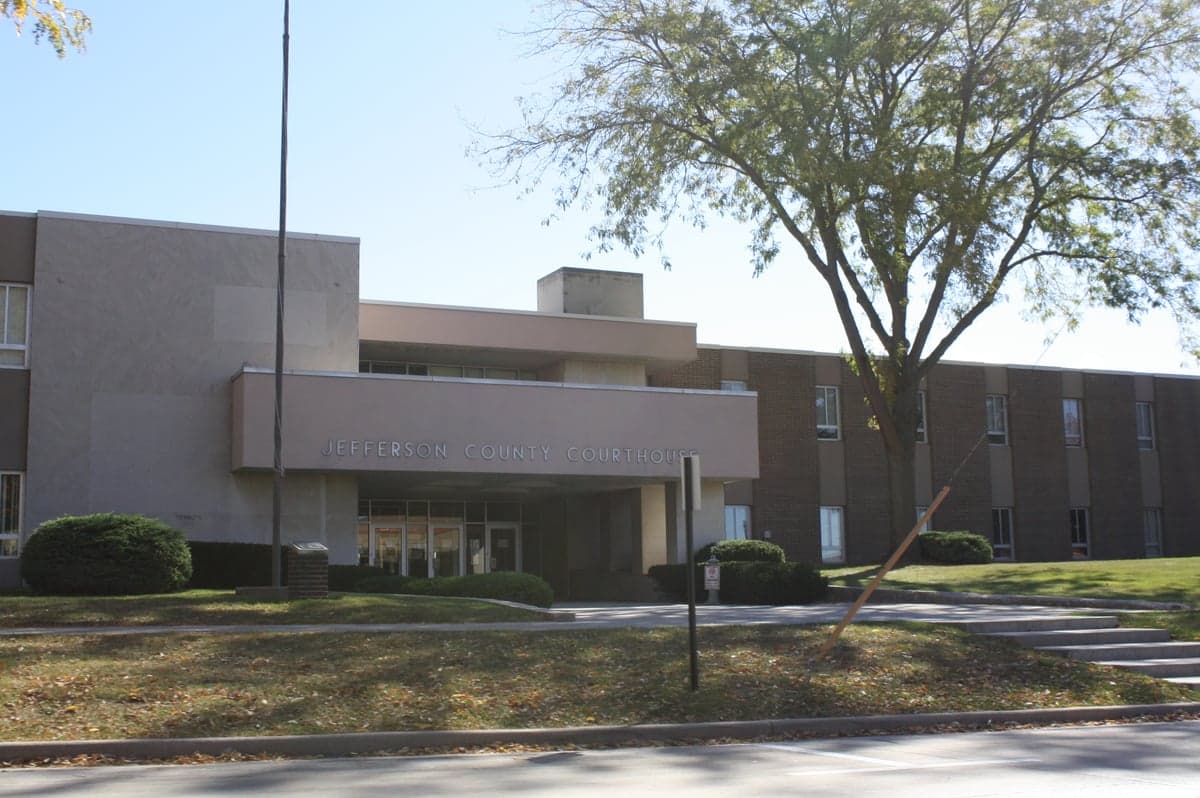
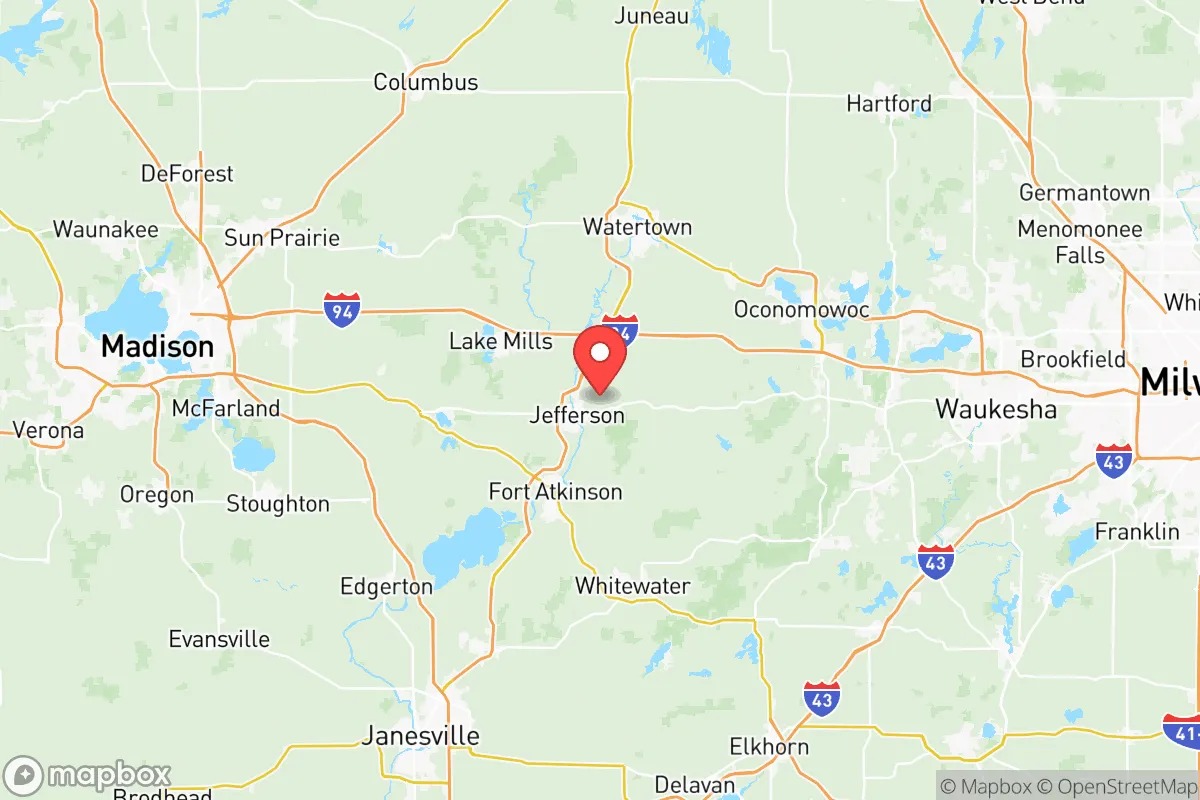
Photo: Wikipedia
Demographics of Jefferson County
Affluence Level in Jefferson County
A middle-class area roughly in line with national averages across income, home values, education, and employment.
People of Jefferson County
Jefferson County, Wisconsin, is a predominantly white, rural-to-suburban county of 85,867 residents, where a strong German and Scandinavian heritage still shapes community life, local festivals, and the agricultural landscape. The county’s population is notably less diverse than the state average, with 87.5% identifying as white alone, and a foreign-born share of just 2.3% — roughly half the Wisconsin average. Its identity is rooted in small-town independence, a working landscape of dairy farms and manufacturing, and a slow, steady growth that has attracted families seeking lower costs and quieter living than nearby Madison or Milwaukee.
Settlement & growth (pre-1960)
Before European settlement, the area that is now Jefferson County was home to the Ho-Chunk (Winnebago) people, who lived in villages along the Rock River and its tributaries. The Ho-Chunk were forcibly removed through treaties in the 1830s and 1840s, though many returned and maintain a presence in the region today, particularly in the Wisconsin Dells area to the north. The first permanent American settlers arrived in the late 1830s, primarily Yankees from New England and New York, who were drawn by the promise of fertile prairie land and water power along the Rock River. They founded the county’s earliest towns: Watertown (1836), Jefferson (1836), and Fort Atkinson (1836), each built around gristmills and sawmills that harnessed the river’s current.
The defining demographic wave came in the 1840s through the 1860s, when German immigrants arrived in large numbers, fleeing economic hardship and political unrest in the German states. They were drawn by cheap land, chain migration, and the presence of established German communities in neighboring Dodge and Washington counties. These settlers concentrated in the county’s rural townships and in villages like Waterloo (founded 1845) and Johnson Creek (1850), where they established dairy farms, breweries, and Lutheran churches. By 1870, Germans and their descendants made up roughly half of Jefferson County’s population, a proportion that held for over a century. A smaller but significant wave of Norwegian immigrants arrived in the 1850s and 1860s, settling primarily in the northern part of the county, around Ixonia and Lake Mills, where they built stave churches and maintained their language well into the 1900s.
Irish immigrants, many fleeing the Great Famine, also came in the 1850s, though in smaller numbers. They tended to settle in the county’s growing railroad towns — Palmyra and Sullivan — where they worked on the railroad and in local foundries. The late 19th century saw the arrival of small numbers of Polish and Czech immigrants, who found work in the limestone quarries around Helenville and in the shoe factories of Watertown. By 1900, Jefferson County was a mosaic of ethnic enclaves, each with its own church, school, and social hall, but the German and Scandinavian character was dominant. The county’s population grew steadily from about 20,000 in 1850 to 38,000 in 1900, then to 50,000 by 1950, driven by natural increase and the expansion of dairy farming and light manufacturing.
Modern era (post-1965)
The 1965 Hart-Cellar Act, which opened immigration to non-European countries, had a minimal direct impact on Jefferson County. The county’s foreign-born population remained below 2% through the 1990s, and the vast majority of new residents were domestic migrants. The most significant demographic shift since 1965 has been the suburbanization of the county’s southern and eastern townships, driven by the expansion of the Madison metropolitan area. From the 1980s onward, families and commuters moved into Cambridge, Lake Mills, and Johnson Creek, drawn by lower home prices and good schools. These towns saw their populations double or triple between 1980 and 2020, while the county’s older industrial centers — Watertown and Fort Atkinson — grew more slowly.
The Hispanic population, while still modest at 8.4%, has been the fastest-growing racial/ethnic group since 2000. This growth is largely the result of Mexican and Central American immigrants arriving to work in dairy farming, food processing, and construction. They have concentrated in Watertown and Jefferson, where a small but visible Hispanic business district has emerged, including tiendas, taquerias, and Spanish-language churches. The county’s Black population remains very small at 0.9%, concentrated in Watertown and Fort Atkinson, with roots in the post-World War II migration of African Americans from the South to industrial jobs in Wisconsin. The East/Southeast Asian population (0.4%) is tiny and scattered, with no visible enclave, while the Indian-subcontinent population (0.1%) is negligible. The county’s college-educated share, at 28.1%, is below the state average of 31%, reflecting its blue-collar and agricultural heritage.
The future
Jefferson County is projected to continue its slow, steady growth, reaching roughly 95,000 residents by 2040. The population is aging, with a median age of 42.5 (above the state average of 40), and the under-18 share is declining. The county is becoming slightly more diverse, driven by Hispanic growth, but it will remain overwhelmingly white for the foreseeable future. The Hispanic share is expected to rise to 12-14% by 2040, with continued concentration in Watertown and Jefferson, while the Black and Asian shares will likely remain below 2% each. The most dynamic growth will occur in the southern and eastern townships — Cambridge, Lake Mills, and Johnson Creek — as Madison’s suburban sprawl pushes further into the county. These areas are attracting younger families and professionals, while the northern and western townships are likely to see population stagnation or decline as dairy farms consolidate and young people leave.
Culturally, the county is evolving from a homogeneous German-Scandinavian farming community into a more diverse, suburban-commuter region. The old ethnic identities — German Lutheran, Norwegian Lutheran, Irish Catholic — are fading, replaced by a broader Midwestern conservatism that values low taxes, local control, and traditional family structures. The county voted +18 points Republican in the 2024 presidential election, reflecting its cultural and political leanings. New residents, particularly those from Madison and Chicago, are bringing more liberal views on some social issues, but the county’s overall character remains solidly conservative and rural-influenced.
For someone moving in now, Jefferson County offers a stable, safe, and affordable environment with strong schools in its growing towns and a deep sense of place rooted in its agricultural and ethnic history. The population is not changing rapidly, but it is changing — becoming more suburban, slightly more diverse, and more connected to the Madison economy. The county’s future is one of gradual, managed growth, where the old farming communities coexist with new subdivisions, and where the German and Norwegian heritage remains visible in church suppers, summer festivals, and the names on the mailboxes.

* Values derived from national, state, county, city and local statistics and may differ in a specific area. Last updated: 2026-07-13T23:42:12.000Z
Narrative content on this page is AI-generated and may contain mistakes. Verify any details that matter before acting on them.
ReloMaps may earn a commission from affiliate links at no extra cost to you.

