Photo: Wikipedia
Political ClimatePolitical Climate in Dane County
Showing district-level results — no local-only data available.
Local Political AnalysisPolitical Analysis of Dane County
Dane County is the bluest stronghold in Wisconsin, with a Cook Partisan Voting Index of D+21, meaning it votes about 21 points more Democratic than the national average. This stands in stark contrast to the state of Wisconsin as a whole, which has a Cook PVI of EVEN, making it one of the most evenly divided swing states in the country. The county has been trending steadily leftward for decades, driven by the growth of Madison and its suburbs, and it now provides the overwhelming Democratic margin that often decides statewide elections.
How it compares
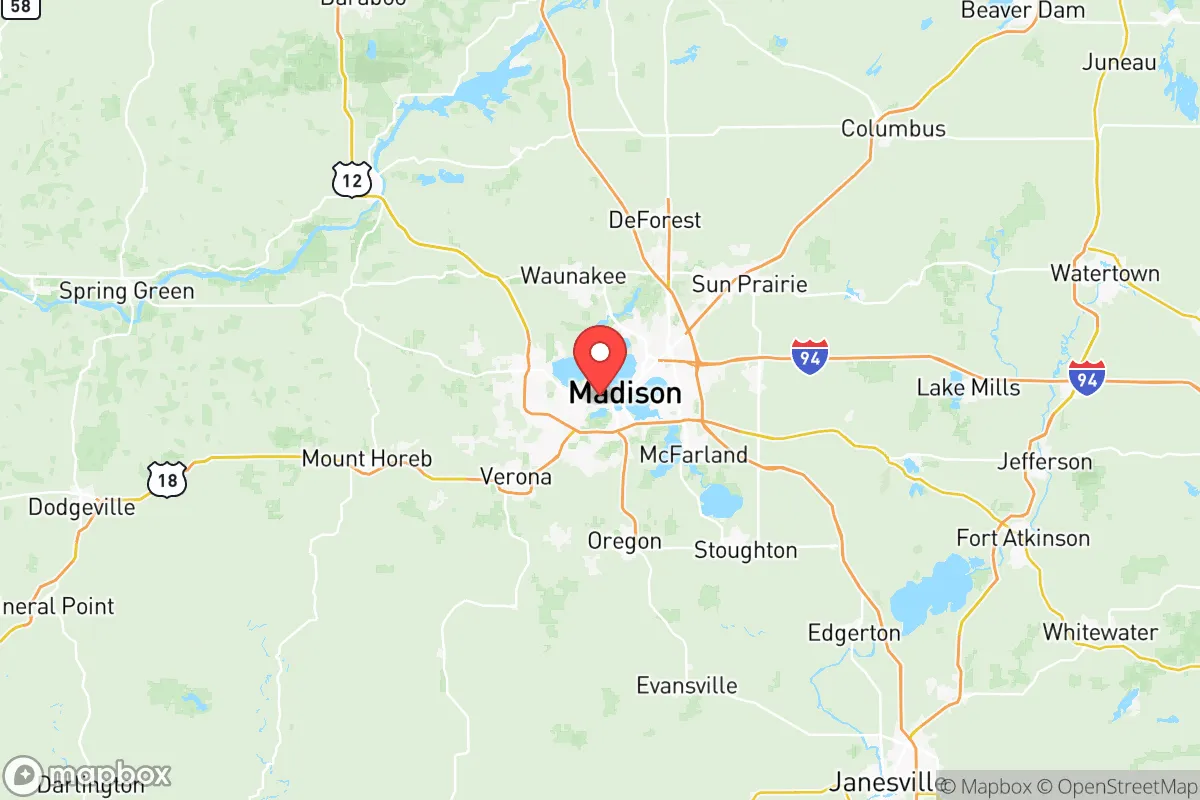
Wisconsin's EVEN rating means it's a pure toss-up, where a few thousand votes in any direction can flip a presidential or Senate race. Dane County, by contrast, is as reliably Democratic as any urban county in the Midwest. In 2020, Joe Biden won Dane County by roughly 260,000 votes, while he won the entire state by just 20,000. That means Dane County's margin alone was more than enough to cancel out Republican margins in every other county combined. The political geography within the county is not monolithic, however. The city of Madison and its inner-ring suburbs like Shorewood Hills and Maple Bluff are deeply blue, often voting 80-90% Democratic. The outer-ring suburbs such as Verona, Middleton, and Fitchburg are also solidly blue but with more moderate leanings. The real variation shows up in the county's rural townships. Towns like Dane, Vermont, and Springfield lean Republican, often voting 55-65% for GOP candidates. The swing precincts are mostly in the fast-growing exurban areas like Waunakee and DeForest, where new arrivals from both parties have created a more competitive dynamic, though these areas still lean blue overall.
What this means for residents
For liberal residents, Dane County offers a political environment where their views are the clear majority. Local government, from the county board to the Madison city council, is overwhelmingly Democratic. Policies like universal pre-K, paid family leave, and strong tenant protections are standard. For conservative residents, the experience is more mixed. They are a distinct minority in most public forums, but they are not without representation. The county's Republican Party is active, and conservative voters in towns like Cross Plains or Mount Horeb can find like-minded neighbors. The practical effect is that conservative residents often feel their voice is drowned out in countywide decisions, particularly on issues like land use, taxes, and public health mandates. However, the county's deep blue tilt also means that statewide Republican candidates rarely campaign here, focusing instead on the WOW counties (Waukesha, Ozaukee, Washington) to run up their own margins.
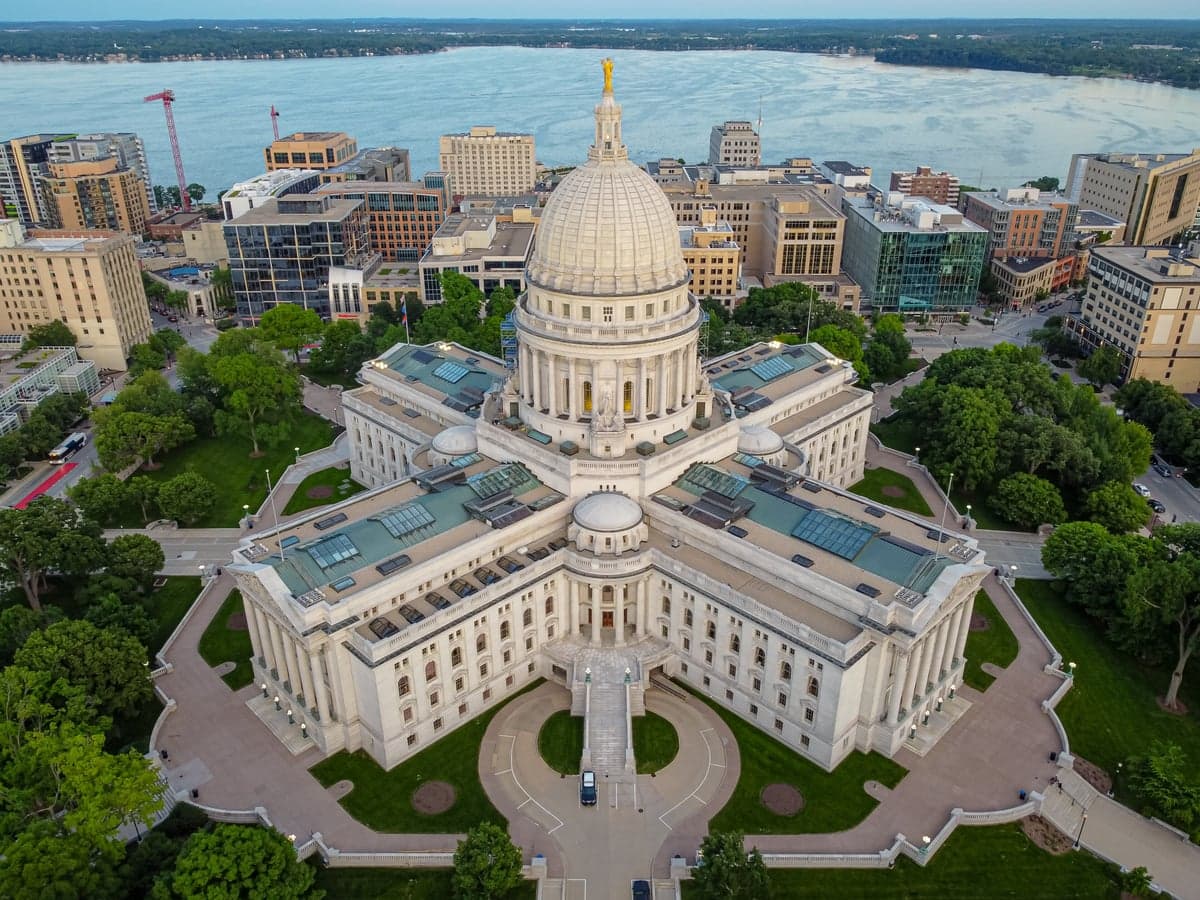
Culturally, Dane County's political lean translates into a distinctly progressive atmosphere that sets it apart from much of the rest of Wisconsin. Madison is home to the state's flagship university, a vibrant arts scene, and a strong emphasis on environmental sustainability. The county has a higher density of farmers' markets, bike lanes, and locally-owned businesses than almost anywhere else in the state. This progressive culture can feel isolating to conservatives, but it also attracts a steady stream of new residents who are drawn to the area's quality of life and job market. The county's political trajectory shows no signs of reversing; as Madison continues to grow and the suburbs densify, the Democratic margin is likely to widen further, making Dane County an even more decisive force in Wisconsin politics for the foreseeable future.

State Political ClimatePolitical Climate in Wisconsin
State Political AnalysisPolitical Environment in the State
Wisconsin is the ultimate swing state, with a Cook PVI of EVEN that perfectly captures its knife-edge political balance. Over the last 20 years, it has flipped from reliably blue (voting for Democrats in every presidential election from 1988 to 2012) to a true battleground where margins are measured in thousands of votes—Donald Trump won it by 22,748 votes in 2016, Joe Biden by 20,682 in 2020, and Trump again by roughly 29,000 in 2024. The state is split almost exactly down the middle: the Democratic coalition is anchored by the urban crescent of Milwaukee, Madison, and the college towns, while the GOP dominates the rural and exurban "WOW counties" (Waukesha, Ozaukee, Washington) and the vast agricultural north and west. This isn't a state where one party coasts; every election is a street fight, and the policy pendulum swings hard with each change of power.
Urban vs. rural divide
The political map of Wisconsin is a tale of two landscapes. Milwaukee County (Biden +40 in 2020) and Dane County (home to Madison, Biden +55) together produce a massive Democratic vote bank—roughly 40% of the statewide Democratic total comes from just these two counties. Meanwhile, the suburban ring around Milwaukee—Waukesha County (Trump +20), Ozaukee County (Trump +15), and Washington County (Trump +30)—has become the GOP's fortress, with turnout rates that rival urban precincts. The rural northwoods counties like Vilas and Oneida have trended hard red, while the Driftless Region in the southwest (around La Crosse and Platteville) remains a mix of conservative farmers and liberal college towns. The key swing counties that decide elections are the "Blue Wall" counties along Lake Michigan: Brown County (Green Bay), Outagamie County (Appleton), and Winnebago County (Oshkosh), which have oscillated between parties. In 2024, Trump flipped Brown County back to red after Biden won it in 2020, sealing the statewide win.
Policy environment
Wisconsin's policy landscape is a patchwork of divided government outcomes. The state has a flat income tax (recently cut from 5.3% to 4.4% under GOP control, with a path to 3.5% by 2027), and property taxes are moderate—the median effective rate is about 1.6%, slightly above the national average. The state is a right-to-work state (passed in 2015) and a constitutional carry state (permitless carry became law in 2023). Education policy is a major flashpoint: the state has a robust school choice program (the Milwaukee Parental Choice Program, the oldest in the nation) and a voucher system that has expanded under GOP legislatures, while Democratic governors have fought to protect public school funding. On healthcare, Wisconsin did not expand Medicaid under the Affordable Care Act until 2014, and the state-run marketplace (Wisconsin Health Insurance Risk Sharing Plan) operates with moderate premiums. Election laws are a constant battleground: the state has voter ID (in effect since 2016), no-excuse absentee voting (restricted to 14 days before an election under 2022 laws), and a bipartisan Elections Commission that has been the target of repeated legislative investigations. The state also has a partisan gerrymander of legislative districts—the GOP has held supermajorities in the Assembly and Senate even when Democrats win statewide races, though a 2024 state supreme court ruling forced new maps that are more competitive.
Recent policy direction
The last five years have seen Wisconsin lurch between conservative and liberal priorities depending on who controls the governor's mansion and the supreme court. Gun and self-defense law: Act 12 (2023) established permitless carry, preempted local firearm ordinances, and expanded self-defense immunity—a clear win for gun rights advocates. Parental and education rights: the 2021-23 budget included a $1.6 billion increase in K-12 funding but also expanded the voucher program to cover 220% of the federal poverty level; a 2022 law banned teaching of critical race theory in K-12 (though enforcement is minimal). Speech and privacy: the state has no broad privacy law, but a 2023 bill (AB 466) restricted the use of facial recognition by law enforcement without a warrant. Medical and bodily autonomy: abortion is legal up to 20 weeks (a 1849 law that would have banned it was struck down by the state supreme court in 2023 in Planned Parenthood v. Kaul), but the issue remains volatile—the court is now considering a challenge to the 20-week limit. Property rights: the state has strong eminent domain protections (2006 amendment), and a 2023 law (SB 203) limited local governments' ability to regulate short-term rentals. Taxation: the 2023-25 budget cut income taxes by $2 billion, with the top rate dropping from 5.3% to 4.4%, and eliminated the personal property tax on businesses. Voting and ballot access: 2022's Act 264 banned private funding of election administration (the "Zuckerbucks" ban), shortened the absentee voting window, and required drop boxes to be staffed—changes that Democrats argue suppress turnout but that Republicans say restore integrity.
Civil unrest & political movements
Wisconsin has a history of intense political activism. The 2011 Act 10 protests against public-sector union restrictions drew 100,000 people to the Madison capitol and sparked a recall effort against Governor Scott Walker (which he survived in 2012). The 2020 Kenosha unrest after the Jacob Blake shooting saw two nights of riots, the Kyle Rittenhouse shooting, and a heavy National Guard presence—the trial and acquittal in 2021 became a national flashpoint for gun rights and self-defense debates. Immigration politics are relatively low-key compared to border states, but Milwaukee County has a "Welcoming City" ordinance limiting cooperation with ICE, while rural counties like Clark County have passed resolutions declaring themselves "Second Amendment sanctuaries." Election integrity remains a live issue: the 2020 election saw Trump's campaign file multiple lawsuits (all dismissed), and a 2022 audit by the nonpartisan Legislative Audit Bureau found no widespread fraud but noted administrative errors. The Wisconsin Supreme Court has become a partisan battleground—the 2023 election of liberal Justice Janet Protasiewicz (who campaigned on abortion rights and fair maps) flipped the court 4-3, leading to the new legislative maps and the abortion law ruling. You'll see "Fight Like Hell" flags and "Defend the Capitol" bumper stickers in equal measure, and the state's tavern leagues and hunting clubs are as politically active as the campus groups in Madison.
Projection
Over the next 5-10 years, Wisconsin will likely remain a toss-up, but the demographic trends favor a slow shift toward Democrats. In-migration is modest—the state grew only 1.2% from 2020-2024—but the newcomers are disproportionately moving to Dane County (Madison) and the Milwaukee suburbs, which are trending bluer. The WOW counties are aging and losing population, while the Fox Valley (Green Bay, Appleton) is growing and becoming more competitive. The new legislative maps (effective 2024) will likely produce a more balanced state legislature, which could lead to more moderate policy outcomes—think expanded Medicaid, a higher minimum wage, and more education funding in exchange for continued tax cuts. The abortion issue will remain a driver: if the state supreme court upholds the 20-week ban, expect a ballot initiative push; if it strikes it down, expect a legislative fight over a 12-week ban. The gun rights trajectory is stable—permitless carry is here to stay, and red-flag laws are unlikely given the current court. The biggest wildcard is the 2026 governor's race: if a Democrat wins, the state will likely see a Medicaid expansion, a higher minimum wage, and a push for universal background checks; if a Republican holds the seat, expect further income tax cuts, school choice expansion, and election law tightening. Either way, the state's political identity as a battleground is baked in—no party will have a permanent majority.
Bottom line for a new resident: If you're conservative, you'll find a state where your values are reflected in gun laws, tax policy, and school choice—but you'll need to accept that statewide elections are a coin flip and that Madison and Milwaukee will feel like a different country. If you're liberal, you'll have strong urban anchors and a state supreme court that's currently friendly to your priorities—but you'll face a legislature that, even under new maps, will likely remain Republican-leaning for the rest of the decade. The practical takeaway is that Wisconsin rewards political engagement: your vote genuinely matters here, and the policy outcomes swing with every election cycle. It's a state where you can own a cabin in the northwoods and hunt deer while your neighbor in Madison bikes to a farmers market, and both of you will feel like your side is constantly fighting for the soul of the place—because you are.
* Values derived from national, state, county, city and local statistics and may differ in a specific area. Last updated: 2026-07-04T08:06:21.000Z
Narrative content on this page is AI-generated and may contain mistakes. Verify any details that matter before acting on them.
ReloMaps may earn a commission from affiliate links at no extra cost to you.

