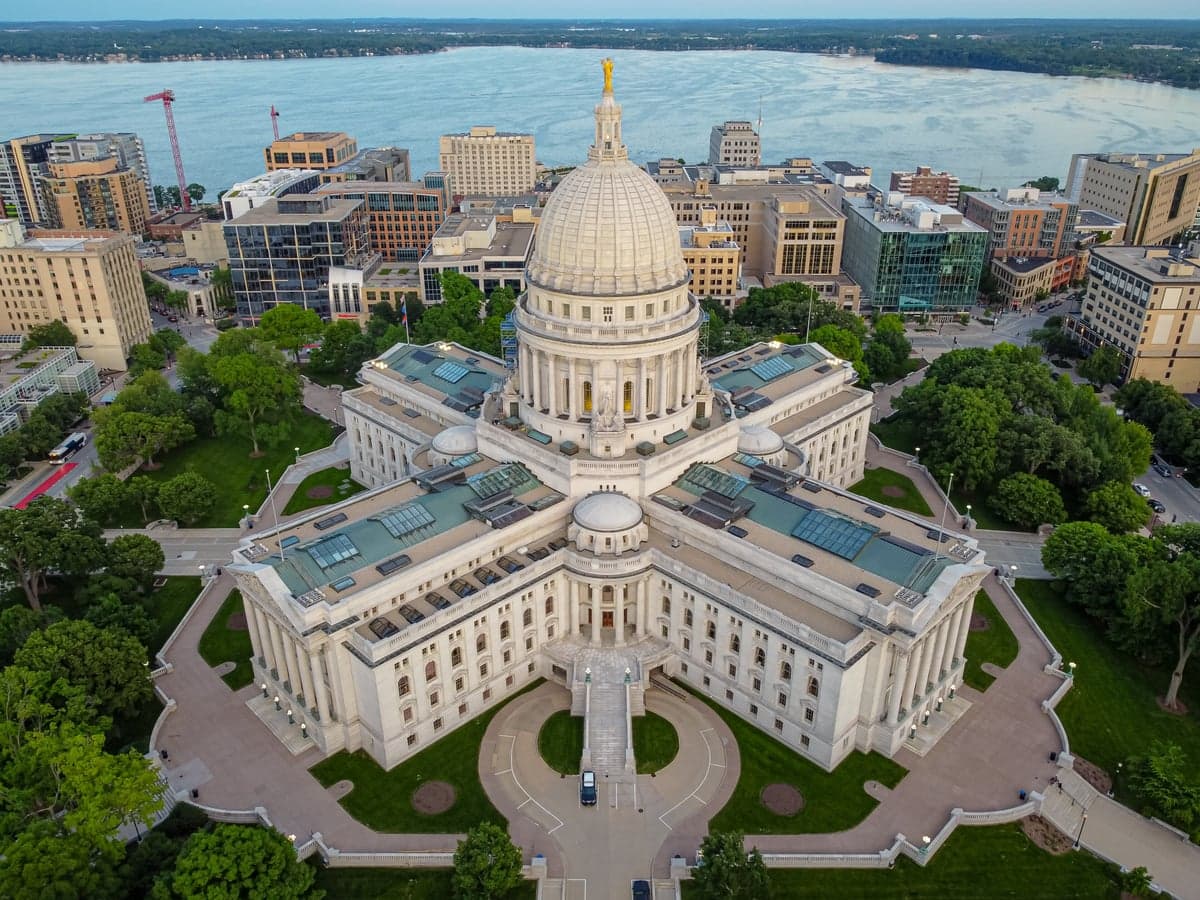
Photo: Wikipedia
Demographics of Dane County
Affluence Level in Dane County
A middle-class area roughly in line with national averages across income, home values, education, and employment.
People of Dane County
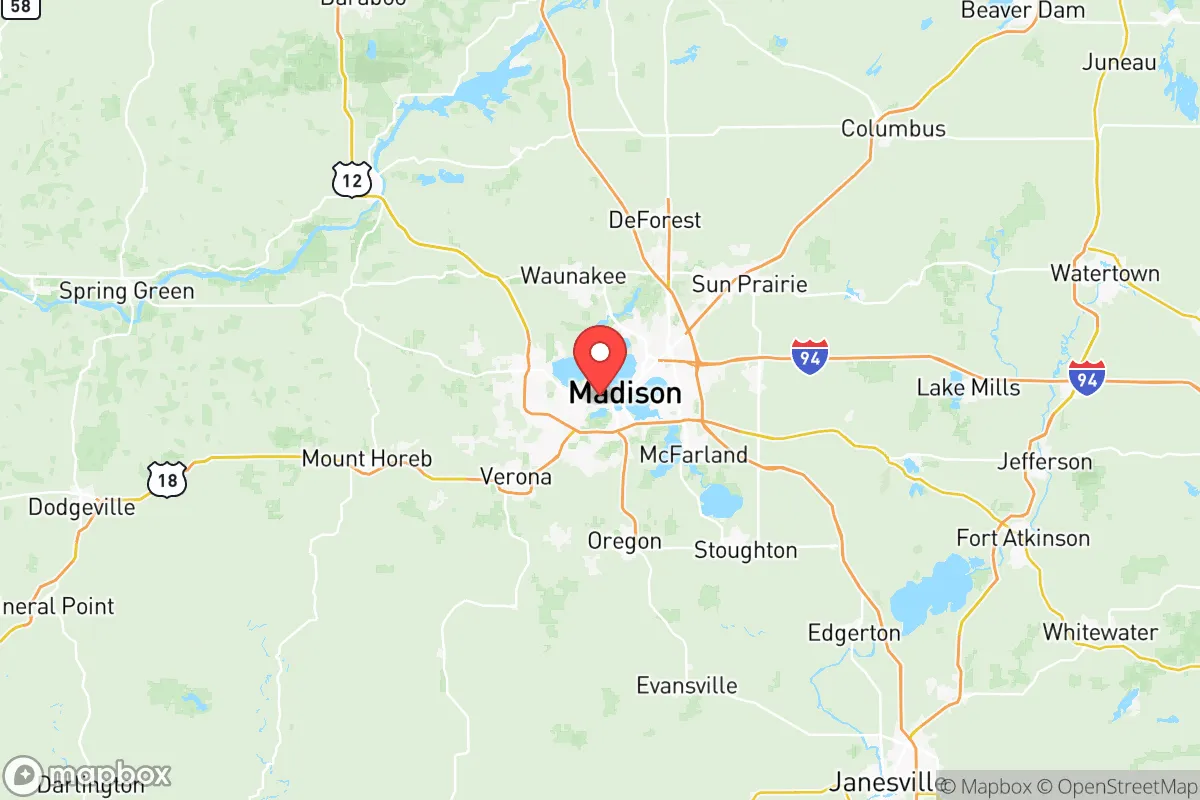
Dane County, Wisconsin, is home to 564,777 residents who form the state's most educated and economically dynamic population, with 54.4% holding a college degree and a median household income well above the Wisconsin average. The county is anchored by Madison, the state capital, and is characterized by a distinctly liberal political culture, a robust knowledge economy centered on the University of Wisconsin-Madison and state government, and a growing diversity that is reshaping communities from the urban core to the suburban fringe. While still predominantly white at 76.7%, the county has seen significant growth in its Hispanic (7.6%), Black (5.1%), East/Southeast Asian (4.0%), and Indian subcontinent (2.0%) populations, creating a mosaic of ethnic enclaves and cultural institutions that distinguish Dane County from the rest of southern Wisconsin.
Settlement & growth (pre-1960)
Before European settlement, the land that is now Dane County was home to the Ho-Chunk Nation, who had villages and agricultural sites along the shores of Lakes Mendota, Monona, Waubesa, and Kegonsa. The Ho-Chunk were forcibly removed in the 1830s and 1840s following the Black Hawk War and a series of treaties, though many families later returned to the region. The first permanent American settlers arrived in the 1830s, primarily Yankees from New England and upstate New York who were drawn by the promise of fertile farmland and the establishment of Madison as the territorial capital in 1836. These early settlers founded the city of Madison on the isthmus between Lakes Mendota and Monona, and they quickly established a political and educational infrastructure that would define the county for generations.
The 1840s and 1850s brought a wave of German immigrants, who became the dominant ethnic group in Dane County and left an enduring mark on its culture and economy. German farmers settled in the towns of Sun Prairie, DeForest, and Waunakee, where they established dairy farms and Catholic and Lutheran parishes that remain community anchors today. Norwegian immigrants also arrived in significant numbers during this period, concentrating in the western part of the county around Mount Horeb and Stoughton, where they built stave churches and founded the region's distinctive Scandinavian festivals. By 1860, foreign-born residents made up roughly one-third of Dane County's population, with Germans and Norwegians accounting for the vast majority.
The late 19th and early 20th centuries saw continued immigration from Germany and Scandinavia, along with smaller numbers of Irish, Polish, and Swiss settlers who found work on farms and in the growing industrial and commercial sectors of Madison. The city of Middleton, founded in 1856, grew as a railroad town and attracted a mix of German and Norwegian immigrants who established breweries, mills, and mercantile businesses. The University of Wisconsin-Madison, founded in 1848, began drawing faculty and students from across the country and abroad, adding a cosmopolitan layer to the county's predominantly rural, ethnic-European character. The Great Migration of Black Americans from the South brought a small but significant African American population to Madison, primarily between 1940 and 1960, as industrial jobs and the university offered opportunities unavailable in the segregated South. By 1960, Dane County was 96% white, with a population of roughly 200,000, and its economy was still heavily tied to agriculture, government, and education.
Modern era (post-1965)
The 1965 Hart-Cellar Act fundamentally reshaped Dane County's demographics, though the changes were slower to arrive than in coastal metropolitan areas. The first significant post-1965 immigrant groups were Hmong refugees from Laos, who began resettling in Madison and its suburbs in the late 1970s and 1980s following the Vietnam War. The Hmong community concentrated in Madison's south and east sides, particularly around the Badger Road corridor and the Allied Drive neighborhood, and later spread to Fitchburg and Monona. Today, the Hmong are the largest East/Southeast Asian group in Dane County, with a population of roughly 12,000, and they have established cultural centers, grocery stores, and annual festivals such as the Hmong New Year celebration at the Alliant Energy Center.
The 1990s and 2000s brought a wave of Indian subcontinent immigrants, primarily professionals in technology, medicine, and academia who were drawn by jobs at the University of Wisconsin-Madison, Epic Systems in Verona, and the growing biotechnology sector. Indian families concentrated in the western suburbs of Middleton and Verona, as well as in the West Side of Madison, where they established temples, grocery stores, and community organizations. The Hispanic population grew rapidly during this same period, driven by immigration from Mexico and Central America as well as domestic migration from other U.S. states. Hispanic workers found jobs in construction, food processing, and agriculture, and they settled in Madison's south side, Sun Prairie, and the rural towns of Cambridge and Deerfield. The Black population also expanded, though more slowly, through both immigration from Africa (particularly Ethiopia and Somalia) and domestic migration from Chicago and Milwaukee, with new arrivals concentrating in Madison's north and east sides.
Domestic migration has been equally transformative. Since the 1990s, Dane County has attracted a steady stream of college-educated professionals from the coasts and the Rust Belt, drawn by the region's strong job market, relatively affordable housing, and high quality of life. This influx has driven rapid suburbanization, with Fitchburg, Sun Prairie, and Verona emerging as the fastest-growing communities in the county. The population has more than doubled since 1960, and the foreign-born share has risen from under 3% to 5.1%, while the white share has declined from 96% to 76.7%. The county's political culture has shifted leftward in tandem with these demographic changes, with Dane County now serving as the Democratic stronghold in a politically divided state.
The future
Dane County is projected to continue growing at a steady pace, with the population expected to reach roughly 650,000 by 2040. The county is becoming more diverse, with the Hispanic and East/Southeast Asian populations growing fastest, while the white share is projected to decline to around 70% by 2040. New immigrant communities are dispersing across the county rather than concentrating solely in Madison, with Sun Prairie and Verona emerging as particularly diverse suburbs. The Indian subcontinent population is expected to grow as Epic Systems and the university continue to recruit skilled workers, while the Hmong community is seeing a generational shift as younger members move to suburbs and pursue higher education at rates above the county average.
The county's cultural identity is evolving from a predominantly German-Scandinavian, rural-tinged character to a more cosmopolitan, knowledge-driven one. The old ethnic festivals — Stoughton's Syttende Mai, Mount Horeb's Cornish Festival, Sun Prairie's Sweet Corn Festival — now share the calendar with Hmong New Year, Diwali celebrations in Middleton, and Mexican Independence Day events on Madison's south side. The political implications of these demographic shifts are significant: Dane County's growing diversity and educational attainment are reinforcing its status as a Democratic stronghold, even as the surrounding counties remain more conservative. For a newcomer, this means moving into a region that is increasingly comfortable with diversity, where ethnic enclaves are well-established, and where the dominant culture is shaped by university liberalism, tech-industry professionalism, and a deep commitment to environmental sustainability.
Dane County is becoming a more diverse, more educated, and more politically progressive place, shaped by the interplay of international immigration, domestic migration, and suburban expansion. For someone moving in now, the county offers a rare combination of Midwestern affordability and coastal-style diversity, with established ethnic communities in Madison, Middleton, Sun Prairie, and Verona that provide cultural continuity for newcomers. The next decade will likely see further dispersion of immigrant groups into the suburbs, continued growth in the knowledge economy, and a gradual but steady decline in the white, rural character that defined the county for its first 150 years.

* Values derived from national, state, county, city and local statistics and may differ in a specific area. Last updated: 2026-07-04T08:06:21.000Z
Narrative content on this page is AI-generated and may contain mistakes. Verify any details that matter before acting on them.
ReloMaps may earn a commission from affiliate links at no extra cost to you.

