
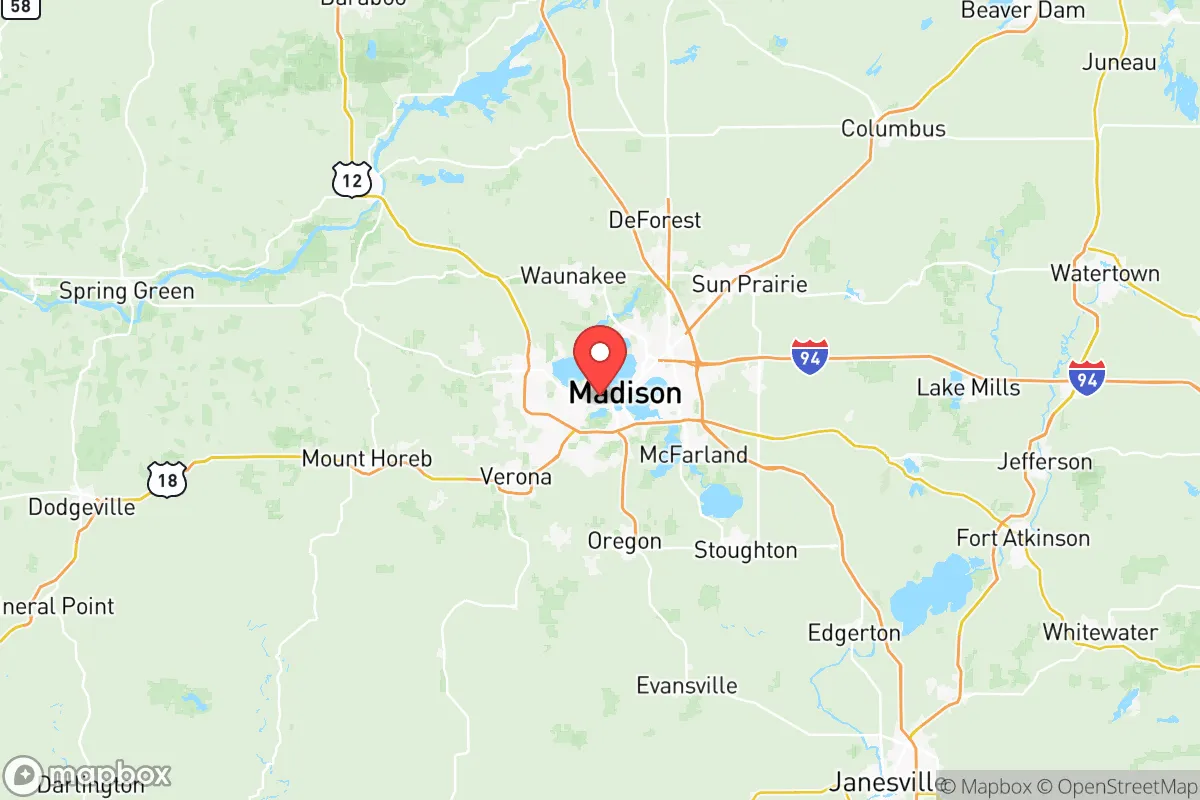
Photo: Wikipedia
Personal Sovereignty in Dane County
Moderate friction. Expect trade-offs in some aspect of personal liberty and independence.
What does Personal Sovereignty tell us?
Personal Sovereignty measures your capacity for self-reliance and independence with minimal government friction. Higher scores mean fewer barriers between you and the way you want to live... but it assumes you have the space you need and good neighbors.
What does this tell us?
Personal Sovereignty measures your capacity for self-reliance and independence with minimal government friction. Higher scores mean fewer barriers between you and the way you want to live... but it assumes you have the space you need and good neighbors.
State Policy
Energy independence: Importer (15% of energy produced in-state)
Personal Liberty
Homesteading

Personal Liberty Analysis
Dane County, Wisconsin, presents a complex environment for personal sovereignty, where a high-tax, heavily regulated urban core in Madison contrasts sharply with more permissive rural townships and villages. The county’s overall autonomy landscape is defined by a progressive county government that prioritizes collective action and regulatory oversight, while state-level preemption laws on firearms and property rights provide a counterbalance. For individuals and families who value self-reliance, the key is understanding where within the county you choose to live — the difference between the city of Madison and towns like Dane, Vermont, or Black Earth is substantial.
Tax burden and regulatory posture: How heavy is the hand of government?
Dane County carries one of the highest tax burdens in Wisconsin, driven primarily by property taxes and county-level levies. The combined state and local sales tax rate in Dane County is 5.5%, but the effective property tax rate — including school district levies — is among the state’s highest, often exceeding 2% of assessed home value in communities like Madison and Middleton. The county government has adopted a robust regulatory posture on land use, environmental standards, and building codes, particularly within the urban service area. However, townships such as Dane and Vermont operate under less restrictive county zoning, allowing more flexibility for accessory structures, home-based businesses, and agricultural uses. The regulatory burden is noticeably lighter outside the Madison metropolitan area, where county oversight is less intensive and local ordinances are more permissive.
Self-defense and gun law specifics: What are your rights to carry and protect?
Wisconsin is a shall-issue state for concealed carry, and Dane County does not impose additional permitting requirements beyond state law. Open carry is legal without a permit, though local ordinances in Madison and Fitchburg restrict firearms in city parks and government buildings. The county sheriff’s office processes concealed carry licenses efficiently, with no known pattern of denial beyond statutory disqualifiers. Stand-your-ground and castle doctrine protections apply statewide, meaning there is no duty to retreat in any place where a person is lawfully present. However, the political culture in Dane County is notably less gun-friendly than in rural Wisconsin; public sentiment in Madison and Middleton leans toward stricter regulation, and local law enforcement may interpret ambiguous situations more cautiously than in counties like Iowa or Sauk. For gun owners, living in towns like Black Earth or Cross Plains offers a more aligned cultural environment while still being within commuting distance of Madison.
Self-reliance and homesteading viability: Lot sizes, zoning, and off-grid feasibility
Homesteading and off-grid living are feasible in Dane County, but viability depends heavily on location. The county’s zoning code permits agricultural and rural residential uses on parcels as small as 1 acre in some townships, though minimum lot sizes of 5 to 35 acres are common in areas designated for exclusive agricultural use. Towns like Vermont and Dane have more permissive zoning for accessory dwellings, farm stands, and home occupations. Off-grid systems — solar panels, rainwater collection, composting toilets — are technically allowed under state plumbing and electrical codes, but county health department approval is required for alternative wastewater systems, which can be a hurdle. The towns of Black Earth and Cross Plains have a higher tolerance for non-standard housing and self-sufficient practices than the urbanized townships. Madison and Middleton effectively prohibit off-grid living through strict building codes and utility connection requirements. For those serious about self-reliance, the western and northern townships offer the best balance of land availability and regulatory leniency.
Personal liberties: Parental rights, medical autonomy, speech, and property
Wisconsin state law provides strong protections for parental rights in education and medical decisions, including a parental consent requirement for minors seeking abortion and a parental opt-out for school curricula. Dane County’s public health department has been proactive in vaccine mandates and masking requirements during public health emergencies, which some residents view as an infringement on medical autonomy. Speech and assembly rights are robustly protected under state and federal law, though the county’s political climate can be socially conformist in Madison and Middleton, where dissenting views on public health or education policy may face informal social pressure. Property rights are generally well-protected, but the county’s comprehensive plan and zoning ordinances impose significant restrictions on land use, particularly in the urban service area. The towns of Vermont and Dane have more permissive approaches to property modifications, home businesses, and land use changes, offering greater de facto autonomy for residents who prefer minimal government involvement in daily life.
Overall, personal sovereignty in Dane County is a story of two landscapes: the urban core where regulatory density is high and collective priorities dominate, and the rural townships where state preemption and local permissiveness preserve more individual latitude. For a conservative-leaning individual or family, the best path to autonomy lies in choosing a town like Black Earth, Cross Plains, Dane, or Vermont — places where tax burdens are lower, gun culture is more accepted, and homesteading is a realistic option. Compared to neighboring counties like Iowa or Sauk, Dane County’s regulatory posture is heavier, but within its borders, the rural townships offer a degree of personal freedom that rivals many parts of the state.

* Values derived from national, state, county, city and local statistics and may differ in a specific area. Last updated: 2026-07-04T08:06:21.000Z
Narrative content on this page is AI-generated and may contain mistakes. Verify any details that matter before acting on them.
ReloMaps may earn a commission from affiliate links at no extra cost to you.

