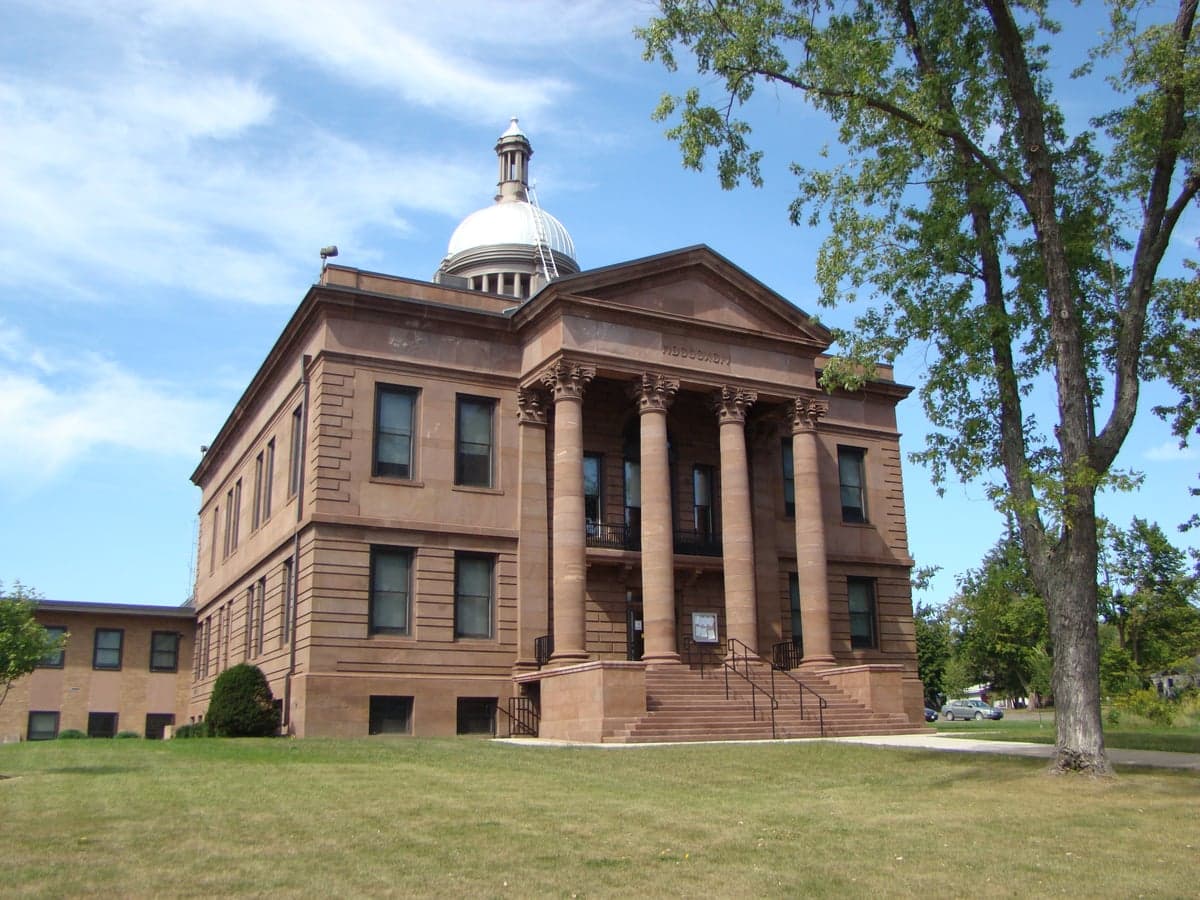
Photo: Wikipedia
Political ClimatePolitical Climate in Bayfield County
Showing county-level results — no local-only data available.
Lean and PVI are calculated from this county’s 2020 and 2024 presidential results, Cook-style.
Political rankings in Wisconsin
- Most Conservative Cities in Wisconsin
- Most Liberal Cities in Wisconsin
- Best Liberal-Leaning Towns in the Midwest
- Safest Liberal-Leaning Towns in the Midwest
- Safest Conservative-Leaning Towns in the Midwest
- Affordable Small Towns for Conservatives
- Most Affordable Liberal-Leaning Small Towns in the U.S.
- Safest Conservative-Leaning Cities in the U.S.
- Most Conservative Counties in Wisconsin
- Most Liberal Counties in Wisconsin
Local Political AnalysisPolitical Analysis of Bayfield County
Bayfield County, Wisconsin, leans reliably Republican with a Cook PVI of R+11, a stark contrast to the statewide PVI of EVEN that reflects Wisconsin’s perennial battleground status. This isn’t a monolith, though—the county’s political geography splits sharply between the liberal-leaning towns along Lake Superior, like Bayfield and Washburn, and the more conservative inland communities such as Iron River, Cable, and Grand View. Over the past decade, the county has held steady at R+10 to R+12, with no dramatic shifts, but the internal divide has widened as national polarization seeps into local politics.
How it compares
Statewide, Wisconsin swings like a pendulum—think 2020’s 20,000-vote margin for Biden—but Bayfield County sits firmly in the red column. In the 2024 presidential race, the county gave Trump roughly 58% of the vote, while statewide he lost by about a point. That R+11 PVI means a Republican candidate here can expect a double-digit cushion, unlike the razor-thin margins in Dane or Milwaukee counties. Locally, the variation is stark: Bayfield town (the city itself) often votes 60-40 Democratic, driven by tourism workers and second-home owners from the Twin Cities, while Iron River and Grand View routinely hit 70% Republican. The swing precincts are in Cable and Drummond, where independent-minded voters—often tied to the outdoor recreation economy—can tip a race by a few points either way. This isn’t a county that’s trending blue; if anything, the inland areas have hardened their GOP lean since 2016, while the lakeshore towns have stayed consistently liberal.
What this means for residents
For conservative residents, the county’s lean means their votes carry weight in local races—county board seats, sheriff, and school board elections often go Republican without much fuss. They’ll find their values reflected in the county’s stance on Second Amendment rights and lower property taxes, which are a perennial issue here. For liberal residents, especially in Bayfield and Washburn, the reality is more about being a vocal minority. They can still win local offices in their own towns—Bayfield’s city council is reliably progressive—but county-wide measures like zoning or land use often tilt conservative. Both sides deal with a practical consequence: the county’s R+11 lean means it’s largely ignored in statewide campaigns, which focus on the I-94 corridor and the Milwaukee suburbs. That can feel like a blessing (fewer attack ads) or a curse (less attention to rural infrastructure).
Culturally, the political divide maps onto a lifestyle split. The lakeshore towns lean blue, with a vibe shaped by artists, seasonal residents, and the Apostle Islands tourism economy—think farmers markets and climate activism. Inland, the red towns are rooted in logging, hunting, and year-round working-class life, where conversations center on forest management and school funding. Policy-wise, this means the county often deadlocks on issues like short-term rental regulations (a flashpoint in Bayfield) versus logging access (a priority in Iron River). The trajectory? Expect the R+11 to hold for the next decade, as the inland population grows slightly faster than the lakeshore, but don’t rule out a surprise—if the Twin Cities exurban creep reaches farther north, Bayfield County could see a slow purple shift over 20 years. For now, it’s a place where you know your neighbor’s politics by whether they fly a flag for the Packers or the lake trout.

State Political ClimatePolitical Climate in Wisconsin
State Political AnalysisPolitical Environment in the State
Wisconsin is the ultimate swing state, with a Cook PVI of EVEN that perfectly captures its knife-edge political balance. Over the past 20 years, the state has shifted from a reliably blue-leaning battleground to a true toss-up, with statewide elections routinely decided by less than a point—Joe Biden won by just 0.6% in 2020, and Donald Trump flipped it back by a similar margin in 2024. The dominant coalitions are a shrinking but still potent Democratic base anchored in Milwaukee and Madison, and a growing, energized Republican coalition in the WOW counties (Waukesha, Ozaukee, Washington) and the vast rural north and west. What makes Wisconsin unique is that neither side can build a durable majority; the state is perpetually contested, and every election feels like a knife fight.
Urban vs. rural divide
The political map of Wisconsin is a study in stark contrasts. Milwaukee County and Dane County (Madison) together cast about 30% of the state's vote and deliver massive Democratic margins—Milwaukee County went +40 for Biden in 2020, while Dane County went +60. These two metros are the engine of the Democratic coalition, powered by union households, university faculty, and a growing population of young professionals. In contrast, the WOW counties (Waukesha, Ozaukee, Washington) are the Republican stronghold, with Waukesha County alone delivering a +30-point margin for Trump. The rural northwoods counties—like Vilas, Oneida, and Lincoln—have been trending red for a decade, as traditional Democratic-leaning rural voters (many of them former union members) have shifted hard to the GOP. The Fox Valley (Appleton, Oshkosh, Green Bay) is the true battleground: Brown County (Green Bay) flipped from Obama to Trump to Biden to Trump, and its suburban and exurban precincts are the most closely watched in the state. The Driftless Region in the southwest (Vernon, Crawford, Richland counties) remains a Democratic-leaning rural outlier, but its population is too small to offset losses elsewhere.
Policy environment
Wisconsin's policy environment reflects its divided government. The state has a flat income tax of 4.4% (down from 7.65% in 2011), with a sales tax of 5% (local counties can add up to 0.5%). Property taxes are above the national median but have been held in check by state-imposed levy limits. The regulatory posture is generally business-friendly, with a right-to-work law (passed in 2015) and a tort reform system that caps noneconomic damages. Education policy is a flashpoint: the state has a robust school choice program (vouchers for private and religious schools, especially in Milwaukee and Racine) that conservatives champion, while liberals point to chronic underfunding of rural and urban public schools. Healthcare is a mixed bag: Wisconsin expanded Medicaid under the Affordable Care Act (BadgerCare Plus), but the state has not created its own insurance exchange, relying on the federal marketplace. Election laws are among the most contested in the nation: the state requires photo ID to vote, allows no-excuse absentee voting, and has a bipartisan election commission that has been under constant legal attack since 2020.
Recent policy direction
Since the 2022 election, with Democratic Governor Tony Evers facing a Republican-controlled legislature, the state has been in a policy stalemate punctuated by occasional compromise. On gun and self-defense law, Wisconsin is a shall-issue state for concealed carry (no permit required since 2011), with no assault weapons ban or magazine limits. The legislature passed a bill in 2023 to allow concealed carry in schools by staff with training, but Evers vetoed it. On parental and education rights, the state has seen a fierce battle over school library books and curriculum transparency, with several conservative school boards (notably in Waukesha and the Fox Valley) adopting policies that allow parents to challenge materials. Speech and privacy are largely protected by the state constitution, though a 2023 law (Act 12) restricted the use of drones for surveillance by private citizens. On medical and bodily autonomy, Wisconsin is a post-Dobbs battleground: a 1849 law banning nearly all abortions was challenged in court, and in 2023 a Dane County judge ruled it does not apply to consensual abortions, effectively restoring access up to 20 weeks. The legislature has passed bills to ban abortion at 14 weeks and to restrict gender-affirming care for minors, both vetoed by Evers. Property rights are strong, with no statewide rent control and limited eminent domain use. Taxation has been trending downward: the 2023-25 budget cut income taxes by $2 billion, with the top rate dropping from 7.65% to 4.4%. On voting and ballot access, the state has seen a push for stricter rules—including a ban on private funding for elections (passed in 2021) and a requirement that absentee ballots be received by Election Day (upheld by the state Supreme Court in 2022). The new liberal majority on the Wisconsin Supreme Court (elected in 2023) is likely to strike down the state's heavily gerrymandered legislative maps, which could reshape the policy landscape entirely.
Civil unrest & political movements
Wisconsin has been a flashpoint for political movements on both sides. The 2020 election aftermath saw massive protests in Madison and Milwaukee, with the state becoming a national symbol of election integrity debates. The Kenosha unrest in August 2020, following the police shooting of Jacob Blake, led to two nights of rioting, arson, and the killing of two protesters by a 17-year-old from Illinois (Kyle Rittenhouse), who was later acquitted. The case became a national rallying cry for both gun rights and racial justice movements. On the right, the Wisconsin Republican Party has been a leader in election integrity efforts, with the state's voter ID law and absentee ballot restrictions serving as models for other states. On the left, the Wisconsin Democratic Party has been a powerhouse of grassroots organizing, with the state's progressive tradition (the birthplace of the Republican Party and the Progressive Movement) still alive in Madison and Milwaukee. Immigration politics are relatively low-key compared to border states, but the state has seen a surge in migrant workers in the dairy industry, and some rural counties have passed symbolic sanctuary city bans. The secession or nullification rhetoric is minimal, though there is a small but vocal "Wisconsin First" movement that advocates for greater state autonomy from federal mandates.
Projection
Over the next 5-10 years, Wisconsin is likely to remain a toss-up, but the demographic trends favor a slight Republican lean. The state's population is aging and growing slowly, with the fastest growth in the conservative-leaning WOW counties and the Fox Valley, while Milwaukee and Dane County are growing more slowly. In-migration from Illinois (especially from the Chicago suburbs) is bringing some moderate Democrats to the WOW counties, but also some conservative-leaning retirees to the northwoods. The 2024 election showed that the state can still swing either way, but the Republican base in the WOW counties and rural areas is more energized and growing faster than the Democratic base in Milwaukee and Madison. The wild card is the state Supreme Court: if the new liberal majority redraws legislative maps to be more competitive, Democrats could win control of the legislature by 2028, which would dramatically shift policy on abortion, education funding, and voting rights. Conversely, if the maps remain gerrymandered, Republicans will continue to control the legislature even if they lose statewide races. A relocator moving in now should expect a state that is perpetually contested, with every election feeling like a national bellwether.
For a new resident, the bottom line is that Wisconsin offers a high quality of life with low taxes, good schools (especially in the suburbs), and abundant outdoor recreation, but you will be living in a state that is constantly fighting over its political identity. If you are conservative, you will find a welcoming environment in the WOW counties, the Fox Valley, and most rural areas, with strong gun rights, school choice, and a business-friendly climate. If you are liberal, you will find a vibrant progressive community in Madison, Milwaukee, and the Driftless Region, with strong labor unions, abortion access, and a robust public university system. The key is to choose your community wisely—Wisconsin is not a monolith, and your experience will depend heavily on whether you settle in Waukesha or Madison, in Green Bay or Eau Claire. The state's political climate is a feature, not a bug, for those who enjoy being at the center of the national conversation.
* Values derived from national, state, county, city and local statistics and may differ in a specific area. Last updated: 2026-10-23T18:03:06.000Z
Narrative content on this page is AI-generated and may contain mistakes. Verify any details that matter before acting on them.
ReloMaps may earn a commission from affiliate links at no extra cost to you.

