
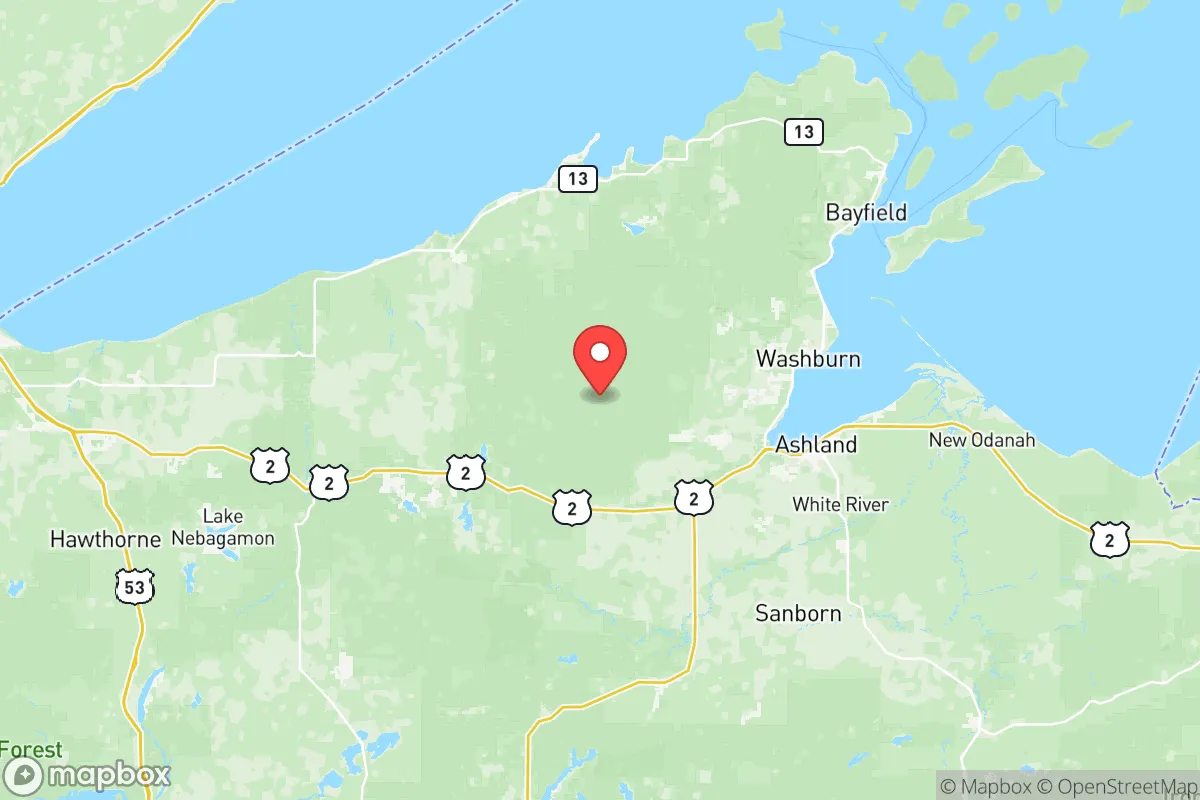
Photo: Wikipedia
Personal Sovereignty in Bayfield County
Moderate friction. Expect trade-offs in some aspect of personal liberty and independence.
What does Personal Sovereignty tell us?
Personal Sovereignty measures your capacity for self-reliance and independence with minimal government friction. Higher scores mean fewer barriers between you and the way you want to live... but it assumes you have the space you need and good neighbors.
What does this tell us?
Personal Sovereignty measures your capacity for self-reliance and independence with minimal government friction. Higher scores mean fewer barriers between you and the way you want to live... but it assumes you have the space you need and good neighbors.
State Policy
Energy independence: Importer (18% of energy produced in-state)
Personal Liberty
Homesteading

Personal Liberty Analysis
Bayfield County, Wisconsin, offers a notably high degree of personal sovereignty, particularly for those willing to embrace its rural character and distance from major urban centers. The county’s regulatory environment is light-touch by Upper Midwest standards, and its gun laws are among the most permissive in the nation, creating a strong foundation for self-reliant living. However, the autonomy picture is not uniform across the county; the lakeshore communities of Bayfield and Washburn have a more active local governance presence than the inland townships like Barnes or Drummond, where de facto freedom is often greater due to lower population density and fewer zoning ordinances.
Tax burden and regulatory posture in Bayfield County
Wisconsin’s state-level tax burden is moderate, with a flat individual income tax rate of 4.4% (as of 2026) and a state sales tax of 5%. Bayfield County adds a 0.5% county sales tax, bringing the total to 5.5%—lower than many neighboring Minnesota counties. Property taxes are the primary local revenue source, and they vary significantly by town. In Iron River and Mason, mill rates are generally lower than in the more developed Bayfield city limits, where lakefront property values drive assessments higher. The county’s regulatory posture is best described as permissive but not absent. There is no county-wide building code for most rural residential construction, though townships may adopt their own. The Wisconsin Department of Natural Resources (DNR) has a noticeable presence, particularly regarding shoreline development and wetland regulations—a factor for anyone buying lakefront property. For inland parcels in Barnes or Drummond, the regulatory touch is lighter, with fewer permit requirements for sheds, fences, or small-scale agricultural structures. The county’s comprehensive plan is advisory, not mandatory, for most rural land uses, giving landowners substantial discretion.
Self-defense and gun law specifics in Bayfield County
Wisconsin is a “shall-issue” state for concealed carry permits, and Bayfield County’s sheriff’s office processes applications efficiently, typically within 30 days. The state preempts local firearm ordinances, meaning Bayfield, Washburn, and all other municipalities cannot enact stricter gun laws than state law allows. This preemption is a critical safeguard for gun owners. Open carry is legal without a permit for anyone 18 or older who can legally possess a firearm. The state’s “castle doctrine” provides a strong presumption of reasonable fear of death or great bodily harm when using force against an unlawful intruder in a home, vehicle, or business. There is no duty to retreat in any place where a person has a legal right to be. Stand-your-ground protections are robust. The local culture in Iron River and Mason is heavily pro-gun, with multiple gun shops and shooting ranges in the area. The Bayfield County Sportsmen’s Club near Washburn is a well-established facility. For a reader prioritizing self-defense rights, Bayfield County offers a legal environment that is among the most favorable in the Midwest, with no local government able to erode those rights.
Self-reliance and homesteading viability: lot sizes, zoning, and off-grid feasibility
Bayfield County is a strong candidate for off-grid and homesteading lifestyles, but feasibility varies by location. Inland townships like Barnes, Drummond, and Mason have minimal zoning, with many parcels zoned as “Forestry” or “General Rural,” allowing for a wide range of uses without conditional use permits. Minimum lot sizes in unzoned townships are effectively governed by state subdivision regulations, which typically require 35 acres for a new land division, but existing parcels of 5-20 acres are common and can be used for homesteading without further subdivision. Off-grid living is legal: there is no county requirement to connect to a municipal water or sewer system. Wells and septic systems are permitted through the county health department, with standard testing requirements. Solar panels and wind turbines are allowed under state law, though the county may require a building permit for structural mounting. In Bayfield and Washburn, city zoning is more restrictive—off-grid systems are less common, and building permits are required for most structures. The Red Cliff Band of Lake Superior Chippewa reservation near Bayfield has its own tribal regulations, which differ from county rules. For a homesteader seeking maximum autonomy, Barnes and Drummond are the most permissive areas, with large tracts of undeveloped land, low population density, and a culture that values self-sufficiency.
Personal liberties: parental rights, medical autonomy, speech, and property
Wisconsin law provides strong protections for parental rights, including the right to direct a child’s education, medical care, and religious upbringing. Homeschooling is legal with minimal regulation—parents must file an annual enrollment form and provide a “sequentially progressive curriculum,” but there are no standardized testing requirements or home visits. Bayfield County has several active homeschooling groups, particularly in the Iron River and Barnes areas. Medical autonomy is generally respected, though Wisconsin has not enacted broad medical freedom legislation. Vaccine mandates for school attendance exist, but exemptions are available for medical, religious, and philosophical reasons. The state does not have a right-to-try law for terminally ill patients, but it does allow for direct primary care agreements. Free speech protections are robust under both the U.S. and Wisconsin Constitutions, and Bayfield County’s local governments do not have a history of restricting public expression. Property rights are strong: Wisconsin is a “private property rights” state, meaning the government must demonstrate a compelling interest for any regulatory taking. The county’s shoreland zoning is the most common area of friction, as the DNR enforces strict setbacks and vegetation buffers on lakes and streams. For inland property owners in Mason or Drummond, these restrictions are largely irrelevant.
Overall, Bayfield County ranks as a high-sovereignty area within Wisconsin, particularly for those who choose inland townships over the lakeshore villages. The combination of permissive gun laws, low regulatory burden on rural land, and strong parental rights creates an environment where self-reliant individuals and families can operate with minimal government interference. The trade-off is access to services: the county’s rural nature means longer travel times for healthcare, shopping, and employment. For a reader who values personal freedom over convenience, Bayfield County—especially the inland communities of Barnes, Drummond, and Mason—offers a level of autonomy that is difficult to find in more populated regions of the Midwest.

* Values derived from national, state, county, city and local statistics and may differ in a specific area. Last updated: 2026-10-23T18:03:06.000Z
Narrative content on this page is AI-generated and may contain mistakes. Verify any details that matter before acting on them.
ReloMaps may earn a commission from affiliate links at no extra cost to you.

