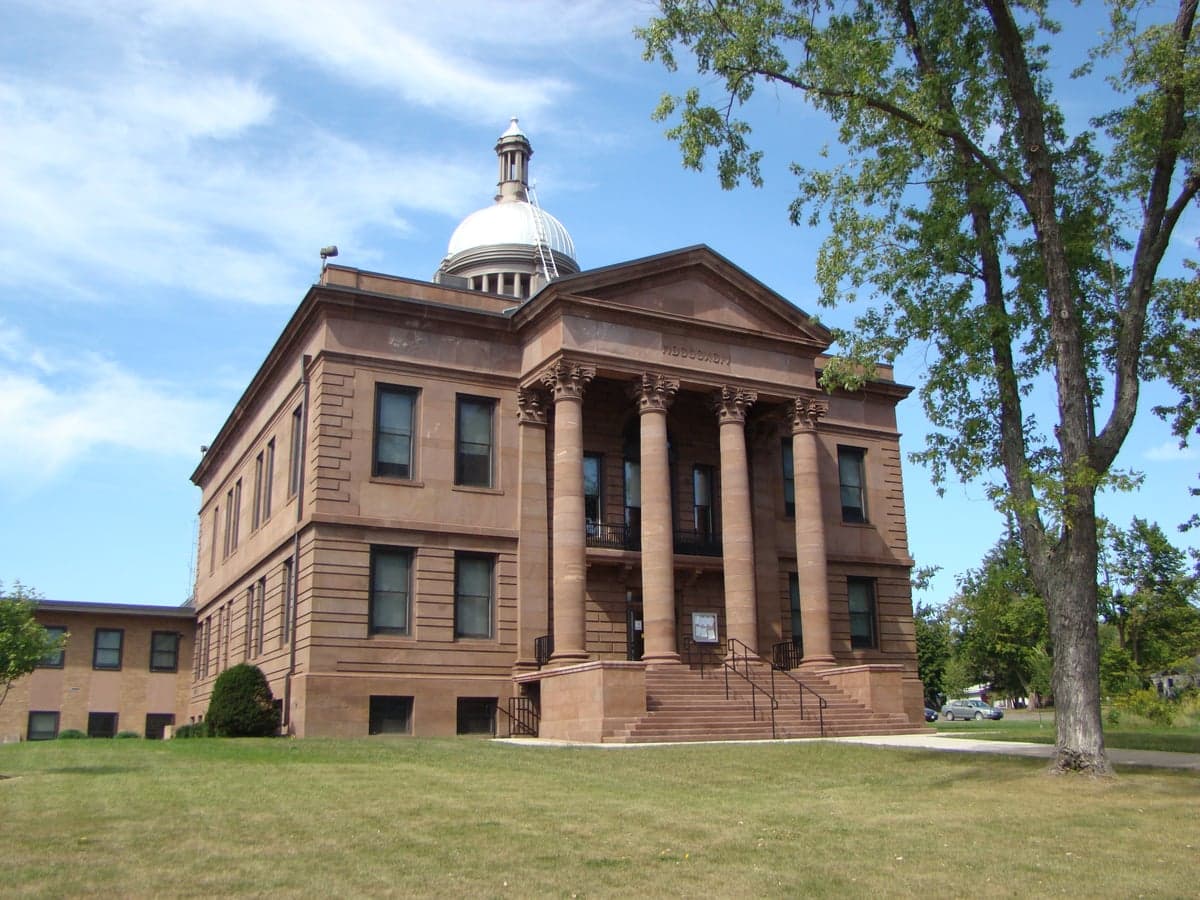
Photo: Wikipedia
Demographics of Bayfield County
Affluence Level in Bayfield County
A middle-class area roughly in line with national averages across income, home values, education, and employment.
People of Bayfield County
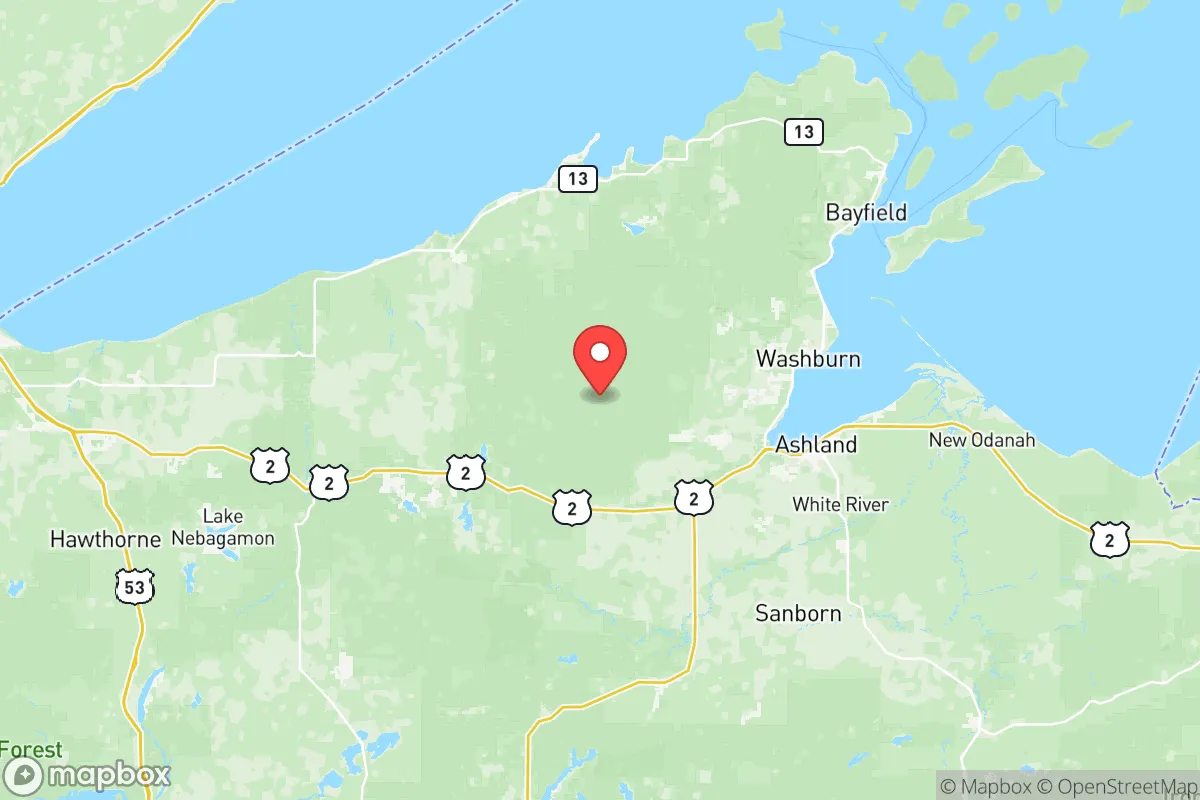
Bayfield County, Wisconsin, is home to 16,410 residents, a population defined by its deep-rooted Native American heritage, a sparse rural character, and a strong connection to the Lake Superior shoreline. With a population density of just 11 people per square mile, it is one of the least densely populated counties in the state, where the largest town, Washburn, holds fewer than 2,000 people. The county’s identity is distinctly shaped by the Red Cliff Band of Lake Superior Chippewa and the Bad River Band of the Lake Superior Tribe of Chippewa Indians, whose reservations cover significant portions of the land. Today, the population is overwhelmingly white (83.9%) with a very small foreign-born share (0.5%), reflecting a history of limited immigration and a stable, long-standing community.
Settlement & growth (pre-1960)
The human history of Bayfield County begins with the Ojibwe (Chippewa) people, who migrated from the eastern Great Lakes region and established villages along the Lake Superior shore by the 17th century. The French fur traders and Jesuit missionaries who arrived in the 1600s, including those who founded the first European settlement at La Pointe on Madeline Island, interacted with the Ojibwe but did not displace them. The 1854 Treaty of La Pointe established the Red Cliff and Bad River reservations, cementing the Ojibwe as the foundational population of the area.
American settlement began in earnest after the 1854 treaty, with the first wave of European immigrants arriving in the 1850s and 1860s. These were primarily Cornish and Irish immigrants drawn by the region’s copper mining boom, centered around the town of Port Wing and the Apostle Islands. The mines proved short-lived, and by the 1870s, the economy shifted to logging and commercial fishing. Scandinavian immigrants—Norwegians, Swedes, and Finns—arrived in large numbers between 1880 and 1910, drawn by the promise of cheap land under the Homestead Act and jobs in the booming timber industry. They established farming communities in the interior, such as Drummond and Cable, and fishing villages along the coast like Cornucopia and Bayfield itself. The Finnish influence remains particularly strong, with many descendants still living in the area and maintaining cultural traditions like the sauna and the region’s distinctive log architecture.
By 1900, the county’s population had peaked at roughly 15,000, driven by the logging industry. The decline of logging after 1910 led to a gradual population drop, as many families moved to cities or left the state. The 1920s and 1930s saw a small influx of German and Polish families who took up marginal farming on cutover lands, but the county never experienced the heavy industrial immigration seen in southern Wisconsin. The population stabilized at around 10,000 by 1950, with the economy shifting to tourism and seasonal recreation, centered on the Apostle Islands National Lakeshore (established 1970) and the Chequamegon National Forest.
Modern era (post-1965)
The post-1965 era brought minimal demographic change to Bayfield County compared to the rest of the United States. The 1965 Hart-Cellar Act, which reshaped immigration nationwide, had almost no effect here: the county’s foreign-born population remains at just 0.5%, and the vast majority of residents are native-born. The most significant demographic shift since 1965 has been the return of Ojibwe people to the reservations, driven by the Indian Self-Determination and Education Assistance Act of 1975 and the growth of tribal gaming. The Red Cliff Band opened the Isle Vista Casino in 1992, which created jobs and drew some tribal members back to the area. Today, the Native American population (not separately reported in the data above but estimated at roughly 10-15% of the county) is concentrated on the Red Cliff Reservation near Bayfield and the Bad River Reservation near Odanah.
Domestic migration has been modest. Since the 1990s, the county has attracted a small but steady stream of retirees and second-home buyers from the Minneapolis-St. Paul metro area, drawn by the lakefront scenery and the Chequamegon National Forest. These newcomers tend to settle in Washburn and Bayfield, the two largest towns, where they have driven up housing prices and contributed to a slight increase in the college-educated share (now 35.0%). The Hispanic population remains tiny at 2.0%, concentrated among seasonal agricultural workers in the potato and berry farms around Iron River and Mason. The Black population (0.6%) and East/Southeast Asian population (0.4%) are negligible, with most individuals employed in professional roles at the county government or the Red Cliff Tribal Health Center.
The county’s overall population has grown slowly but steadily, from 14,008 in 1990 to 16,410 in 2024, a gain of about 17% in three decades. This growth is almost entirely due to domestic in-migration of white retirees and remote workers, not immigration or natural increase. The county’s birth rate is below replacement level, and the median age (roughly 50) is among the highest in Wisconsin.
The future
Bayfield County is likely to become slightly older and slightly more affluent over the next 10-20 years, but not significantly more diverse. The foreign-born share will remain below 1%, as the county lacks the job base—no major employers, no universities, no large-scale agriculture—to attract immigrants. The Hispanic population may grow modestly as agricultural operations expand, but it will remain a small fraction of the total. The Native American population is expected to hold steady or grow slightly, as tribal sovereignty and gaming revenues continue to provide economic stability.
The most notable trend is the dispersal of new residents into the interior, away from the crowded lakefront. Towns like Cable and Drummond are seeing new subdivisions of vacation homes and year-round remote-worker housing, as high-speed internet expands. This is putting pressure on the county’s limited housing stock and driving up prices, making it harder for younger families and service workers to afford homes. The cultural identity of the county is evolving from a working-class logging and fishing community to a recreation-oriented retirement and tourism destination, with a growing emphasis on outdoor amenities like the Birkebeiner cross-country ski race and the Apostle Islands sea kayaking.
For someone moving in now, Bayfield County offers a quiet, safe, and scenic rural lifestyle with a strong sense of place rooted in Ojibwe and Scandinavian heritage. The trade-offs are clear: limited job opportunities outside of tourism, healthcare, and tribal government; a long, harsh winter; and a population that is overwhelmingly white and older. The county is not becoming more diverse or dynamic—it is becoming more of what it already is: a beautiful, remote corner of Wisconsin where the people value privacy, tradition, and the natural world.

* Values derived from national, state, county, city and local statistics and may differ in a specific area. Last updated: 2026-10-23T18:03:06.000Z
Narrative content on this page is AI-generated and may contain mistakes. Verify any details that matter before acting on them.
ReloMaps may earn a commission from affiliate links at no extra cost to you.

