Political ClimatePolitical Climate in Mcculloch County
Showing district-level results — no local-only data available.
Local Political AnalysisPolitical Analysis of Mcculloch County
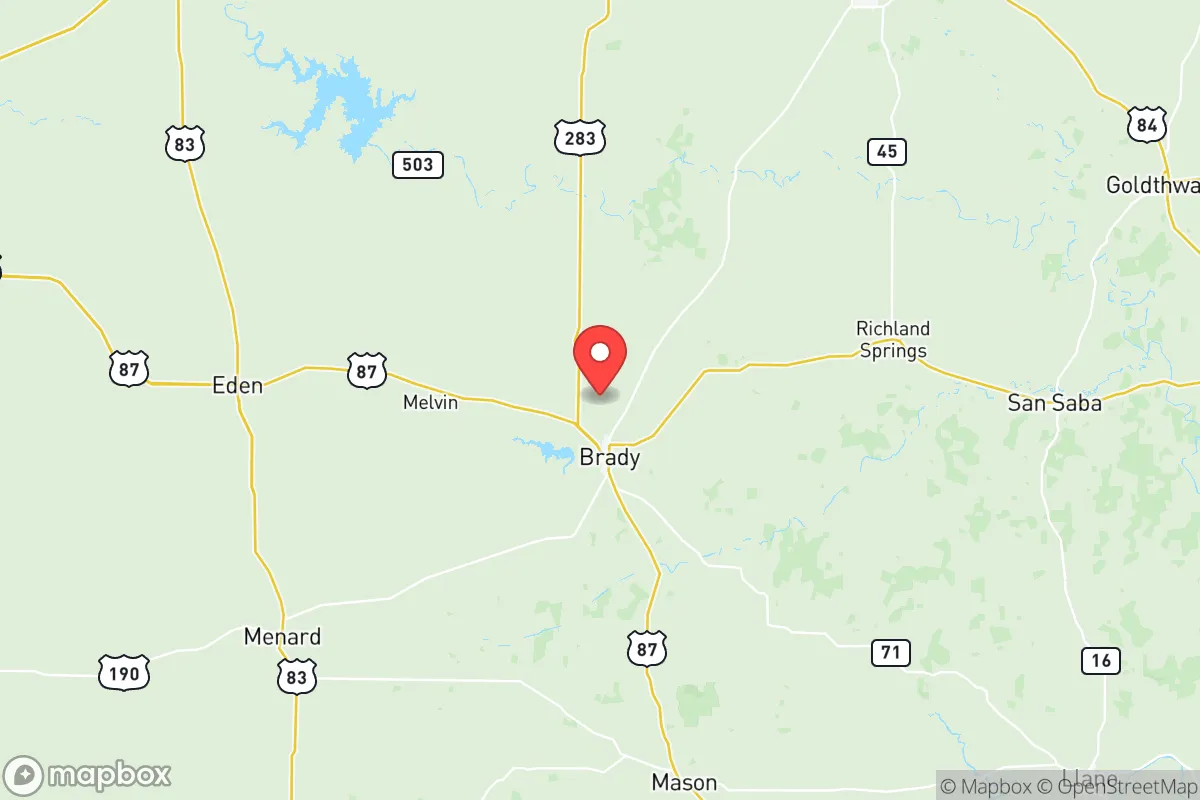
McCulloch County is one of the most reliably Republican counties in Texas, with a Cook Partisan Voting Index (PVI) of R+22—a full 18 points more conservative than the state’s overall R+4 rating. This isn’t a recent shift; the county has voted for the GOP presidential candidate by wide margins in every election since 2000, and the trend has only deepened. In 2024, Donald Trump carried the county with over 80% of the vote, a number that would be eye-popping even in much of West Texas. The county seat, Brady, is the political and population center, and it votes overwhelmingly red, but there are subtle variations across the smaller communities that give the county a more textured political landscape than the raw numbers suggest.
How it compares
To put the R+22 PVI in perspective, McCulloch County is roughly as conservative as the Texas Panhandle or the deeply red counties along the I-35 corridor south of San Antonio. By contrast, Texas as a whole is R+4, meaning the state is competitive enough that Democrats can win statewide office in good years (like Beto O’Rourke’s 2018 Senate race) but still leans Republican. In McCulloch County, a Democrat hasn’t carried the county since Jimmy Carter in 1976, and even then it was a narrow win. The gap between the county and the state has widened over the past two decades: in 2000, George W. Bush won the county by about 35 points; by 2024, the margin had grown to over 60 points. This isn’t just a rural-versus-urban story—neighboring counties like Mason (R+18) and Menard (R+16) are also deep red, but McCulloch stands out for its consistency and intensity. The only precinct that occasionally shows a blip of blue is the small community of Rochelle, where a handful of Democratic-leaning households can shift a local race by a few dozen votes, but it’s never enough to change the countywide outcome.
What this means for residents
For conservative residents, McCulloch County is a comfortable place to live politically. Local offices—county commissioner, sheriff, school board—are almost always held by Republicans, and there’s little pressure to moderate on issues like gun rights, property taxes, or energy policy. The county’s economy is heavily tied to agriculture (cattle, cotton, and pecans) and oil and gas, so Republican stances on land use and deregulation resonate strongly. For liberal residents, the reality is more isolating. There’s no organized Democratic party presence in the county; the last time a Democrat ran a serious campaign for county judge was in 2014, and they lost by 40 points. Socially, progressive views on topics like abortion or LGBTQ rights are rarely discussed in public, and those who hold them often keep quiet to avoid friction. That said, the county is not hostile—people are generally polite and neighborly—but the political homogeneity means liberal residents tend to drive to San Angelo or Austin for community events or political engagement. The practical effect is that local policy is shaped almost entirely by conservative priorities, from low taxes to limited regulation, with little debate.
Culturally, McCulloch County is a place where church attendance is high, hunting and fishing are central to recreation, and the annual Brady Rodeo is a bigger deal than any election. The county’s politics reflect that lifestyle: there’s strong support for the Second Amendment, skepticism of federal land management (especially around the nearby Colorado River), and a general preference for local control over state mandates. One notable distinction from the rest of Texas is the county’s stance on water rights—McCulloch sits over the Edwards-Trinity Aquifer, and residents have fought hard against proposed groundwater export projects, a cross-partisan issue that unites ranchers and environmentalists alike. In the near future, expect the county to stay deep red, though the growing Hispanic population (now about 35% of the county) could slowly shift the needle in local races over the next decade, especially if national Democrats invest in rural outreach. For now, though, McCulloch County remains a stronghold of Texas conservatism, where the politics are as steady as the summer heat.

State Political ClimatePolitical Climate in Texas
State Political AnalysisPolitical Environment in the State
Texas is a solidly Republican state with a Cook PVI of R+4, but that number masks a dramatic and ongoing political transformation. Over the past 10-20 years, the state has shifted from a reliably red stronghold to a fiercely contested battleground, driven by explosive growth in its major metros and a deepening urban-rural divide. The dominant coalition remains conservative, anchored by the suburbs, exurbs, and vast rural areas, but the Democratic vote share has been climbing steadily, fueled by the booming populations of Houston, Dallas, Austin, and San Antonio, as well as the fast-growing Latino electorate. The trajectory is clear: Texas is trending purple, but the pace and final destination remain the central political question of the decade.
Urban vs. rural divide
The political map of Texas is a study in stark contrasts. The state's four largest metros—Houston, Dallas-Fort Worth, San Antonio, and Austin—are the engines of Democratic growth. Harris County (Houston) and Dallas County are now reliably blue, while Bexar County (San Antonio) and Travis County (Austin) are deep blue. The 2020 election saw these urban centers deliver massive margins for Joe Biden, with Harris County alone providing a net gain of over 300,000 votes. In contrast, the vast rural and exurban areas—places like the Panhandle around Lubbock and Amarillo, East Texas, and the Hill Country west of Austin—vote overwhelmingly Republican. The suburbs are the true battleground. Collin County (north of Dallas) and Denton County, once solidly red, have shifted to competitive or even lean-blue territory, while Fort Bend County (southwest of Houston) has become a Democratic stronghold. The Rio Grande Valley, historically a Democratic stronghold, has shown signs of a rightward shift, with counties like Zapata and Starr flipping to Trump in 2020, a trend that has Republicans optimistic about future gains among Latino voters.
Policy environment
Texas’s policy environment is defined by a small-government, low-tax, and low-regulation philosophy. There is no state income tax, a major draw for relocators, and property taxes are among the highest in the nation to compensate. The state’s regulatory posture is famously business-friendly, with minimal zoning in many cities and a "right-to-work" law that limits union power. On education, the state has a robust school choice movement, with a new Education Savings Account (ESA) program passed in 2023 that allows families to use public funds for private school tuition. Healthcare policy is a flashpoint: Texas has not expanded Medicaid under the Affordable Care Act, leaving roughly 1.5 million low-income adults without coverage. Election laws were tightened in 2021 with Senate Bill 1, which added new ID requirements for mail-in voting, banned drive-through and 24-hour voting, and gave partisan poll watchers more access. The state also has a near-total abortion ban (triggered by Roe v. Wade’s overturn) and a permitless carry law for handguns, reflecting its strong conservative stance on social and Second Amendment issues.
Recent policy direction
Recent legislation in Texas has pushed the state decisively to the right on a broad range of liberties. On gun rights, the 2021 permitless carry law (HB 1927) allows most adults to carry a handgun without a license or training. On parental and education rights, the 2023 "Parental Bill of Rights" (HB 900) restricts what books can be in school libraries and requires parental consent for certain health services. On speech, the state passed a law (HB 20) in 2023 that effectively bans large social media platforms from moderating content based on viewpoint, though it is currently tied up in court. On privacy and surveillance, Texas has a biometric privacy law (the Capture or Use of Biometric Identifier Act) that is one of the strongest in the nation, allowing individuals to sue companies for collecting biometric data without consent. On medical and bodily autonomy, the state’s near-total abortion ban (SB 8, the "Heartbeat Act," and the trigger law) is among the most restrictive, with no exceptions for rape or incest. Property rights are generally strong, with no state-level rent control and a relatively straightforward eminent domain process. On voting, SB 1 (2021) tightened ballot access, but early voting remains generous by national standards. The overall direction is toward maximizing individual liberty in economic and gun matters while restricting it on social and medical issues.
Civil unrest & political movements
Texas has seen its share of political flashpoints. The 2020 George Floyd protests in Austin, Houston, and Dallas were large and occasionally violent, leading to property damage and a lasting debate over policing. The state’s immigration politics are a constant source of tension. Governor Greg Abbott’s Operation Lone Star, launched in 2021, has deployed state troopers and National Guard to the border, bused migrants to Democratic-led cities like New York and Chicago, and installed razor wire and buoys in the Rio Grande. This has sparked legal battles with the Biden administration and drawn sharp criticism from immigrant rights groups. Sanctuary city policies are effectively banned by state law (SB 4, 2017), which requires local law enforcement to cooperate with federal immigration authorities. Secession rhetoric, while fringe, has a small but vocal following, with the Texas Nationalist Movement pushing for a referendum on independence. Election integrity remains a hot-button issue, with many Republicans still questioning the 2020 results, though no evidence of widespread fraud has been found. A new resident would notice the omnipresence of political signage, the intensity of local political debates, and the visible presence of law enforcement, especially in border areas like El Paso and the Rio Grande Valley.
Projection
Over the next 5-10 years, Texas is likely to continue its slow but steady shift toward a more competitive two-party system. The key drivers are demographic: the state’s population is growing by about 1,000 people per day, many of them moving from blue states like California and New York. These newcomers tend to be more moderate or liberal, especially on social issues, and they are concentrated in the urban and suburban counties that are already trending blue. The Latino electorate, which makes up about 30% of the state’s population, is not monolithic; while younger Latino voters lean Democratic, older and more religious Latino voters are increasingly open to Republican appeals on economic and cultural issues. The Republican Party will likely maintain its grip on the state legislature and statewide offices for the near term, thanks to gerrymandered districts and strong rural turnout, but the presidential margin will continue to narrow. A new resident moving in now should expect to see a state that remains conservative in its policy orientation but where the political conversation is increasingly dominated by the urban-rural divide, immigration, and the culture wars. By 2030, Texas could be a true swing state, with the potential to flip blue in a presidential election if Democratic turnout in the metros continues to grow.
For a new resident, the bottom line is that Texas offers a political environment that is deeply conservative on fiscal and social issues, but with a rapidly diversifying population that is pushing it toward the center. If you are a conservative, you will find a state government that largely aligns with your values, with low taxes, strong gun rights, and a business-friendly climate. If you are a liberal, you will find a vibrant and growing political community in the major cities, but you will also face a state government that is actively hostile to many of your policy preferences, especially on abortion, immigration, and voting. The practical takeaway is that your day-to-day experience will vary dramatically depending on where you live—a liberal in Austin or Houston will have a very different political reality than a conservative in Lubbock or Tyler. The state is not a monolith, and its political future is very much in play.
* Values derived from national, state, county, city and local statistics and may differ in a specific area. Last updated: 2026-07-27T22:12:38.000Z
Narrative content on this page is AI-generated and may contain mistakes. Verify any details that matter before acting on them.
ReloMaps may earn a commission from affiliate links at no extra cost to you.

