Quality of Life in Mcculloch County
A livable area that tracks near national norms for affordability, walkability, and neighborhood health.
What does Quality of Life tell us?
Quality of Life measures an area by evaluating factors like cost of living, nearby amenities, country club access, airport proximity, socioeconomic signals and neighborhood character. For large states, this is a general average — quality of life can vary dramatically between metro areas, suburbs, and rural communities within the same state.
What does this tell us?
Quality of Life measures an area by evaluating factors like cost of living, nearby amenities, country club access, airport proximity, socioeconomic signals and neighborhood character. For large states, this is a general average — quality of life can vary dramatically between metro areas, suburbs, and rural communities within the same state.
Cost of Living
42% below national average
153%
The Real Cost of Living in Mcculloch County for 2026
| Tier | Individual | Family (4) |
|---|---|---|
| Survival | $13k | $25k |
| Comfortable | $23k | $34k |
| Luxury | $94k+ | $145k+ |
| Elite (Top 5%) | $113k+ | $175k+ |
Quality-of-Life Analysis
McCulloch County, Texas, offers a spectrum of quality-of-life options that range from the modest conveniences of its county seat, Brady, to the quiet solitude of unincorporated communities like Rochelle and Voca. The county’s character is defined by its central Texas Hill Country setting, with a cost of living index of 58 (well below the national average of 100) and a median home value of $104,400, making it one of the more affordable places in the state. People drawn here typically fall into two camps: those seeking a low-cost, slower-paced life in a small town with basic services, and those who prioritize absolute privacy and land ownership in the county’s sparsely populated rural stretches.
Largest town(s) & population centers
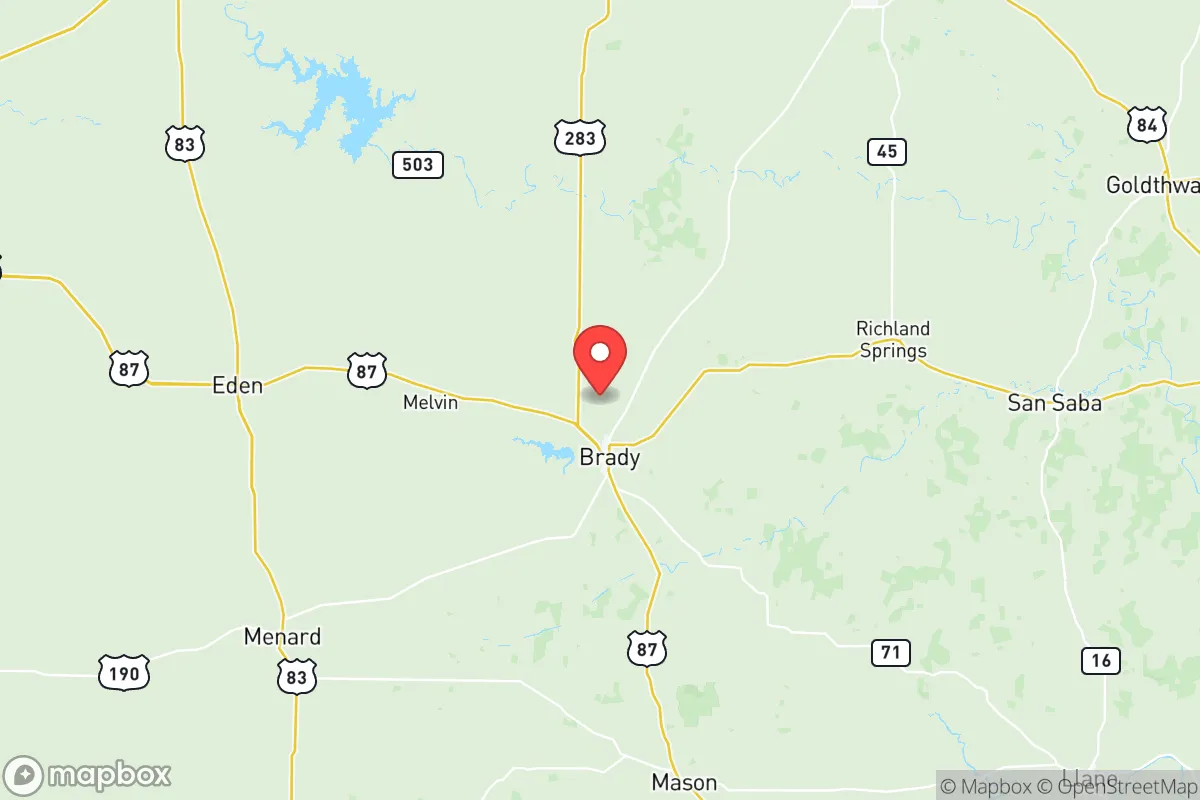
Brady is the county’s only incorporated city and its undisputed hub, home to roughly 5,500 of the county’s 7,500 residents. Daily life in Brady revolves around a compact downtown anchored by the McCulloch County Courthouse, with grocery stores, a hospital (Heart of Texas Healthcare System), and a handful of local restaurants and shops. The town serves as a regional service center for ranchers and retirees, with a median rent of $838 and an average commute of just under 27 minutes—most residents work within the county or commute to nearby towns like Mason or San Saba. Brady’s schools, the Brady Independent School District, are the primary draw for families, though the town lacks the retail and entertainment options found in larger cities like San Angelo (about 60 miles west). The community is tight-knit, with events like the annual Brady Rodeo and the World Championship Goat Cook-Off providing social anchors.
Smaller towns & rural pockets
Beyond Brady, McCulloch County is dotted with unincorporated communities that offer a markedly different lifestyle. Rochelle, roughly 15 miles northeast of Brady, is a tiny crossroads with a population under 200, a post office, and little else—residents here often commute to Brady or work remotely on ranches. Voca, located about 20 miles west of Brady, is even smaller, with a handful of homes and a historic school building that now serves as a community center. Lohn, in the county’s southeastern corner, is another unincorporated settlement where life is defined by open ranchland and minimal traffic. These areas offer the lowest property costs in the county—vacant land can be found for under $2,000 per acre—but come with trade-offs: no municipal water or sewer, limited internet access, and the nearest grocery store or hospital is a 20- to 30-minute drive into Brady.
Cost & lifestyle range
The cost of living in McCulloch County varies noticeably between Brady and its rural outskirts. In Brady, the median home value of $104,400 buys a modest three-bedroom house on a standard lot, often within walking distance of downtown or the school. Renters pay a median of $838 per month, typically for older duplexes or small single-family homes. At the higher end of the county’s spectrum, a few newer subdivisions on Brady’s south side feature homes in the $150,000–$200,000 range, offering more square footage and modern finishes. At the lower end, rural properties in Rochelle or Voca can be purchased for under $70,000—often fixer-uppers or mobile homes on acreage—but buyers must factor in well and septic costs. The lifestyle trade-off is clear: Brady provides walkable access to basic amenities and a social community, while the rural pockets offer solitude and land at the expense of convenience. For example, a family in Brady can walk to the public library or a park, while a resident near Lohn might drive 25 minutes for a gallon of milk.
Who thrives in McCulloch County? Retirees on fixed incomes and remote workers who value low housing costs and a quiet environment find the county appealing, especially in Brady where healthcare and basic services are within reach. Ranchers and farmers are drawn to the rural areas for the affordable land and agricultural lifestyle. Families with school-age children typically settle in Brady to access the ISD, while those seeking complete seclusion—and who can handle the logistics of rural living—find the unincorporated communities like Rochelle and Voca ideal. The county is not suited for those who need urban amenities, diverse employment, or high-speed internet, but for the right person, it offers a genuine, low-cost slice of Texas Hill Country life.

Crime in Mcculloch County
Crime rates similar to the national median for U.S. locations.
Violent CrimeViolent Crime Analysis
Property CrimeProperty Crime Analysis
Crime Analysis
Mcculloch County, Texas, reports a violent crime rate of 342.3 per 100,000 residents and a property crime rate of 1,780.9 per 100,000, placing it in a moderate-risk tier compared to both state and national averages. The county’s overall safety picture is shaped by its small-town character and rural geography, but crime patterns vary significantly between its principal communities—Brady, Rochelle, Melvin, and Lohn—and the unincorporated areas that surround them. Understanding these local dynamics is essential for anyone evaluating relocation to this Central Texas region.
Crime in context
Mcculloch County’s violent crime rate of 342.3 per 100,000 is roughly 8% below the Texas state average of 372 per 100,000 and slightly above the national median of 380 per 100,000. Property crime at 1,780.9 per 100,000 is about 12% lower than the Texas average of 2,024 per 100,000, but still higher than the safest rural counties in the state. The county’s crime index is heavily influenced by Brady, the county seat and largest town, which accounts for the majority of reported incidents. By contrast, the smaller communities of Rochelle (population ~200) and Lohn (~150) report near-zero violent crime in most years, though property theft—particularly farm equipment and vehicle burglaries—remains a concern in these outlying areas. The 198th Judicial District, which covers Mcculloch County alongside Concho and Menard counties, operates with a conservative judicial philosophy that emphasizes victim rights and public safety, contributing to lower recidivism compared to more progressive urban jurisdictions like Travis County or Harris County.
What residents experience
Daily life in Mcculloch County is generally safe, but residents face distinct risks depending on location. In Brady, the most common safety issues are theft from vehicles and occasional burglaries of unoccupied homes, particularly along the US-87 and US-377 corridors. The Brady Police Department maintains a visible presence, and the county sheriff’s office covers the rural expanse with a deputy-to-population ratio that is adequate for response times of 10–20 minutes in most areas. Residents of Melvin and Rochelle report that unlocked outbuildings and unattended equipment are the primary targets, reflecting an agricultural crime pattern that is less common in suburban settings. Domestic violence incidents, while not frequent, are a concern in isolated households, and the county’s distance from major trauma centers (over 60 miles to San Angelo) means that emergency medical response for violent incidents can be delayed. Overall, the county’s low population density and strong community ties act as natural deterrents, but the lack of a progressive district attorney’s office—which in larger Texas cities has been linked to reduced prosecution rates and increased property crime—means that offenders here face consistent consequences.
Neighborhood-level variation is pronounced. The safest areas are the unincorporated communities of Voca and Fife, where crime is virtually nonexistent, and the newer subdivisions on the eastern edge of Brady, which benefit from neighborhood watch programs and proximity to the sheriff’s substation. The highest-risk zones are the older rental neighborhoods near Brady’s downtown square and the mobile home parks along US-87 south of town, where property crime rates can be double the county average. For those considering relocation, the advice is clear: choose properties in the outlying communities or the newer residential developments in Brady, and always secure vehicles and outbuildings regardless of location. The county’s conservative legal environment provides a meaningful safety advantage over jurisdictions with progressive prosecutors, such as Dallas County or Bexar County, where softer sentencing has been correlated with rising recidivism and public concern.
* Values derived from national, state, county, city and local statistics and may differ in a specific area. Last updated: 2026-07-27T22:12:38.000Z
Narrative content on this page is AI-generated and may contain mistakes. Verify any details that matter before acting on them.
ReloMaps may earn a commission from affiliate links at no extra cost to you.

